Studying Medicine at Istinye University Istanbul: The Complete Guide for International Students

AI Snapshot
Studying Medicine at Istinye University Istanbul: The Complete Guide for International Students — a quick summary from Turkey University to help students researching study options in Türkiye. Full guide to studying medicine at Istinye University Istanbul. English MD, TEPDAD accredited, ~$29,000/yr, dual teaching hospitals. Apply free
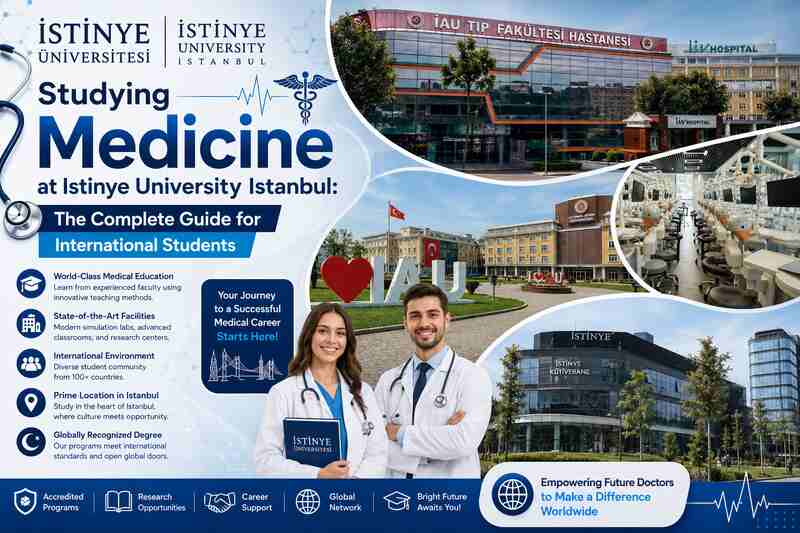
Studying medicine at Istinye University means enrolling in a 6-year, English-medium Tıp Doktoru (MD) program at one of Istanbul's fastest-growing private universities a program built around a committee-based integrated curriculum, delivered across two purpose-built teaching hospitals, and supported by four active research laboratories. The Faculty of Medicine holds YÖK accreditation, TEPDAD national medical education accreditation (awarded 2023), and WDOMS listing. Annual tuition for the English-medium program is approximately $29,000 per year for international students.
This is the most comprehensive guide available in English on Istinye University medicine. It covers everything a serious applicant needs: the full curriculum structure, both teaching hospitals with verified infrastructure data, all four research labs, tuition and scholarships, WDOMS-based international licensing pathways, and how applying through Imtiyaz Education gives you the fastest admission, the best scholarship access, and complete on-ground support from acceptance letter through your first week on campus.
We've been placing students in Turkish medical programs since 2005. What follows comes from that experience not a brochure.
What Is Istinye University?
Istinye University (İstinye Üniversitesi ISU) is a private foundation university established in 2015 by the 21st Century Anatolian Foundation (21. Yüzyıl Anadolu Vakfı), based in Istanbul. It is registered with YÖK, Turkey's Higher Education Council, and operates across multiple Istanbul campuses. Despite being founded less than a decade ago, ISU has grown rapidly: it currently serves over 3,877 registered international students from 96 countries and offers 65 bachelor's degree programs across 9 faculties.
The Faculty of Medicine is one of ISU's flagship programs. It operates across two clinical campuses connected to its two teaching hospital partnerships: İSÜ Sağlık Uygulama ve Araştırma Merkezi - Liv Hospital Bahçeşehir and İSÜ Sağlık Uygulama ve Araştırma Merkezi - Medical Park Gaziosmanpaşa. Both are fully operational university hospitals with real patient volumes across all major specialties.
For a full institutional profile, see our Istinye University university page on turkeyuniversity.org.
YÖK Accreditation, TEPDAD, and WDOMS
ISU's Faculty of Medicine holds three critical credentials:
YÖK accreditation, all Turkish higher education programs require YÖK registration. ISU is fully registered. The Tıp Doktoru degree it confers qualifies at Turkey's Level 7 (TYYÇ), aligned with EQF-LLL Level 7 and QF-EHEA Second Cycle the international qualification framework used for degree equivalency evaluation across Europe and most of the world.
TEPDAD accreditation, in 2023, the Tıbbi Eğitim Programları Değerlendirme ve Akreditasyon Derneği (TEPDAD), Turkey's national medical education accreditation body, granted accreditation to Istinye University's Faculty of Medicine. TEPDAD is the Turkish equivalent of the bodies that conduct WFME (World Federation for Medical Education) standard evaluations. Gaining TEPDAD accreditation is a significant quality marker in the Turkish private medical education landscape not all private faculties hold it. ISU received it within less than a decade of establishment, which reflects the pace and seriousness of its academic development.
WDOMS listing, the World Directory of Medical Schools lists ISU's Faculty of Medicine, which is the prerequisite for graduates to apply for ECFMG certification (USMLE), PLAB (UK), AMC (Australia), and the licensing bodies in most countries worldwide.
The Medicine Curriculum at Istinye University: How It Actually Works
Studying medicine at Istinye University means completing a 6-year, English-medium program structured in two clear phases: a preclinical phase (Years 1–3) and a clinical phase (Years 4–6). The ISU curriculum uses a committee-based integrated system subjects are not taught as isolated departmental courses but organized around organ systems and disease processes in coordinated, horizontally and vertically integrated blocks.
Why the Committee-Based Model Matters
The evidence for integrated, committee-based curricula over traditional department-segregated teaching is well established in the medical education literature. A 2014 study by Sadofsky et al. published in Archives of Pathology & Laboratory Medicine, examining national standards in pathology education for integrated medical school curricula, found that integrated organ-system curricula where pathobiology, clinical science, and disease mechanisms are taught together rather than in sequential blocks produce significantly better knowledge application and clinical reasoning outcomes than traditional segmented teaching. ISU's committee structure directly implements this model.
More broadly, a 2013 review by Mørcke et al. in Advances in Health Sciences Education, examining the origins, theoretical basis, and empirical evidence of outcome-based education in medicine, confirmed that outcomes-based, integrated curricula provide a strong foundation for defining requisite knowledge, skills, and competency assessment particularly when aligned with explicit program learning objectives. ISU's curriculum is mapped to declared competency-based outcomes aligned with national and international medical education standards.
Years 1–3: Preclinical Phase
The first three years are built around committee courses — coordinated modules that integrate basic science subjects around human biology and disease. Year 1 committees include: Medical Biology and Genetics, Basic Chemical Concepts and Macromolecules, Cell Structure and Functions, Locomotor System, Cardiovascular-Respiratory System, and Alimentary System. Communication skills, medical informatics, and history of medicine run as horizontal threads throughout.
Year 2 deepens into: Urinary System, Reproductive System, Endocrine System, Nervous System and Sense Organs, Defense Mechanisms and Infection again delivered as coordinated committee courses, not separate departmental lectures. Medical ethics and clinical skills continue as horizontal threads.
Year 3 bridges the preclinical and clinical worlds through: Oncology, General Pathology, Pharmacology integration, and an Introduction to Clinical Medicine block that formally begins hospital exposure under supervision before the full clinical immersion of Year 4.
Students use Blackboard as the primary learning management system, supplemented by MEDU and OIS (the student information portal) for academic tracking, grade access, and portfolio management. Lab guides, clinical assessment guides, and student portfolios are published on the faculty documentation portal giving students structured expectations for each stage of training.
Years 4–6: Clinical Phase
Year 4 and 5 involve 6 internship placements and 28 department rotations across all major specialties, delivered at ISU's two teaching hospitals. Core clinical rotations cover: Internal Medicine, General Surgery, Obstetrics and Gynecology, Pediatrics, Cardiology, Pulmonary Diseases, Neurology, Psychiatry, Radiology, Dermatology, Orthopedics and Traumatology, Infectious Diseases, ENT, Ophthalmology, Urology, Anesthesiology, Emergency Medicine, Forensic Medicine, and Physical Medicine and Rehabilitation.
Year 6 is the internship year students function as near-independent physicians under supervision, rotating through Internal Medicine, Public Health and Family Medicine, Emergency Medicine, Child Health and Diseases, General Surgery, Gynecology and Obstetrics, and elective specialties. This year produces the clinical autonomy and procedural confidence that defines readiness for residency.
Language of instruction: English throughout the curriculum. In-hospital clinical teaching at the university hospitals follows Turkish-medium instruction alongside English supervision this is standard across all Turkish private medical programs regardless of language track.
Student Assessment Framework
ISU uses a competency-based assessment model across all phases. Components include: written MCQ and short-answer examinations, OSCEs (Objective Structured Clinical Examinations) for clinical skills, portfolio assessments, workplace-based assessments during rotations, and student self-assessment logs. Assessment reports are published through the OIS system, giving students and academic advisors clear, real-time visibility of progress against program learning objectives.
The faculty maintains curriculum mapping documentation, including a published Müfredat Haritası (curriculum map) and Akademik Program Kitapçıkları (academic program booklets) for each year among the more transparent curriculum documentation practices among Istanbul private medical schools.
This is the section that separates ISU from most competitors. ISU is not operating from a shared affiliate arrangement it has two dedicated ISÜ Sağlık Uygulama ve Araştırma Merkezi (Health Application and Research Center) hospitals, both branded and operated as university hospital campuses.
Hospital 1: ISÜ SUAM - Liv Hospital Bahçeşehir
The primary university hospital is the isü Liv Hospital Bahçeşehir, opened in December 2016 and operated in partnership with MLP Care (the parent group of both Liv Hospital and Medical Park). This is a 21-floor, 62,500 m² smart-building hospital in Bahçeşehir, fully operating as a tertiary-level teaching hospital. Infrastructure confirmed from official ISU sources:
394 beds (including annex building)
94 ICU and observation beds (including 30 observation rooms convertible to ICU under emergency protocols)
12 operating theatres (1 IVF, 2 Ophthalmology, plus standard surgical theatres)
10 palliative care beds palliative care unit, which is rare in private university hospitals
Helicopter landing pad for emergency transfers
Child ICU ISU Liv is among a select few hospitals in Turkey with a dedicated pediatric intensive care unit
24/7 specialist physician coverage in: Obstetrics and Gynecology, Internal Medicine, Pediatrics, Cardiology, Hand Surgery, General Surgery, Orthopedics and Traumatology, Neurosurgery, Plastic Surgery, and Stroke Center
The specialist centers within the hospital include: Organ Transplant Center, Spinal Health Center, Stroke Center, Speech and Language Therapy Polyclinic, Sleep Disorders Center, IVF Center, Medical Oncology and Oncological Surgery, Hand Surgery, Palliative Care Center, Interventional Radiology, Advanced Interventional Radiology, and Medical Aesthetics.
For medical students, the clinical depth here is genuine. The Organ Transplant Center and the pediatric ICU, in particular, represent case complexity that most private Turkish hospital affiliations simply do not offer at the same level.
Hospital 2: ISÜ SUAM - Medical Park Gaziosmanpaşa
The second clinical training hospital is ISÜ Medical Park Gaziosmanpaşa in the Gaziosmanpaşa district an SGK-contracted university hospital operating under the ISÜ SUAM framework since 2018, following the Istinye University partnership with Medical Park. Key facts from the official hospital page:
272 beds across a 60,000 m² closed area in central Gaziosmanpaşa
15 operating theatres with modern surgical technology
SGK contract treating all insurance categories, not just private pay, which means genuine breadth of patient cases and disease presentations
Full specialty coverage with a multidisciplinary approach: Cardiology, Internal Medicine, Neurology, Neurosurgery, Pediatrics, Obstetrics and Gynecology, General Surgery, Orthopedics, Psychiatry, Radiology, Medical Oncology, Dermatology, and more
VM premium ward offering hotel-grade patient accommodations, reflecting the quality standards of the broader MLP Care hospital group
The SGK contract at Gaziosmanpaşa is important for students. It means the hospital actively sees the full socioeconomic cross-section of Istanbul's patient population, not just private insurance holders. For clinical training, diversity of patient presentation and disease context is directly relevant to developing well-rounded clinical judgment.
Together, the two ISÜ SUAM hospitals give Istinye University students access to more than 650 combined beds, 27 combined operating theatres, two distinct Istanbul districts, and clinical environments ranging from tertiary oncological surgery and organ transplantation to general medicine and emergency care.
Competing articles consistently ignore this section. ISU's Faculty of Medicine operates four named research laboratories, all confirmed from the official research laboratory page:
İSÜKÖK, Stem Cell and Tissue Engineering Application and Research Center
The Stem Cell and Tissue Engineering lab (İSÜKÖK) works on regenerative medicine applications cell culture, tissue engineering protocols, and biomedical research. Students in the advanced years of the program have access to research projects in stem cell biology and regenerative approaches relevant to clinical medicine.
İSÜMKAM, Molecular Cancer Research Center
The Molecular Cancer Research Center focuses on the molecular basis of oncological diseases tumor biology, molecular diagnostics, and cancer pathway research. Given the Organ Transplant Center and Medical Oncology capabilities at both hospital affiliates, this lab reflects ISU's serious investment in oncology-focused research infrastructure.
İSUCAN, Neurological Sciences Research and Application Center
The Neurological Sciences center covers research in neurology, neuroscience, and related clinical applications. This aligns with the Stroke Center at Liv Hospital Bahçeşehir and the active Neurosurgery and Neurology departments at both hospital affiliates.
İSÜ3D, 3D Design and Prototyping Application and Research Center
The 3D Design and Prototyping lab is genuinely forward-looking for a medical school. The lab supports 3D-printed anatomical models for surgical planning and education, prototype medical devices, and biomedical engineering research. For medical students, this means access to 3D anatomical visualization and surgical simulation tools that go beyond what cadaver-based anatomy labs alone provide. It positions ISU within the emerging field of precision medical education, where 3D-printed models and patient-specific anatomical reproductions are increasingly used for surgical preparation and teaching.
Annual tuition for the English-medium medicine program at Istinye University is approximately $29,000 per year for international students, published across multiple confirmed 2026 sources. This makes ISU one of the higher-priced English-medium programs in Istanbul's private medical market and the price reflects what the program delivers.
Total tuition across the 6-year program at standard rates: approximately $174,000.
Payment Structure
ISU's payment system requires a 50% pre-registration deposit to secure enrollment this amount is deducted from the total tuition fee, not added to it. The remaining balance must be paid by 1 December of the relevant academic year. Payment is accepted by USD wire transfer or international credit card. Turkish-issued credit cards are not accepted for international student fee payments.
A 5% discount applies for full advance annual payment. A 5% sibling discount applies if a family member is currently enrolled at ISU.
Scholarships
ISU offers annual "Excellence Scholarships" for qualifying international students. Scholarship amounts and eligibility conditions are assessed individually at the point of application. Students who apply through a partner agency which we are have access to scholarship information and negotiations at the point of offer, not after enrollment.
Value in Context
University | Annual Tuition (Int'l) | Language | Hospital | TEPDAD |
|---|---|---|---|---|
Istinye University | ~$29,000 | English | Liv (394 beds) + Medical Park GOP (272 beds) | Yes (2023) |
Bahçeşehir (BAU) | $28,000 | English | BAU Göztepe (on-site) | In progress |
Istanbul Medipol | $44,000 | English/Turkish | Medipol Mega Hospital | Yes |
Biruni University | ~$21,000 | English | Biruni Hospital (617 beds, TEMOS) | In progress |
Istanbul Altinbas | ~$20,000 | English | Altinbas Hospital | In progress |
At $29,000, ISU is priced similarly to BAU but offers TEPDAD accreditation which BAU has not yet achieved and a dual-hospital clinical environment spanning both major hospital networks in Istanbul (Liv/MLP Care and Medical Park). For students who prioritize accreditation signals and clinical depth above price-point alone, ISU's position is clear.
For the full current fee breakdown, see our Istinye University fees guide.
Living Costs Near ISU
ISU's main campus and Liv Hospital are in Bahçeşehir a well-connected, mid-range residential area in the European side of Istanbul. The Gaziosmanpaşa hospital campus is centrally located and well-served by tramway and metro connections. A student living moderately near either campus can expect:
Shared accommodation: $300–$500/month
Food: $150–$250/month
Transport (student pass): $35–$45/month
Total monthly: $500–$800
All-in annual cost including standard tuition: approximately $35,000–$39,600/year. With a 5% advance payment discount applied, the tuition portion comes to $27,550.
ISU's WDOMS listing, YÖK accreditation, and TEPDAD certification together constitute a strong international recognition package. Here is what they mean for graduates across major destination countries.
United States (USMLE / ECFMG)
WDOMS listing makes ISU graduates eligible for ECFMG certification and USMLE Steps 1 and 2 CK the pathway to US residency through the NRMP Match. There is no structural USMLE preparation integrated into ISU's curriculum (unlike Biruni University), so students interested in the US pathway need to self-direct USMLE preparation alongside regular curriculum commitments. The licensing door is fully open the preparation work is the student's.
United Kingdom (PLAB / GMC)
WDOMS-listed graduates are eligible to sit PLAB 1 and PLAB 2, the pathway to General Medical Council registration. ISU's English-medium delivery reduces the language burden specifically for PLAB 2's clinical skills component, where communication in an English-speaking clinical environment is assessed.
Nigeria (MDCN)
Medical and Dental Council of Nigeria evaluates degrees from WDOMS-listed, YÖK-accredited institutions. ISU graduates are eligible to apply for MDCN credential verification and provisional registration. The process involves document authentication and typically a qualifying exam. Achievable we've worked with Nigerian students at Turkish medical schools who returned to practice.
Egypt (Egyptian Medical Syndicate)
Turkish YÖK-accredited WDOMS-listed degrees are eligible for Egyptian Medical Syndicate evaluation. Egyptian students who have completed Turkish medical degrees have returned and practiced. Pre-enrollment confirmation of current requirements with the Syndicate is advisable.
Pakistan (PMC)
Pakistan Medical Commission requires a qualifying exam for foreign graduates from WDOMS-listed institutions. Confirm the current PMC approved institutions list at pmc.gov.pk before enrolling. Eligibility based on WDOMS listing and YÖK accreditation is the starting point.
GCC Countries (Saudi Arabia, UAE, Qatar, Kuwait)
Saudi Commission for Health Specialties (SCFHS) and equivalent Gulf bodies evaluate WDOMS-listed YÖK-accredited Turkish degrees. ISU graduates are eligible for these evaluation processes. TEPDAD accreditation the Turkish national medical education accreditation is an additional positive signal for Gulf credentialing authorities familiar with international accreditation frameworks.
Australia and New Zealand (AMC / MCNZ)
WDOMS listing makes ISU graduates eligible to sit the AMC examination, the pathway to AHPRA registration in Australia. New Zealand Medical Council operates a similar eligibility process.
Europe (Country-Level Evaluation)
EQF Level 7 alignment means ISU's Tıp Doktoru qualifies for equivalency evaluation across European national medical authorities: GMC in the UK, BÄK in Germany, BIG-register in the Netherlands, and equivalent bodies in France, Spain, Italy, and other EU countries. National language qualifications are typically required for EU practice.
The honest position: ISU's degree is a real, internationally eligible medical qualification. TEPDAD accreditation places it above many Turkish private medical faculties in terms of quality signaling. No foreign degree provides automatic practice rights anywhere what ISU gives you is the right eligibility foundation to enter every major licensing process. We advise each applicant individually on the pathway specific to their country and career goals.
Academic Requirements
A high school diploma with strong performance in Biology and Chemistry is the baseline. ISU does not require YÖS for international students, though equivalent exams (SAT, International Baccalaureate, A-Levels) may support the application. A competitive academic profile typically shows 70–75%+ equivalent secondary school GPA.
Language Requirements
The English-medium program requires English proficiency documentation. TOEFL iBT or IELTS Academic scores are the standard pathway. Students who need language preparation can complete ISU's English Preparatory Year program. The preparatory year fee is deducted from the total tuition fee if it is lower than the enrolled program fee.
Required Documents
Certified high school diploma and full transcript
Passport copy
English proficiency certificate
Equivalency certificate (denklik) from Turkey's Ministry of National Education, or your agency can guide this process
Passport-size photographs
Health insurance documentation
All documents not in English or Turkish require sworn certified translation. Our Istanbul office holds court-accredited sworn translation authority, producing these in-house, same-day, accepted by Turkish universities and authorities without additional steps.
Application Timeline
ISU has one medicine intake per year: Fall semester only. Applications open in spring and seats are allocated progressively. Early applications from February through May carry the strongest position for scholarship eligibility and seat access. Late summer applications carry significantly reduced scholarship flexibility. We strongly recommend not waiting until July or August for a Fall start.
Every student deserves a direct answer to this question, not a marketing paragraph.
ISU's Faculty of Medicine has been running since 2015 and received TEPDAD accreditation in 2023 that's national medical education accreditation from Turkey's main evaluation body, achieved within 8 years of founding. For a private university, that pace reflects serious academic commitment.
The dual hospital model Liv Hospital Bahçeşehir (394 beds, helicopter pad, organ transplant, pediatric ICU) and Medical Park Gaziosmanpaşa (272 beds, 15 theatres, SGK-contracted) gives students access to more than 650 combined beds and a breadth of clinical cases that most single-hospital affiliations don't provide. The Organ Transplant Center and pediatric ICU at Liv Hospital, in particular, represent high-acuity exposure that is rare in private medical education.
The committee-based integrated curriculum with competency-aligned assessment is well-designed on paper and the TEPDAD certification, which involves external academic review of curriculum quality, suggests it functions well in practice.
The research lab infrastructure four named labs including stem cell, molecular oncology, neuroscience, and 3D prototyping gives students research access that goes beyond the basic lab setups at lower-priced competitors.
At $29,000/year, ISU is not the cheapest option. Students for whom price is the primary driver will find more affordable English-medium programs at Biruni (~$21,000) or Altinbas (~$20,000). But students who want TEPDAD accreditation, dual teaching hospital access, active research infrastructure, and a rapidly internationalizing institutional culture ISU makes a strong case.
Q: Is studying medicine at Istinye University fully in English? A: Yes. The ISU Faculty of Medicine offers an English-medium program where all lectures, seminars, laboratory sessions, and written assessments are conducted in English across all six years. In-hospital clinical rotations at the university's teaching hospital affiliates involve Turkish-medium instruction alongside English supervision this is universal across all Turkish private medical programs and is not unique to ISU.
Q: What are Istinye University medicine fees for international students in 2026? A: Annual tuition is approximately $29,000 per year for the English-medium program, as confirmed by 2026 published sources. Total program tuition over 6 years at the standard rate is approximately $174,000. A 5% advance payment discount applies for full annual payment. Excellence scholarships are available for qualifying students. Pre-registration deposit is 50% of the annual tuition fee, deducted from total fees at final registration. There are no application fees when applying through Imtiyaz Education.
Q: Does Istinye University medicine have TEPDAD accreditation? A: Yes. ISU's Faculty of Medicine received TEPDAD (Tıbbi Eğitim Programları Değerlendirme ve Akreditasyon Derneği) accreditation in 2023. TEPDAD is Turkey's national medical education accreditation body, aligned with WFME (World Federation for Medical Education) standards. This accreditation is held by relatively few private Turkish medical schools and represents a meaningful quality signal for licensing authorities in many countries.
Q: Is the ISU medicine degree listed in WDOMS? A: Yes. ISU's Faculty of Medicine is listed in the World Directory of Medical Schools (WDOMS), which is the prerequisite for ECFMG eligibility (USMLE/US residency), PLAB eligibility (UK GMC registration), AMC eligibility (Australia), and national medical council evaluation in most countries worldwide.
Q: What hospitals do ISU medical students train in? A: Students train at two dedicated ISÜ SUAM (Health Application and Research Center) hospitals: Liv Hospital Bahçeşehir (394 beds, 12 theatres, organ transplant center, pediatric ICU, helicopter pad) and Medical Park Gaziosmanpaşa (272 beds, 15 theatres, SGK-contracted). Together these hospitals provide over 650 beds and 27 operating theatres across two Istanbul districts.
Q: When should I apply and when does intake start? A: ISU medicine has one intake per year Fall semester only. Applications open in spring. Apply between February and May for the strongest scholarship and seat access. Late summer applications carry significantly reduced scholarship flexibility and available places. Fall semester typically begins in September.
Q: How long does admission take when applying through Imtiyaz? A: For applicants with complete documentation, admission decisions from ISU typically come back within 24–48 hours through our priority partnership channel. We review your file before submission to eliminate delays from missing or incorrect documents.
Q: What support does Imtiyaz provide after acceptance? A: Full on-ground support: VIP airport transfer on arrival, sworn document translations (court-accredited, in-house, same-day), final university registration guidance, ikametgah (residence permit) application, Turkish tax ID support, health insurance guidance, course selection, and 24/7 availability during the arrival weeks. Our goal is that by the time your first lecture starts, you've had nothing to worry about except medicine.
Q: How does ISU medicine compare to other Istanbul private medical programs? A: ISU sits at the upper end of Istanbul's English-medium private medical market. At $29,000/year, it's priced similarly to BAU ($28,000) but holds TEPDAD accreditation that BAU has not yet achieved. It's higher than Biruni ($21,000) and Altinbas ($20,000), which lack dual teaching hospital infrastructure and TEPDAD status. It's significantly cheaper than Medipol ($44,000). ISU's clearest advantage over all comparable-price competitors is the combination of TEPDAD accreditation, two dedicated teaching hospital campuses with verified infrastructure, and four active research labs.
Q: Can I get a scholarship for ISU medicine? A: Yes. ISU offers annual Excellence Scholarships for qualifying international students. Conditions and amounts are evaluated individually. We access scholarship information and rates at the point of application through our direct partnership students who apply early in the admissions cycle have the strongest scholarship position.
If you're considering ISU and want to move forward, reach out to our team at turkeyuniversity.org. There are no fees on your side. We handle the full process from your first document review to your first day on campus.
Twenty-one years. Over 100,000 applications processed. 10,000+ students enrolled at Turkish universities. That's what we bring to every new student who contacts us. When you apply through Imtiyaz, your only job is to focus on becoming a doctor.
International students sometimes ask why they should work with an agency rather than apply directly. It's a fair question and deserves a direct answer.
Applying directly to ISU is technically possible. The practical difference is this: when you apply on your own, the university processes your application in the general queue. When you apply through us a direct university partner your file goes through a priority review channel with an advisor who has already checked your documents for completeness. Admission decisions for clean applications come back within 24–48 hours.
Scholarships are another area. ISU's Excellence Scholarships are available, but the specific rates and conditions aren't always published in full. We negotiate access to scholarship structures at the point of application, not after enrollment. Students who come to us in spring typically have more options than those who arrive in July when seats are almost full.
There are also zero costs to you. ISU pays us directly for successful placements. You pay nothing for our service.
But the part that changes the most is what happens after your acceptance letter. Most agencies send you a PDF and a WhatsApp number. We don't operate that way.
When your flight lands at Istanbul Airport, a member of our team is physically there to meet you with VIP transfer. Our Istanbul office handles your sworn document translations court-accredited, in-house, same-day. We go with you through final university registration, help you set up your Turkish tax identification number, file your ikametgah (residence permit) application before the legal deadline, guide you through health insurance registration, and support your course selection for the first semester.
The reason this matters is simple. Students from Nigeria, Libya, Egypt, Yemen, Pakistan, and across the Arab world arrive in Istanbul without knowing anyone, without speaking Turkish, and facing a dense administrative sequenc residence permit, registration, tax ID, health insurance, bank account, university card all within the first few weeks, all with legal deadlines. If you miss the residence permit window, there are real consequences. If you submit the wrong document version at registration, you get sent away. These things happen to students who navigate alone.
Our job is to make the transition invisible. By the time your first lecture starts, you've done nothing except prepare for medicine. That's not a tagline it's what 21 years of experience and over 100,000 processed applications looks like in practice.