Turkey Higher Education Statistics 2026: Official YÖK Data Every International Student Should Know

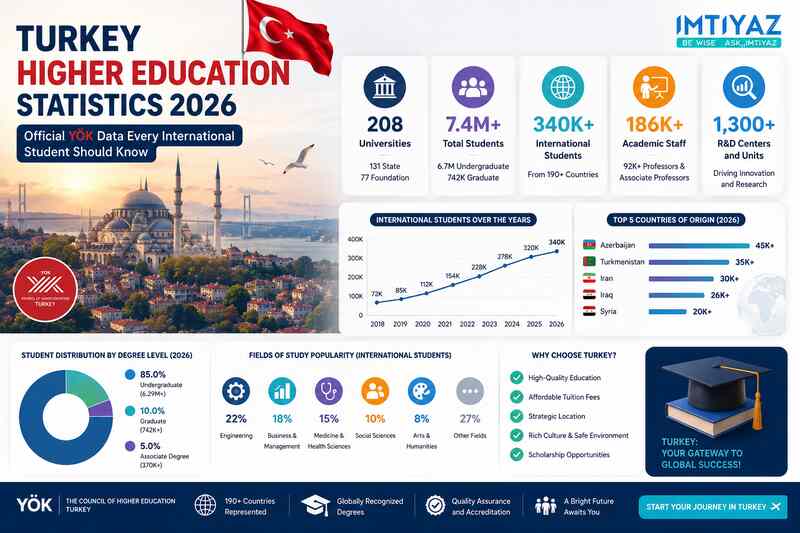
If you're researching Turkey as a study destination, at some point someone will throw a number at you "Turkey has over 200 universities" or "thousands of international students choose Turkey every year." But where do these numbers actually come from? And how reliable are they?
The answer is YÖK Yükseköğretim Kurulu, Turkey's Council of Higher Education. Every year, YÖK publishes a comprehensive statistical bulletin covering every registered university in the country. Student enrollment, new admissions, teaching staff, graduate numbers, program breakdowns by gender all of it is publicly documented and updated annually.
The data I'm sharing in this article comes directly from the YÖK Higher Education Statistics Bulletin for 2025-2026, published on 27 March 2026. These are the most current official figures available on Turkey's higher education system. We use this source consistently at Imtiyaz Education when advising students because when a family asks us whether Turkey's university system is real, accredited, and substantial enough to be worth four years of study and investment, this is exactly the kind of data we point to.
Let's go through what the numbers actually show.
Turkey's University System at a Glance: 2025-2026
The headline figure from the 2025-2026 YÖK bulletin: 208 higher education institutions operating in Turkey during this academic year.
That number includes state universities (devlet üniversiteleri), foundation universities (vakıf üniversiteleri), and foundation vocational schools (vakıf meslek yüksekokulları). Between these three categories, Turkey covers an enormous range of programs, campuses, and tuition levels — from highly competitive state universities with centuries-old academic traditions to newer private institutions built specifically to serve international students in English.
The total number of enrolled students across all institutions: 6,301,434.
Break that down by university type and you get a clear picture of how the system is structured:
State universities: 5,445,808 students
Foundation (private) universities: 838,664 students
Foundation vocational schools: 16,962 students
So roughly 86% of Turkey's university students study at public institutions, and just under 14% at private ones. For international students, though, the balance tips differently — private universities handle a much larger share of international admissions because they offer English-taught programs, faster admission processes, and more flexibility in entry requirements.
New Student Admissions in 2025-2026
Total new admissions across all institutions for the 2025-2026 academic year: 1,393,763 students.
Of these:
1,146,356 enrolled in state universities
240,659 enrolled in foundation universities
6,748 enrolled in foundation vocational schools
Breaking it down by degree level:
Vocational (associate) programs: 669,095 new students
Undergraduate (bachelor's): 556,298 new students
Master's programs: 152,471 new students
Doctoral programs: 15,899 new students
The undergraduate intake number is the one most relevant to international students applying for bachelor's degrees. Over half a million new bachelor's students were admitted in one academic year — this is a system with real scale and real infrastructure to support it.
Total Enrolled Students by Degree Level
When you look at all enrolled students (not just new admissions), the full scale becomes even clearer:
Vocational associate programs: 2,532,769 students
Undergraduate programs: 3,348,536 students
Master's programs: 330,464 students
Doctoral programs: 89,665 students
The master's and doctoral figures are worth paying attention to. Turkey's graduate education sector is larger than many people assume, and it's growing. Students who complete a bachelor's degree in Turkey and want to continue to postgraduate study have real options within the country, at both state and private institutions.
State vs Private: What the Split Looks Like
For international students deciding between a Turkish public university and a private one, the statistical picture is useful context.
In terms of enrolled students (excluding open/distance education), 78.9% study at state universities and 21.1% at private ones. For new admissions specifically, state universities captured 73.8% of new students.
So public universities still dominate by volume. But here's the practical reality: most of those state university students gained admission through highly competitive national processes requiring TR-YÖS exam scores. For international applicants who haven't sat a centralized Turkish exam, private universities are where the realistic pathways exist and private university quality has improved substantially over the past decade.
At Imtiyaz Education, our partner network covers more than 75 private universities across Turkey and Northern Cyprus. We work only with YÖK-registered institutions, and we always check program-specific accreditation before recommending any university to a student. The number of private universities has grown, but not all of them are equal which is exactly why independent guidance matters.
Gender Distribution Among Students
The YÖK 2025-2026 bulletin breaks down student enrollment by gender, and it's worth noting for any student trying to understand what the campus environment looks like:
Across all degree levels (excluding open education):
48.5% male, 51.5% female
Breaking it down further:
Vocational programs: 52.1% male, 47.9% female
Undergraduate: 46.9% male, 53.1% female
Master's: 48.6% male, 51.4% female
Doctoral: 47.9% male, 52.1% female
Women outnumber men at the undergraduate and doctoral levels a trend that's consistent with what we see across our own student applications at Imtiyaz. Medicine, health sciences, pharmacy, and education are heavily female-majority fields in Turkey. Engineering and some technical programs remain male-majority, though the gap is closing at the undergraduate level.
Graduate Numbers: 2024-2025 Academic Year
The YÖK bulletin also publishes graduate data for the previous academic year. For 2024-2025, 874,171 students graduated from Turkish higher education institutions.
By institution type:
State universities: 729,140 graduates
Foundation universities: 141,889 graduates
Foundation vocational schools: 3,142 graduates
By degree level:
Associate (vocational): 348,624 graduates
Bachelor's: 425,744 graduates
Master's: 84,928 graduates
Doctoral: 14,875 graduates
Over 425,000 undergraduate graduates in a single academic year. That's a significant labor market contribution, and it reflects a system that is actually producing graduates at scale not just enrolling students.
For international students, this matters because it addresses a concern we hear often: "Will my degree from Turkey actually mean something?" The scale and consistency of Turkish graduate output, combined with YÖK's recognition framework and program-level accreditations like TEPDAD (medicine) and MÜDEK (engineering), give Turkish degrees real substance in international contexts.
How the Data Compares Year-on-Year
The 2025-2026 bulletin includes comparison data with previous years. A few meaningful shifts:
Student enrollment trend (excluding open education):
2024-2025: 4,146,534 students
2025-2026: 4,053,042 students
A slight decrease of roughly 2.3% in the non-distance student population. This reflects demographic shifts and may also reflect changes in open/distance education enrollment patterns, since total enrollment including all modalities remains at 6.3 million.
New admissions excluding open education:
2024-2025: 1,030,580 new students
2025-2026: 944,662 new students
Again a slight decrease consistent with broader demographic trends in Turkey's domestic population pipeline. For international students, this is actually a positive signal: it means competition for seats at state universities is slightly less intense than in recent peak years, and foundation universities are actively competing for enrollment by improving scholarship offers.
Factor | State Universities | Private (Foundation) Universities |
|---|---|---|
Total enrolled (2025-26) | 5,445,808 | 838,664 |
New admissions (2025-26) | 1,146,356 | 240,659 |
Typical tuition | Very low (< $1,500/yr for most programs) | $3,000 - $20,000/yr depending on program |
Admission requirement | TR-YÖS exam score or equivalent | High school diploma + documents |
Language of instruction | Mainly Turkish (some English programs) | Many English-taught options |
International student access | More restricted | More accessible |
Teaching staff | 157,196 | 32,379 |
Admission timeline | 3-6 months | 24-72 hours typical |
For the vast majority of international students applying without a TR-YÖS score, private foundation universities are the realistic and well-established route. The quality gap between public and private has narrowed considerably several foundation universities now outrank state institutions in global ranking systems for specific faculties.
What These Numbers Mean If You're Applying Now
If you're an international student reading this data and planning to apply for the 2026-2027 academic cycle, here's what the statistics are telling you practically:
The system is large and legitimate. Over 6.3 million students, 208 institutions, 189,868 academic staff, and nearly 900,000 graduates in a single year this isn't a small or experimental higher education sector. It's a mature, large-scale system with real infrastructure.
Private universities are substantial. Over 838,000 students enrolled in foundation universities, with 240,000 new admissions in a single year. These institutions aren't niche alternatives they're a significant part of Turkey's higher education landscape.
Accreditation is program-specific, not institution-wide. A university being YÖK-registered is necessary but not sufficient. The specific accreditations that matter TEPDAD for medicine, MÜDEK for engineering, WDOMS listing for international medical licensing must be checked at the program level.
Admissions are still open for 2026-2027. Most private universities in our network accept applications on a rolling basis throughout the year. The 15,899 new doctoral students and 152,471 new master's students enrolled in 2025-2026 suggest the graduate intake remains strong.
At Imtiyaz Education, we've used official YÖK data as the foundation of our advising for over 21 years. When we tell a student "this university is YÖK-registered" or "this medical program is TEPDAD-accredited," we're not citing a brochure we're cross-referencing official databases that are publicly accessible and updated regularly. That's the difference between guidance and guesswork.
If you want to apply to a Turkish university for the 2026-2027 intake, the process starts with a conversation. No application fees, no commitment at the first step, and our team replies the same day. Apply through turkeyuniversity.org and let us match you to a program based on your grades, budget, and goals using the same official data we've just walked you through here.
YÖK tracks academic staff across all institutions in detail. For 2025-2026, Turkey's higher education system employs 189,868 teaching staff in total.
Broken down by university type:
State universities: 157,196 teaching staff
Foundation (private) universities: 32,379 teaching staff
Foundation vocational schools: 293 teaching staff
By academic rank:
Professors (Profesör): 42,195
Associate Professors (Doçent): 25,733
Assistant Professors (Doktor Öğretim Üyesi): 47,616
Instructors (Öğretim Görevlisi): 34,646
Research Assistants (Araştırma Görevlisi): 39,678
Gender split among teaching staff: 52.8% male, 47.2% female overall.
One detail worth noting: at the professor level, the gender split skews more significantly 64.4% male, 35.6% female. At the research assistant level, it's actually reversed: 44.7% male and 55.3% female. This reflects a pipeline effect common across most university systems globally, where senior ranks still lag behind in female representation even as younger academic generations are closer to parity.
The ratio of students to teaching staff works out to approximately 33 students per academic staff member across the full system. At individual universities, this varies considerably major state universities in Istanbul and Ankara tend to have larger class sizes, while some private universities compete on smaller cohorts as a selling point.
Medicine is one of the most common programs international students inquire about. The YÖK data for 2025-2026 includes faculty-by-faculty breakdowns, and the numbers for medical faculties specifically are significant.
Total students enrolled in Tıp Fakültesi (School of Medicine) programs across Turkey: 129,559, split across 118 medical faculties at different universities.
New medical admissions for 2025-2026: 21,398 students (9,282 at state universities, 9,127 at foundation universities).
That foundation university share nearly 9,000 new medical students in one year reflects how seriously private medical schools have scaled up in Turkey. But scale without quality assurance is meaningless. This is why we always check TEPDAD accreditation and WDOMS listing for every medical program before we recommend it to a student. A medical school enrolled in 9,000 students annually that isn't WDOMS-listed is a serious problem for any student who intends to practice medicine outside Turkey after graduation. [internal link: /blog/turkey-medical-universities]
Dentistry, Pharmacy, and Engineering: Scale Data
For students in other competitive fields, the YÖK data shows strong enrollment at scale:
Dentistry (Diş Hekimliği Fakültesi):
94 dental faculties across Turkey
Total enrolled: 54,249 students
New admissions 2025-2026: 8,798 students
Pharmacy (Eczacılık Fakültesi):
51 pharmacy faculties
Total enrolled: 25,391 students
New admissions: 4,177 students
Engineering (Mühendislik Fakültesi, core engineering faculties):
93 engineering faculties of the primary type
Total enrolled: 235,064 students
New admissions: 35,739 students
These figures cover only the largest engineering faculty category. Including all engineering-adjacent faculties (engineering and architecture, engineering and natural sciences, technology faculties, etc.) pushes Turkey's total engineering student population well above 400,000.
For students applying to engineering programs, MÜDEK accreditation Turkey's national engineering accreditation body and a Washington Accord signatory since 2011 determines whether your degree will be recognized as equivalent to ABET-accredited programs in the US, UK, Canada, and Australia. Not all of Turkey's engineering programs have this. We check this at the program level for every engineering student we advise. [internal link: /blog/studying-engineering-in-turkey]
Q: Where does the official Turkey higher education statistics data come from? A: All figures cited in this article come directly from the YÖK (Yükseköğretim Kurulu Council of Higher Education) Higher Education Statistics Bulletin for 2025-2026, published on 27 March 2026. YÖK is the national regulatory body overseeing all universities in Turkey. Detailed statistical tables are available at istatistik.yok.gov.tr.
Q: How many universities does Turkey have in 2026? A: According to the YÖK 2025-2026 statistics bulletin, Turkey has 208 higher education institutions. This includes state universities, foundation (private) universities, and foundation vocational schools.
Q: How many students are enrolled in Turkish universities in 2025-2026? A: Total enrollment across all Turkish higher education institutions stands at 6,301,434 students for the 2025-2026 academic year. Of these, 5,445,808 study at state universities, 838,664 at foundation universities, and 16,962 at foundation vocational schools.
Q: How many teaching staff work in Turkish universities? A: Turkey's higher education system employs 189,868 academic staff in 2025-2026. This includes 42,195 professors, 25,733 associate professors, 47,616 assistant professors, 34,646 instructors, and 39,678 research assistants.
Q: How many students graduated from Turkish universities in 2024-2025? A: A total of 874,171 students graduated from Turkish higher education institutions in the 2024-2025 academic year, including 425,744 undergraduate graduates and 84,928 master's graduates.
Q: Is Turkey's university system large enough to be taken seriously internationally? A: The data is clear. With over 6.3 million enrolled students, 208 institutions, nearly 190,000 academic staff, and 874,000 graduates in a single year, Turkey operates one of the largest higher education systems in Europe and the broader region. Several Turkish universities appear in QS and Times Higher Education rankings, and Turkish degrees are recognized in most countries when the relevant program-level accreditations are in place.
Q: Do private Turkish universities have proper accreditation? A: YÖK registration is mandatory for all legally operating universities in Turkey, both public and private. Beyond registration, individual programs may carry additional accreditations TEPDAD for medicine, MÜDEK for engineering, AACSB or EQUIS for business. These program accreditations are what matters most for international recognition of your degree. Always verify at the program level, not just the institution level.
Q: How does Imtiyaz Education use this YÖK data? A: We use official YÖK data as the basis of our university recommendations, accreditation checks, and enrollment guidance. When we advise a student on whether a specific program at a specific university is appropriate for their country's licensing requirements, we cross-reference YÖK registration data, TEPDAD accreditation lists, WDOMS listings, and individual university data. This is what 21 years of on-ground experience looks like in practice not opinions, but verified official information.