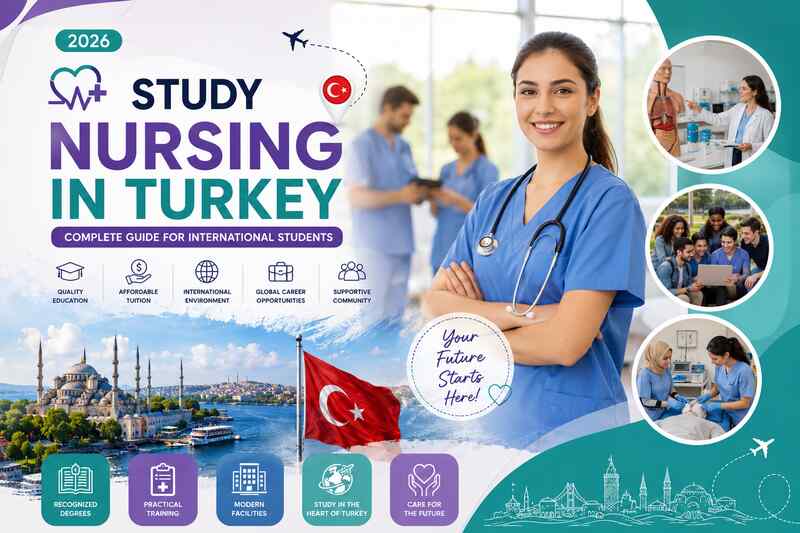
Study Nursing in Turkey 2026 - Complete Guide for International Students

AI Snapshot
Study Nursing in Turkey 2026 - Complete Guide for International Students — a quick summary from Turkey University to help students researching study options in Türkiye. Study nursing in Turkey 2026: fees $2,900-$9,000/yr, 4-year BSN, English programs, DHA/NMC/NCLEX pathways. Medipol, Gelisim, Kent, Aydin. Apply free
Study nursing in Turkey for international students in 2026 and you graduate into one of the most in-demand careers on the planet. That is not marketing language it is a supply reality. The World Health Organization's State of the World's Nursing 2025 report puts the global nursing workforce shortage at 5.8 million nurses. The countries with the largest deficits are in Africa, South-East Asia, and the WHO Eastern Mediterranean Region, which is precisely where most of our applicants come from. That gap will not close by 2030.
For a student willing to commit four years to a serious clinical degree, this means a career with documented global demand, established licensing pathways into the UAE, Saudi Arabia, UK, and Germany, and salaries that significantly exceed what most degree programs produce. Turkey is right now one of the most practical and cost-effective countries to complete that nursing degree English-medium programs, real hospital clinical training, fees starting from $2,900 per year, and no entrance exam at private universities.
This guide covers everything: the year-by-year nursing curriculum, university profiles with exact fees, licensing pathways by destination country, salary data abroad, and how to apply.
Why Nursing in Turkey is Worth Taking Seriously
A lot of students still think of nursing as a backup plan to medicine. The salaries say otherwise.
In Dubai in 2026, the average registered nurse earns AED 8,000-12,000 per month tax-free. That is $2,200-$3,300 per month with nothing deducted. Experienced ICU, emergency, or operating room nurses in Dubai private hospitals earn AED 18,000-25,000 per month. In Saudi Arabia, foreign nurses working under hospital contracts earn SAR 5,000-10,000 per month, with free housing, annual flights included, and end-of-service gratuity. In Germany, registered nurses earn 2,600-3,500 euros gross per month, and the government has created specific immigration pathways for internationally trained nurses to fill documented shortages.
These are consistent 2026 figures from DHA, NMC-registered employers, and Gulf healthcare groups. Not recruitment website projections.
Nursing is not a backup plan. It is a plan.
Why Turkey for Nursing - The Honest Case
Turkey has over 75 private universities with established health sciences faculties offering nursing programs in English and Turkish. But the real case for studying nursing in Turkey is specific, not general.
Clinical training in real hospitals. Istanbul Medipol University runs nursing students through simulation labs and then directly into Medipol Mega University Hospital a 700-plus bed facility covering adult medicine, surgery, pediatrics, ICU, oncology, emergency, and community health rotations. Students are not practicing on mannequins until graduation and meeting a real patient for the first time. They are in hospitals from Year 2 onward with increasing patient responsibility each year.
Programs aligned with European nursing standards. Many Turkish universities align their nursing curricula with EU nursing education frameworks, which matters for graduates applying to work in the Gulf or UK where licensing boards check whether foreign training meets European benchmarks.
English-medium instruction. Nursing in Turkey is available in English at Medipol, Aydin, Gelisim, Kent, Altinbas, Atlas, Istinye, Biruni, and others. Studying in English from Year 1 builds the clinical language competency that DHA, NMC, and SCFHS licensing exams require.
No entrance exam. Private Turkish universities admit nursing students based on high school grades only no YOS, no IELTS, no standardized test. The same simple admission pathway as physiotherapy and pharmacy.
Fees make sense. Annual nursing fees at private Turkish universities range from $2,900 to $9,000 per year. Total four-year tuition: $11,600-$36,000. Compare that to Australia ($20,000-$35,000 per year), Canada ($15,000-$25,000 per year), or the UK (£9,250-£18,000 per year for international students).
University Profiles and Nursing Fees 2026
Istanbul Medipol University:
Medipol is the first choice among our students for health sciences programs. The Faculty of Health Sciences has dedicated vocational skills laboratories at the South Kavacik campus built specifically for nursing students to practice clinical procedures before hospital rotations begin. Students then rotate through Medipol Mega University Hospital, giving them access to high-volume patient care in one of Istanbul's largest private hospital complexes. The curriculum covers Fundamentals of Nursing, Medical Sciences, Clinical Sciences, Ethics and Professional Development, Community Health, and Research Methods. The English-medium track is fully supported with bilingual academic staff.
Nursing fees at Medipol 2026:
English program: approximately $7,700-$9,000/year
Turkish program: approximately $7,000-$7,700/year
Istanbul Aydin University (IAU):
Aydin University's nursing program sits within a health sciences faculty that also includes medicine, dentistry, and pharmacy, giving nursing students cross-disciplinary exposure and access to hospital partnerships supporting the broader medical faculty. IAU is popular among students from Arab countries for its strong administrative support including Arabic-language staff and established document processing workflows.
Nursing fees at Aydin University 2026:
English program: approximately $5,500-$7,000/year
Turkish program: approximately $4,500-$5,500/year
Istanbul Gelisim University (IGU):
Gelisim is the strongest budget option for nursing in Istanbul from a legitimate accredited university. Ranked 16th overall among Turkish universities and 9th among private universities, this is a real institution. The nursing program follows the national UÇEP curriculum aligned with European standards. Hospital partnerships support clinical rotations, and the program is offered in both English and Turkish.
Nursing fees at Gelisim University 2026:
English program: approximately $4,000-$4,500/year
Turkish program: approximately $3,500/year
Istanbul Kent University:
Kent's central Taksim campus gives students access to Istanbul's healthcare network in a way suburban campuses cannot match. The nursing program is in English and Turkish. Kent is specifically recognized by Jordan, Iraq, Egypt, Algeria, Lebanon, Yemen, Palestine, and Syria -- a clear advantage for students from those countries returning home to practice.
Nursing fees at Kent University 2026:
English program: approximately $2,900-$3,200/year (among the lowest in Istanbul)
Turkish program: approximately $2,500/year
Other Strong Nursing Universities in Turkey for International Students
University | Annual Fee (English) | Annual Fee (Turkish) | Notable Feature |
|---|---|---|---|
Bahcesehir University (BAU) | ~$6,500-$7,500 | ~$5,500-$6,500 | Ranked 5th among Turkish universities (THE 2026), Erasmus+ exchange |
Altinbas University | ~$6,000-$7,000 | ~$5,000-$6,000 | Strong clinical labs, Altinbas Hospital partnerships |
Istinye University | ~$7,000-$8,000 | ~$5,500-$6,500 | IstinyePark hospital network |
Istanbul Atlas University | ~$5,000-$6,000 | ~$3,500-$5,000 | European nursing framework alignment |
Biruni University | ~$4,500-$5,500 | ~$3,500-$4,500 | Affordable, good hospital partnerships |
Yeditepe University | ~$7,000-$8,500 | ~$5,000-$6,000 | Research-strong, Kadikoy campus |
Nisantasi University | ~$5,500-$7,000 | ~$3,500-$4,500 | Central Istanbul, English support |
Halic University | ~$4,000-$5,000 | ~$3,000-$4,000 | Budget-friendly, hospital partnerships |
Public universities including Hacettepe, Ankara University, and Istanbul University-Cerrahpasa offer nursing programs for $1,000-$3,000/year. Hacettepe is the premier nursing school in Turkey and its graduates have very strong international recognition, but admission for international students is genuinely competitive.
Study nursing in Turkey for internaitonal students across eight semesters and graduate with a Bachelor of Science in Nursing (BSN) and the protected title of Hemshire (Nurse). The four years are staged carefully: foundational science first, then clinical nursing theory, then supervised patient contact, then intensive clinical internship.
Year 1 - Medical and Nursing Foundations
The first year builds the scientific base everything clinical depends on. Students study human anatomy and physiology covering all major organ systems, medical microbiology and infectious disease basics, biochemistry and cellular biology, medical terminology (critical for English-track students), introduction to nursing history, philosophy, and professional ethics, fundamentals of nursing including patient assessment, vital signs, wound care, and safe patient handling, health promotion and disease prevention, and research methods and evidence-based nursing concepts.
Year 1 includes the first simulation lab sessions, where students practice basic nursing skills IV insertion, catheterization, wound dressing, bed bathing on clinical mannequins under faculty supervision before entering real patient environments.
Year 2 - Clinical Nursing Sciences and First Hospital Rotations
Year 2 deepens clinical knowledge and begins real patient contact. The curriculum covers medical-surgical nursing across cardiovascular, respiratory, renal, neurological, and gastrointestinal conditions, pharmacology for nurses including drug classifications, dosage calculation, and adverse effect management, adult health nursing covering chronic disease management and post-operative care, pediatric nursing, mental health and psychiatric nursing, community health nursing, nutrition and clinical dietetics, and introduction to critical care concepts.
Year 2 typically includes the first supervised hospital rotations in internal medicine and surgical wards, where students observe and assist with real patient care under direct supervision of registered nurses and faculty.
Year 3 - Specialized Nursing and Intensive Clinical Practice
By Year 3, students are functioning as supervised junior clinical nurses. The curriculum moves into specialization areas: obstetric and midwifery nursing covering prenatal care, labor support, and postpartum care, geriatric nursing covering elderly patients with multiple comorbidities and dementia care, oncology nursing including chemotherapy administration and symptom management, ICU and critical care nursing covering mechanical ventilation and hemodynamic monitoring, emergency and trauma nursing including triage and resuscitation protocols, operating room nursing, rehabilitation nursing, nursing leadership and ward management, and nursing research methodology.
Clinical rotations in Year 3 are more independent than Year 2, with students rotating through pediatric, maternity, emergency, and specialized units.
Year 4 - Advanced Clinical Internship and Professional Readiness
The final year is predominantly clinical. Students complete structured, extended hospital internship hours covering adult medicine and surgery, maternity and neonatal wards, emergency department or ICU, and community health placements including school health centers and family health units. A capstone or thesis project is typically completed in Year 4 alongside clinical work.
By graduation, nursing students at strong Turkish programs will have accumulated substantial supervised clinical hours across multiple specializations. This directly impacts licensing abroad the DHA, DOH, SCFHS, and NMC all ask how many clinical hours the program provided and in which departments.
Graduates leave with the BSN qualification and the Hemshire title, eligible for professional registration in Turkey and internationally through the relevant licensing pathways.
Our team has placed enough health sciences students through the application, arrival, and first semester process to know what genuinely surprises students. Good and bad.
The clinical training starts earlier than students expect. Unlike some programs where students spend three years in lectures before touching a patient, Turkish nursing programs start simulation lab work in Year 1 and real hospital rotations in Year 2. Students who come expecting a classroom-heavy experience are consistently surprised by how clinical the program feels from early on.
Turkish language comes up more than students anticipate. Even in English-track programs, clinical rotations happen in Turkish hospitals with Turkish patients. Learning basic clinical Turkish how to ask where it hurts, how to explain a procedure, how to reassure a family member is not optional. Most universities include Turkish language courses. Take them seriously. It makes a real difference by Year 3.
The workload is serious. Pharmacology, anatomy, physiology, pathology, and clinical competency exams are demanding. Students who come prepared academically do well. Students who coast on "it's cheaper than back home" run into trouble in Year 2.
Istanbul is an exceptional city to study healthcare. A city of 15 million people generates a volume and variety of patient cases that students in smaller cities or countries with less dense healthcare systems simply do not see at the same scale.
This section exists because no other guide covers it properly, and it is the most important information for students with international career plans.
Working as a Nurse in the UAE
Dubai licensing goes through the DHA (Dubai Health Authority). Abu Dhabi goes through the DOH (Department of Health Abu Dhabi). Both require DataFlow credential verification of your Turkish BSN, followed by a licensing exam. The process takes 3-6 months. Entry-level registered nurses in Dubai earn AED 8,000-12,000 per month tax-free in 2026. Senior ICU, emergency, or specialist nurses earn AED 18,000-25,000 per month. Most hospital packages include housing or housing allowance, annual flights, and health coverage.
Working as a Nurse in Saudi Arabia
The SCFHS (Saudi Commission for Health Specialties) processes foreign nurse registrations through the Prometric exam pathway. Turkish BSN graduates need degree attestation and equivalency, DataFlow credential verification, and a passing score on the Prometric nursing exam. Typical timeline: 3-5 months. Nurse packages in Saudi hospitals include housing allowance, annual flights, and tax-free salary of SAR 5,000-10,000 per month depending on experience and specialty.
Working as a Nurse in the UK
The NMC (Nursing and Midwifery Council) regulates nursing in the UK. For Turkish graduates, the pathway involves the NMC Test of Competence -- a Computer Based Test (CBT) and an Objective Structured Clinical Examination (OSCE). English language requirement: IELTS 7.0 in each band, or OET with a B grade. Full process typically takes 9-14 months. Once registered, NHS Band 5 nurses (entry level) earn £28,000-£32,000 per year. The UK has an active international nurse recruitment program with ongoing demand.
Working as a Nurse in Germany
Germany has a documented nurse shortage and structured immigration pathways for healthcare workers. The process involves credential recognition (Berufsanerkennung) through the relevant state authority, German language requirement (typically B2 level), and in some cases a supervised adaptation period. Registered nurses in Germany earn approximately 2,600-3,500 euros gross per month. The large Turkish community in Germany and cultural familiarity make the transition more manageable for Turkish graduates than for many other nationalities.
Working as a Nurse in Arab Countries
Turkish nursing degrees are accepted in Jordan, Egypt, Libya, Sudan, Iraq, and Yemen through their Ministry of Health registration processes. Specific steps vary by country but the process is generally straightforward for students returning home after graduation from Turkey.
Working as a Nurse in the USA
Turkish BSN graduates can attempt the NCLEX-RN exam through a US state Board of Nursing. The process involves CGFNS credential evaluation, state Board application, and NCLEX scheduling through Pearson VUE. The US pathway is longer (typically 12-24 months from graduation to license) and requires strong English, but once licensed, nurses earn $55,000-$90,000 per year or more depending on state and specialty.
Country | Annual Tuition (International) | Duration | English Option | Recognition |
|---|---|---|---|---|
Turkey (private) | $2,900-$9,000 | 4 years | Yes | European standards, Gulf and Arab countries |
Turkey (public) | $1,000-$3,000 | 4 years | Limited | Strong, competitive to enter |
Malaysia | $4,000-$9,000 | 3-4 years | Yes | Good for Gulf and Asia |
Georgia | $3,000-$5,000 | 4 years | Yes | Limited, some recognition gaps |
Romania | $3,500-$5,500 | 4 years | Yes | EU country, strong EU recognition |
UK | £9,250-£18,000/year | 3 years | Yes | Best global recognition, expensive |
Australia | A$20,000-A$35,000/year | 3-4 years | Yes | Excellent recognition, high cost of living |
Canada | C$15,000-C$25,000/year | 4 years | Yes | Excellent recognition, expensive |
Getting into a private Turkish university nursing program as an international student is straightforward. What you need:
High school diploma (minimum approximately 60% average)
Valid passport (minimum 6 months validity)
Certified and translated copy of high school certificate
Passport-size photos
No entrance exam. No YOS. No IELTS at the point of admission.
Applications open in January and February for September intake. Apply early. Nursing seats at popular Istanbul universities fill faster than most students expect especially English-medium tracks with limited capacity. By June or July, the best options are gone.
Our agency processes applications to all the universities in this guide with zero fees. Admission letter within 24 hours. After that, we guide you through student visa, sworn translation and notarization of documents through our court-accredited Istanbul translation service, and after arrival -- VIP airport pickup, residence permit, university registration, and course selection.
Q: Is nursing in Turkey a good career choice for international students? A: Yes, especially for students targeting the Gulf (UAE, Saudi Arabia, Qatar), Germany, or returning to Arab countries. The WHO estimates a global nursing shortage of 5.8 million as of 2023. Turkish BSN graduates with strong clinical hours have genuine pathways into Gulf, European, and Arab job markets.
Q: How many years is nursing in Turkey? A: Four academic years (eight semesters). The program leads to a Bachelor of Science in Nursing (BSN) and the protected title Hemshire (Nurse). Master's programs add two years for those wanting to specialize or move into academic positions.
Q: Can I study nursing in Turkey in English? A: Yes. English-medium nursing programs are offered at Medipol, Aydin, Gelisim, Kent, Altinbas, Atlas, Istinye, Biruni, Nisantasi, and others. Fees for English-track programs are typically $500-$1,500/year higher than the Turkish equivalent at the same university.
Q: Do I need IELTS or YOS to apply for nursing studies in Turkey? A: No. Private Turkish universities do not require IELTS, TOEFL, or YOS for nursing applications. Admission is based on your high school certificate only. Minimum GPA is usually 60% out of 100.
Q: Can I work as a nurse in the UAE after graduating from Turkey? A: Yes, through the DHA (Dubai) or DOH (Abu Dhabi) licensing process involving DataFlow credential verification and a licensing exam. Turkish nursing graduates who plan their clinical hours properly and apply to DHA or DOH within six months of graduation can be licensed within 3-6 months. Entry-level nurses in Dubai earn AED 8,000-12,000 per month tax-free.
Q: What is the cheapest university for nursing in Turkey for international students? A: Istanbul Kent University offers the lowest fees among accredited Istanbul private universities for English-medium nursing approximately $2,900/year. Gelisim University is next at around $4,000/year for the English program. Both are YOK-registered with hospital clinical training.
Q: Is a Turkish nursing degree recognized in Saudi Arabia? A: Yes, through the SCFHS Prometric exam pathway. Turkish BSN graduates need credential verification through DataFlow, degree and transcripts attested, and a passing score on the Prometric nursing exam. The Saudi pathway typically takes 3-5 months.
Q: What specialties can I pursue after finishing nursing in Turkey? A: Two-year Master's programs in ICU and critical care nursing, pediatric nursing, oncology nursing, community health nursing, midwifery, psychiatric nursing, and nursing management are available. Full program costs run $3,000-$8,000 total.
Nursing is unusual among degree choices. An engineer's career is shaped by the local industry. A business graduate's network is built in one country. A nurse carries a skillset recognized everywhere humans get sick which is everywhere, always.
The WHO, ICN, and every major health authority agree: there are not enough nurses. That shortage is not disappearing this decade. Graduates from strong programs with real clinical hours, recognized degrees, and the willingness to sit a licensing exam have genuine global mobility.
Turkey gives you one of the most cost-effective paths to that degree. Four years. $11,600-$36,000 total tuition. Real hospital training. English-medium instruction. Established licensing pathways.
We have placed students in Turkish universities for over 21 years, processed more than 100,000 applications, and enrolled more than 10,000 students. Zero application fees. Admission letter within 24 hours. Apply at turkeyuniversity.org and our team responds with a personalized university comparison within 24 hours.