Campus Life at Turkish Private Universities 2026 - What International Students Actually Experience

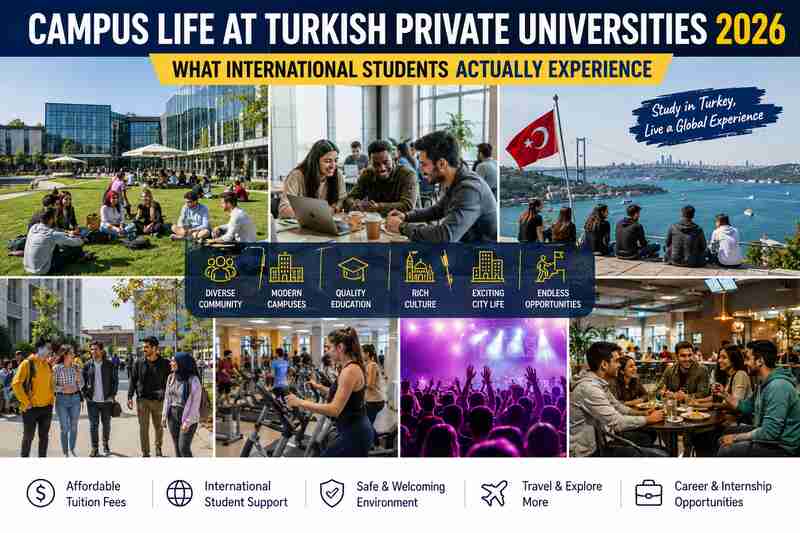
University brochures are all the same. Smiling students in glass-walled libraries. Empty, pristine labs that look like they've never been used. A rooftop terrace with a view. These images are not lies exactly the facilities do exist but they tell you nothing about what your actual day looks like nine months into your first year at a private university in Istanbul.
This guide does. We've worked with over 3,000 international students from 47 countries who've enrolled in Turkish private universities through us. We've seen what helps students settle quickly, what catches them off guard, what the campus clubs are actually like, how the dormitory experience really plays out, and what nobody warned them about before they landed. This is that conversation the one we have in person with students who ask us, honestly, what to expect.
What "Campus Life" Actually Means in Turkey; First, Adjust Your Expectations
Student life at Turkish private universities is genuinely good. But it works differently from campuses in the UK, US, Canada, or Australia and students who arrive with those expectations sometimes struggle to connect, not because the experience is bad, but because they're looking for it in the wrong places.
In Anglo-American universities, campus life often organizes itself automatically. Dormitory floors become social units. Freshers' weeks are institutionally managed. The social structure is built into the physical layout. Turkish private universities don't really work this way. The social life is there it's active, diverse, and for many students genuinely memorable but it requires you to go looking for it. Students who join clubs in the first two weeks of semester consistently describe a richer experience than those who wait until month three and then wonder why they don't know anyone.
That's not a criticism of Turkish universities. It's a practical orientation that nobody puts in the welcome pack. We're telling you now so you arrive prepared, not surprised.
Student Clubs; The Social Core of Private University Life
Major private universities in Turkey have between 50 and 90+ officially recognized student clubs. This is not a marketing statistic these are active, funded organizations that host events, run competitions, organize travel, and provide the main social infrastructure for international students.
For international students specifically, four categories of club matter most:
International Student Clubs are typically the largest and most organized. Universities like Istanbul Medipol, Bahçeşehir (BAU), Üsküdar, and others with significant international student populations run dedicated international clubs that organize welcome events, cultural exchange nights, city tours, and social meetups throughout the semester. For a student arriving from Pakistan or Nigeria or Egypt with no existing social network in Istanbul, this club is often where the first genuine friendships form. Don't skip the first event because you're tired from arrival week. That first event is usually when the connections that last four years are made.
Erasmus and Exchange Clubs exist at universities with large Erasmus networks Üsküdar University has over 400 international agreements, Istanbul Bilgi has over 600 Erasmus partnerships and these clubs run some of the most active social calendars on campus. Cultural nights, language exchange sessions, joint weekend trips to Cappadocia, the Aegean coast, or Bursa Erasmus clubs tend to organize these, and they're open to all students, not just exchange students. For a full-degree international student who wants to meet Europeans, Asians, and Turks in the same space, an Erasmus club is one of the most effective routes.
Sports Clubs are active and organized at most major private universities. Football (futbol), basketball, volleyball, swimming, chess, martial arts most campuses have internal leagues and competitions across all of these. For students who played sport seriously at home and want to continue, this is also one of the fastest ways to build a cross-cultural social group. Sport works as a language when Turkish and English haven't aligned yet. We've seen students who barely spoke to anyone for three weeks finally click with a group through weekly football training. It happens consistently enough that we genuinely recommend joining a sports club even if sport isn't your primary social interest.
National Student Associations deserve special mention because they serve a practical function that goes beyond social connection. The Nigerian Students Association, Arab Student Association, Pakistani Student Association, and similar national groups exist at multiple major Istanbul universities. For a student who just arrived and needs to know which bus goes to the immigration bureau, which market sells the right spices, which neighborhoods are affordable and safe, which phone plan actually works these associations are the fastest source of accurate, peer-tested information. In our experience, students who connect with their national association within the first week navigate the practical side of Istanbul life significantly faster than those who don't.
Sports Facilities; The Honest Range
This is an area where private universities vary more than their marketing suggests. The honest picture:
Well-equipped universities (Medipol, Üsküdar, BAU, Nişantaşı, and a few others) have indoor gyms, swimming pools, sports courts basketball, tennis, volleyball and organized league structures. Some have dedicated sports complexes that rival mid-size private gyms in Istanbul. These are available to students free or at minimal cost with their student card.
Smaller or newer private universities typically have fewer on-campus facilities but offer access to nearby municipal sports facilities at student discount rates. Istanbul's municipal sports infrastructure is genuinely good the city has subsidized sports centers across most districts so the off-campus option isn't a downgrade, just a different logistics calculation.
Either way, staying physically active in Istanbul is not difficult. The city has public parks, running paths along the Bosphorus, student basketball courts, and a culture of sports that's embedded into daily neighborhood life. Students who want to train regularly, whether at the university or at a local facility, will find it possible on a student budget.
Dormitories and Housing; What to Actually Expect
University dormitories at Turkish private institutions range from basic shared rooms to reasonably comfortable private accommodation and the quality difference between a $2,000/year dorm and a $5,000/year dorm is significant. The cheaper rooms are often shared with two or three other students, with communal bathrooms and a shared common area. Not unpleasant, but close quarters. The mid-range options typically offer shared doubles or singles with better common facilities, on-site laundry, and 24-hour security.
The honest recommendation for first-year international students: live in the university dormitory for at least your first semester, regardless of what cheaper apartments you can find off-campus. Here's why.
Walking distance to campus matters enormously during the first months when everything else is new. Istanbul's traffic and transport geography can make a 45-minute commute genuinely exhausting when you're also navigating a new academic environment, a new language, new administrative processes, and a new social landscape simultaneously. Dormitory life also creates proximity to other students in the same situation which is where unplanned social connections tend to happen. Sharing a floor with thirty other students who are all figuring out the same things you are produces friendships that studying from an apartment three metro stops away simply doesn't.
After the first semester, when you know the city better, know which neighborhoods suit your lifestyle, and have a social network through classes and clubs, the calculation for private apartments changes. Many of our students move off-campus for year two and find it works well. Starting there, before you know the city or the people, is a harder path.
Food, Transport, and Daily Life in Istanbul; Practical Numbers
Food on campus: University cafeterias at major private institutions serve subsidized meals that most international students describe as adequate to good. A typical lunch soup, main course, salad, and water runs the equivalent of $1–$3. Students who eat at the cafeteria consistently can manage monthly food costs at $80–$130. Students who eat out frequently in Istanbul will spend $200–$300 or more per month, because Istanbul's restaurant culture is good and prices have risen in dollar terms over recent years.
Transportation: Istanbul has an integrated transport system metro, tram, metrobüs, ferry, and bus accessible with the İstanbulkart student card, which provides a meaningful discount on all modes. Monthly transport spend for a student who commutes regularly and occasionally travels around the city runs $25–$50. The city is genuinely navigable on a student budget, but students on the Asian side commuting to the European side or vice versa should factor in longer travel times during peak hours. Istanbul is a 16-million-person city traffic is real.
Mobile and internet: A Turkish SIM with a monthly data package costs around $15–$25 and works well across the city. On-campus WiFi is available at all major universities but varies in reliability and speed. Most students buy a SIM immediately on arrival — it's one of the first practical steps we walk our students through when they arrive.
Monthly budget summary for a realistic student: Dormitory accommodation $170–$400, food $100–$150 (cafeteria-primary), transport $30–$50, mobile $20, personal expenses $100–$200. Total: roughly $420–$820 per month depending on accommodation choice and lifestyle. Istanbul sits at the higher end of the Turkish cost range but remains significantly below comparable European capitals.
Learning Turkish; The Question Everyone Has
Programs are in English. Daily life, eventually, requires some Turkish. This tension is real and worth addressing directly.
At major private universities, the campus environment is genuinely bilingual. Academic staff in international programs communicate in English. Administrative communications come in both languages. Many Turkish students at these universities speak workable-to-good English. So surviving the academic side without Turkish is entirely possible hundreds of our students do it every year.
But Istanbul outside the campus is Turkish. The landlord, the local market, the immigration bureau counter, the utility company, the neighborhood tea house these interactions are in Turkish, and navigating them with Google Translate is possible but slow and sometimes frustrating. Students who pick up even basic conversational Turkish "ne kadar?" (how much?), numbers, pleasantries, transport directions find daily life significantly smoother within three or four months. It's also something that Turkish students notice and appreciate. Making the effort to speak even poorly in Turkish builds social credit with local peers in a way that staying in English-only mode doesn't.
Several universities offer free or subsidized Turkish language courses for international students through their own programs or through TÖMER partnerships. We recommend every international student sign up, even if just for the beginner level. You won't regret it in month six.
The Mental and Social Adjustment; Being Honest About the Hard Part
The first six to eight weeks in a new country are genuinely difficult for most students, regardless of how excited they were when they applied. This is not a Turkey-specific observation it's a human one. But it's worth naming because social media and university marketing both tend to project an experience where everything clicks immediately and every week is an adventure.
The reality for most international students in Istanbul: the first two weeks are exciting. Weeks three through six can feel quieter, sometimes isolating, as the novelty fades and the distance from home becomes more concrete. Students who push through this period by joining clubs, attending events, and building campus routines consistently describe month three onwards as genuinely positive. Students who withdraw during this period staying in the apartment, attending only classes, delaying social engagement often find the isolation compounds.
This is something our team at Imtiyaz Education talks about directly with students before and after arrival. It's one of the reasons we stay in contact with our students throughout their first semester not just for administrative issues, but because we know from experience what weeks four through six feel like, and we want students to know that someone who has been through the same path is a phone call away.
How Imtiyaz Education Prepares You for Campus Life Before You Land
Our work with international students doesn't start when you arrive in Istanbul. It starts months earlier, when we're helping you understand what the campus of your specific university actually looks like day-to-day which clubs are active, what the dormitory setup is, what the surrounding neighborhood is like, and what to realistically expect in your first semester.
When we meet you at the airport in our VIP transfer car and take you to your accommodation, we're not just completing a logistics task. We're with you at the beginning of something, and we know from 3,000 students and nearly a decade of doing this exactly what questions you'll have in the first week and exactly what the answers are.
The housing setup, the dormitory check-in, the SIM card, the Turkish bank account, the ikamet appointment we walk through all of it with you. Not by phone from another country. In person, in Istanbul, by people who have lived this experience themselves.
That on-ground reality is what we offer. And it starts with a free consultation at turkeyuniversity.org before you've even chosen your university, while you're still figuring out what campus life in Turkey is going to mean for you.