Best Turkish Universities for Medicine for American Students (2026): TEPDAD, USMLE, Rankings and What Actually Matters

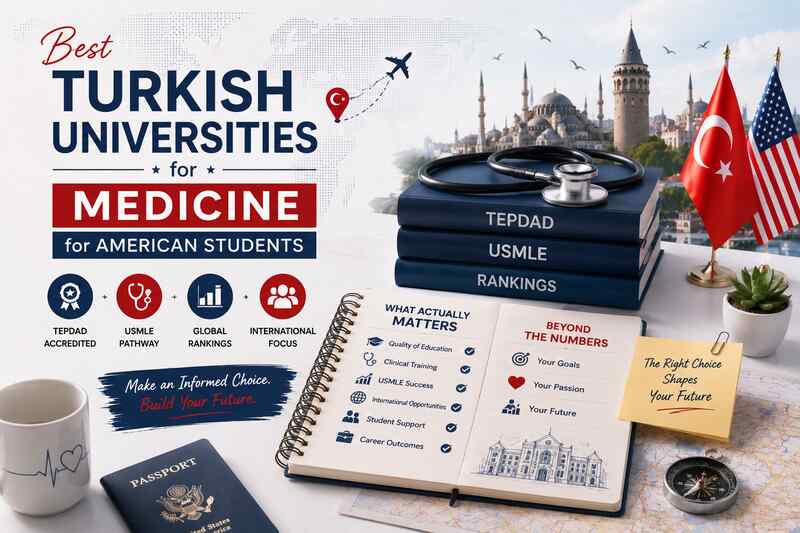
There are more than 30 private medical schools in Turkey offering English-medium programs. For an American student trying to identify the best Turkish universities for medicine for American students, the marketing is loud, the fee ranges vary from $17,000 to $44,000 per year, and the information that actually matters TEPDAD accreditation status, USMLE preparation infrastructure, hospital quality benchmarks, ranking data, and genuine graduate outcomes is scattered, sometimes outdated, and rarely compared in one place.
This guide is the comparison American students actually need. It covers five programs that represent the strongest choices for US-oriented students in 2026: Istanbul Medipol, Bahcesehir (BAU), Istinye, Biruni, and Uskudar. The evaluation criteria are specifically chosen for what matters to American students: ECFMG eligibility, USMLE preparation alignment, TEPDAD accreditation as a quality signal, hospital infrastructure, research credentials relevant to competitive US specialty applications, and realistic total cost with scholarship access.
We've been placing students including Americans in these programs since 2005. This is the guide we give every US pre-med student who contacts us.
What Criteria Actually Matter for American Students
Before comparing programs, the criteria need to be agreed on. An American student targeting US Internal Medicine residency has different priorities than one targeting orthopedic surgery or returning home to practice in a Gulf country.
For US residency targets (the primary American student use case), priority order:
WDOMS listing with ECFMG eligibility, non-negotiable. Verify at wdoms.org before considering anything else. All five programs in this guide pass.
USMLE preparation quality, is it structural (built into curriculum) or self-directed (student's responsibility)?
TEPDAD accreditation, external curriculum quality review, increasingly noticed by US residency program directors evaluating foreign medical schools
Hospital clinical quality and volume, affects clinical competency, ERAS letter quality, and the depth of cases you document
Research infrastructure, relevant for competitive specialties and academic medicine
Global rankings, relevant for program director name recognition
Total cost with realistic scholarship access
English-medium delivery quality, not all "English programs" deliver equally in practice
For students uncertain of their direction: choose the program combining WDOMS listing + TEPDAD + lowest realistic total cost + strongest USMLE alignment. This maximizes flexibility for all future directions.
The TEPDAD Landscape - Updated 2026
TEPDAD (Tibbi Egitim Programlari Degerlendirme ve Akreditasyon Dernegi) is Turkey's national medical education accreditation body, aligned with WFME (World Federation for Medical Education) standards. TEPDAD accreditation involves external academic review of curriculum design, teaching methodology, clinical training quality, and assessment systems not just self-reported compliance.
Confirmed TEPDAD holders among Istanbul private medical schools (2026):
University | TEPDAD Status | Term |
|---|---|---|
Istanbul Medipol | Accredited | Until 2030 |
Bahcesehir (BAU) | Accredited | Active |
Istinye University | Accredited | Awarded 2023 |
Baskent University | Accredited | Active |
Koc University | Accredited | Active |
Biruni, Uskudar, and IAU: WDOMS-listed and YOK-accredited, working toward TEPDAD.
Why does TEPDAD matter for American students specifically? US residency program directors who receive applications from foreign medical school graduates often ask: "did this school undergo any external quality review beyond their national registration?" TEPDAD is the answer for accredited Turkish programs. It's the equivalent signal to LCME accreditation for US programs not the same thing, but a recognizable external quality framework.
Related Guides
Annual fee: ~$44,000 (International School of Medicine, 100% English) TEPDAD: Accredited until 2030 WDOMS: Yes, confirmed ECFMG-eligible USMLE prep: Student-directed (not structurally integrated) Hospitals: Medipol Mega University Hospital complex (largest private hospital network affiliated with any Turkish medical school) QS World Ranking 2026: 1,001–1,200 band EduRank: Top 50 in Turkey
The Two Schools; A Critical Distinction Most Guides Miss
Medipol operates two entirely separate medical schools, and confusing them is one of the most common errors in Turkish medical school research:
International School of Medicine (ISM): 100% English-medium. TEPDAD-accredited until 2030. Students from 100+ countries. Annual tuition: approximately $38,000–$44,000 for international students. This is the program relevant for American students.
School of Medicine (Turkish-medium): Approximately 70% Turkish / 30% English. Lower annual fee (~$30,000). TEPDAD-accredited. Different student population, different clinical year scheduling. Not the right choice for an American student without strong Turkish language preparation.
When researching Medipol, always confirm which school's fees and curriculum are being quoted the difference is significant.
Hospital Network; The Scale Advantage
Medipol's hospital network is the largest private hospital network affiliated with any Turkish medical school multiple campuses across Istanbul including the Mega University Hospital in Bagcilar. The scale means students in clinical years encounter genuinely high patient volumes and wide case diversity. Specialties that require volume for competency Surgery, Internal Medicine, Obstetrics benefit from Medipol's breadth in ways that smaller single-hospital programs can't replicate.
Research Infrastructure
Medipol's research output has grown significantly since its founding in 2009. SABITA (Health Sciences and Technologies Research Institute) coordinates interdisciplinary research. The university has published in Springer, Lancet, and major specialty journals. For students interested in research publications during their Turkish studies — a strong ERAS differentiator Medipol has faculty actively publishing and seeking student co-investigators.
Graduate Outcomes
Medipol graduates have entered US residency programs, primarily in Internal Medicine, Family Medicine, and Psychiatry — the core IMG-accessible specialties. The TEPDAD accreditation until 2030 means the curriculum quality has been externally certified by an independent body through the end of the program for any student enrolling in 2026.
Honest Assessment for American Students
Medipol is the right choice for American students who want the most established TEPDAD-accredited program with the largest clinical network, and who are comfortable with the higher fee. At $44,000/year, the 6-year total is approximately $264,000 plus living below a US private medical school but above all other programs in this guide. The scholarship structure is less transparent than at Biruni or BAU we advise American students to negotiate scholarship terms explicitly at the application stage.
Best for: American students prioritizing institutional establishment, TEPDAD-to-2030 certification, and maximum clinical volume. Strong for Internal Medicine, Surgery, and Ob/Gyn tracks. Also relevant for students from countries where Medipol's brand recognition is specifically strong (Arab world, Central Asia).
See full guide: Studying Medicine at Istanbul Medipol University
Annual fee: $28,000 (English-medium) TEPDAD: Accredited WDOMS: Yes, confirmed ECFMG-eligible USMLE prep: Student-directed Hospital: BAU Goztpe Health Campus (integrated on-site, education + research + hospital in single complex) QS World Ranking 2026: 1,201–1,400 band EduRank: Top 40 in Turkey; medicine 76th in Turkey, 2,474th globally
The Research Lab Advantage; Unique in Istanbul
BAU's Faculty of Medicine carries the most internationally credentialed research infrastructure among Istanbul private medical schools. This is the distinguishing feature American students targeting competitive specialties or academic medicine need to understand:
Stanford-BAU Biomechanics Research Laboratory: established 2013 with Stanford's Robotics Department. First 3D real-time motion analysis center in Turkey. Active US-Turkish research collaboration.
Advanced Medical Technologies Laboratory: MIT, Boston University, EPFL Switzerland, and Italian National Research Council partnerships. Research areas: molecular diagnostics, cell characterization, microfluidic systems, biomedical imaging.
Stem Cell and Regenerative Medicine Laboratory: GMP-licensed for biological product preparation. Clinical applications in diabetic wound treatment, burn management, cartilage repair active published research, not theoretical infrastructure.
These partnerships are verifiable from official BAU faculty pages. They appear on publications. A BAU medical student who participates in research here can list Stanford-collaboration research activity on their ERAS application a meaningful differentiator that US program directors recognize.
For American students targeting competitive specialties Neurology, Internal Medicine research tracks, academic Cardiology, Oncology BAU's research credentials are the clearest path to a stronger ERAS application from a Turkish medical school.
The TEPDAD + Research Combination
BAU is one of two Istanbul private medical schools in this guide that hold both TEPDAD accreditation AND internationally recognized research partnerships. This combination external curriculum quality review AND verifiable US institutional research affiliations is unique in Istanbul's private medical education landscape.
Campus Integration Model
BAU's Goztpe campus integrates the education building, research building, and university hospital within a single complex. Students walk from preclinical lectures to research labs to hospital clinical work in the same location from Year 1 onward. The proximity reduces the disorientation of the preclinical-to-clinical transition and enables more frequent ad-hoc faculty contact than geographically dispersed programs.
The Year 3 elective curriculum is distinctive in Istanbul private medicine: Machine Learning in Drug Design, AI Design in Medicine, Bioinformatics, Medical Epigenetics, Python Programming in Medicine. These are not cosmetic additions they reflect a faculty culture that takes the medicine-technology intersection seriously, and produce students with skills US academic medicine programs increasingly value.
Honest Assessment for American Students
BAU is the right choice for American students who have research ambitions, are interested in technology-adjacent medicine, or are targeting competitive specialties where research publications matter for residency applications. At $28,000/year, it is the second-most-affordable TEPDAD-accredited program in this group after Istinye's scholarship-adjusted rate.
Best for: American students targeting academic medicine, research-intensive specialties, or who want Stanford/MIT institutional associations visible on their academic record. Strong for students interested in the intersection of medicine and technology — an increasingly important profile in US academic medicine.
See full guide: Studying Medicine at Bahcesehir University
Annual fee: ~$29,000 TEPDAD: Accredited (awarded 2023) WDOMS: Yes, confirmed ECFMG-eligible USMLE prep: Student-directed Hospitals: Liv Hospital Bahcesehir (394 beds) + Medical Park Gaziosmanpasa (272 beds, SGK-contracted) = 666 combined beds, 27 operating theatres QS World Ranking 2026: 2,787th globally (EduRank) International students: 3,877 from 96 countries
TEPDAD in 8 Years, What That Means
Istinye was founded in 2015. TEPDAD accreditation was awarded in 2023 8 years after founding. The speed of this achievement reflects serious academic investment. TEPDAD evaluation involves an in-depth review by external assessors of curriculum design, teaching quality, clinical training standards, and assessment systems. Receiving it in the 8th year of existence and the 6th year of medical education is notable.
For American students evaluating the best Turkish universities for medicine for American students specifically on accreditation signals: Istinye's 2023 TEPDAD gives it a quality credential that Biruni and Uskudar have not yet achieved.
Dual Hospital Clinical Breadth
The dual hospital model is Istinye's most concrete clinical advantage:
Liv Hospital Bahcesehir (ISU SUAM 1): 394 beds, 21 floors, 62,500 m². 12 operating theatres (including 1 IVF, 2 Ophthalmology). 94 ICU/observation beds. 10 palliative care beds. Dedicated pediatric ICU. Helicopter landing pad. Organ Transplant Center. Stroke Center. 24/7 overnight specialists in Cardiology, Internal Medicine, Pediatrics, Ob/Gyn, Orthopedics, Neurosurgery, Hand Surgery, Plastic Surgery. This level of 24/7 overnight specialist coverage is rare even among private Turkish teaching hospitals.
Medical Park Gaziosmanpasa (ISU SUAM 2): 272 beds, 60,000 m². 15 operating theatres. SGK-contracted meaning all patient categories, not just private insurance. Full specialty coverage. The SGK contract adds clinical diversity that fully private hospitals cannot replicate.
Combined: 666 beds, 27 operating theatres, two Istanbul districts. For clinical training breadth, this is the strongest dual-hospital setup among Istanbul private programs.
Four Research Laboratories
ISUKOK (Stem Cell and Tissue Engineering), ISUMKAM (Molecular Cancer Research), ISUCAN (Neurological Sciences), ISU3D (3D Design and Prototyping). Each has active research output. The 3D prototyping lab for anatomical models and surgical simulation is particularly forward-looking a technology now standard at internationally benchmarked medical schools.
Graduate Outcomes and International Student Body
3,877 international students from 96 countries gives Istinye one of the most internationally diverse student bodies in Istanbul's private medical sector. This has practical value: clinical rotations at ISU SUAM hospitals include English-speaking staff, and the academic environment is designed for non-Turkish students. Graduates from Istinye's Faculty of Medicine have entered postgraduate programs in Europe, the GCC, and have USMLE-eligible degrees for US residency applications.
Honest Assessment for American Students
Istinye is the right choice for American students who want TEPDAD accreditation + the broadest clinical volume access in Istanbul private medicine + an increasingly international campus culture at a price similar to BAU. The absence of BAU's specific US institutional research partnerships is the trade-off. What you gain is dual-hospital clinical breadth that exceeds most programs at this price point.
Best for: American students prioritizing TEPDAD accreditation signals and maximum clinical volume, particularly for Surgery, Internal Medicine, and high-acuity specialty tracks. Also strong for students from GCC and Arab countries where Istinye's recognition is growing.
See full guide: Studying Medicine at Istinye University
Annual fee: ~$21,000 (scholarship range: 25%–50%, effectively $10,500–$15,750/year) TEPDAD: In progress not yet achieved WDOMS: Yes, confirmed ECFMG-eligible USMLE prep: Structurally integrated from Year 1 the ONLY Istanbul private program with this Hospital: Biruni Hospital (617 beds, TEMOS-accredited, 100 ICU beds, 20 theatres including 1 hybrid OR, BMT and organ transplant center) EduRank: Global rank 2,172; top 50 Turkey
The USMLE Integration; What It Actually Means
Biruni is the best Turkish university for medicine for American students specifically targeting US residency and the reason is one specific, verifiable fact: Biruni is the only Istanbul private medical school that has structurally integrated USMLE preparation into the core curriculum from Year 1, confirmed from the official AKTS program catalogue.
This is not a marketing claim. The AKTS curriculum documentation confirms that USMLE-relevant content is embedded in the required course structure across all phases. Students at Biruni are not self-studying USMLE alongside a regular curriculum the two are aligned. The curriculum is explicitly designed to produce graduates who are simultaneously qualified for the Turkish TUS (medical specialization exam) and for USMLE.
For American students: the practical implication is real. A student at BAU, Istinye, or Medipol who wants to pursue US residency must self-direct a full parallel USMLE preparation curriculum alongside their Turkish medical coursework effectively studying for two different exam systems simultaneously. A student at Biruni has that USMLE alignment built in. The difference in readiness by Year 4 is measurable.
Biruni Hospital; Larger Than You'd Expect at This Price
At $21,000/year, you might expect a modest university hospital. What Biruni actually has is the largest single-hospital clinical training affiliate in this guide:
617 beds, 80,000 m², opened at current scale in 2023
100 ICU beds the most intensive care capacity of any Istanbul private medical school hospital
20 operating theatres including a hybrid OR for minimally invasive vascular and oncological procedures
TEMOS International Accreditation the same framework as internationally benchmarked hospitals
Licensed BMT (bone marrow transplantation) center available at very few Turkish hospitals regardless of ownership type
Licensed Organ Transplant Center
SGK-contracted full patient population diversity
International Patient Center serving patients from 118+ countries, English-speaking clinical staff routinely present
The 617-bed figure exceeds Medipol's Goztpe campus, Istinye's individual hospitals, and every other single-hospital affiliate in this comparison. For clinical competency, volume matters and Biruni's hospital delivers it.
BirDeHa and BirBilginOl; Technology-Enhanced Learning
Two proprietary learning platforms unique to Biruni:
BirDeHa (Biruni Derse Hazirlik): pre-class preparation system. Before each session, students receive structured preparatory materials so they arrive with baseline knowledge activated. The session builds on this rather than introducing it from zero.
BirBilginOl: post-class consolidation and self-assessment. After each session, students test and consolidate the material. The prepare-attend-consolidate cycle replaces passive lecture attendance with active learning methodology.
No other Istanbul private medical school at this price point operates equivalent proprietary platforms. The research evidence for active learning over passive lecture in medical education is strong, and Biruni's platform investment reflects a faculty that takes this seriously.
Phase-by-Phase Research Pathway
From Phase I (Year 1), Biruni students complete a mandatory research curriculum: Medical Research I and II in the first two years, culminating in the Project Course in Phase III a full research cycle including ethics committee application, data collection, congress presentation, and TÜBİTAK 2209-A grant eligibility. Students produce research output during undergraduate training.
For American students targeting competitive specialty residencies: ERAS applications benefit from research publications and presentations. A Biruni student who has completed the Phase III project cycle has documentation of research activity during medical school a stronger ERAS profile than a student who has no research output.
Honest Assessment for American Students
Biruni is the best choice for American students who are primarily targeting US residency, need USMLE preparation aligned with their curriculum rather than added to it, and want the strongest hospital of this group by clinical intensity at the most affordable price. The honest trade-off: no TEPDAD accreditation yet. For US residency where WDOMS listing is the foundational requirement TEPDAD is an additional quality signal but not the deciding factor for ECFMG eligibility. Students for whom TEPDAD is specifically required by their target state board should confirm before enrolling.
At 50% scholarship: $10,500/year, $63,000 total program tuition. All-in 6-year cost with Istanbul living: approximately $120,000–$130,000. Less than 25% of US private medical school equivalent.
Best for: American students targeting US residency who want USMLE preparation built into their curriculum, the largest and most intensively equipped single hospital in this comparison, and the best value. The strongest financial case in Istanbul English-medium medicine.
See full guide: Studying Medicine at Biruni University
Annual fee: ~$24,000 TEPDAD: In progress WDOMS: Yes, confirmed ECFMG-eligible USMLE prep: Student-directed Hospitals: NPiSTANBUL Brain Hospital (149 beds, 5x JCI, world's first accredited Brain Hospital) + Istanbul Atasehir Memorial (143 beds) + 2 public training hospitals (Umraniye + Sancaktepe) EduRank: 59th Turkey overall; 77th Turkey medicine, 2,501st globally THE Ranking 2026: 1,500+ global; 13th among Turkish private universities
NPiSTANBUL; The Most Internationally Credentialed Hospital Affiliate in Istanbul
Uskudar's teaching hospital is uniquely distinctive. NPiSTANBUL Brain Hospital passed the JCI (Joint Commission International) audit for the fifth consecutive time in 2024 giving it more consecutive JCI certifications than any other teaching hospital affiliated with an Istanbul private medical school. IAU's Medical Park Florya has one JCI certification. NPiSTANBUL has five.
The hospital carries the designation "World's First Accredited Brain Hospital" (2018, JCI) and "Turkey's First Accredited Neuropsychiatric Hospital" (2012, JCI). Clinical capabilities include: deep brain stimulation surgery (for Parkinson's, OCD, treatment-resistant depression, epilepsy), robotic neurosurgery, pharmacogenetics as clinical standard (TDM and genotyping for psychiatric medication optimization), and a 16-bed Level 3 ICU.
For American students interested in Neurology, Psychiatry, or Neurosurgery: no other Istanbul private program offers this level of clinical exposure in these specialties. Deep brain stimulation candidates, pharmacogenetically-managed treatment-resistant psychiatric disorders, robotic neurosurgical cases this is the clinical environment for a student who knows their specialty direction early.
The Curriculum Differentiator; Subjects No Other Istanbul Program Teaches
Uskudar's preclinical curriculum includes compulsory subjects found nowhere else in Istanbul private medicine: Positive Psychology, Health Informatics, Health Sociology, Health Economics, and Medical Humanities. These aren't electives they're required. The rationale is grounded in the university's founding vision under Prof. Dr. Nevzat Tarhan (psychiatrist, neuroscientist, former Turkish Health Minister): physicians should understand the full human context of disease, not just the biological system.
For American students: these subjects produce graduates with broader clinical and intellectual preparation particularly relevant for Psychiatry, Primary Care, and academic medicine, where the ability to understand patients in social and systemic context is increasingly valued.
Four Research Centers and the Ayhan Songar Library
Five active research centers: NPFUAM (Neuropsychopharmacology), NPSUAM (Neuropsychiatry clinical research primary research output driver), USKUDAB (Experimental Research), USMERA (Medical Radiation), KIMER (Personalized Treatment). The KIMER center's pharmacogenetics research connects directly to NPiSTANBUL's clinical pharmacogenetics program.
The Ayhan Songar Faculty Library: 550 m², 122 seats, 54,193 e-journals in medicine, 58 database subscriptions including Cochrane Library, Elsevier ClinicalKey, DynaMed, and MEDLINE. For students doing USMLE self-preparation, Cochrane and ClinicalKey access without additional subscription cost is a genuine resource advantage.
Graduate Outcomes
Uskudar graduates from the faculty's first cohorts (the program launched in 2018) have entered Turkish TUS programs and international postgraduate pathways. The combination of WDOMS listing, English-medium delivery, and NPiSTANBUL clinical training positions graduates well for the standard USMLE-ECFMG pathway. The THE 2026 ranking appearance (1500+, 13th among Turkish private universities) reflects improving institutional quality metrics.
Honest Assessment for American Students
Uskudar is the right choice for American students who know their specialty direction points toward neurology, psychiatry, neurosurgery, or behavioral medicine and who want clinical exposure at a world-class specialist hospital from Year 4 onward. At $24,000/year without TEPDAD, it sits between Biruni's value and BAU's research prestige. For the specific clinical profile it offers five-JCI NPiSTANBUL there is no equivalent in Istanbul private medicine.
Best for: American students targeting neurology, psychiatry, neurosurgery, or behavioral medicine. Also strong for students who value the curriculum's Positive Psychology and Health Humanities components as indicators of a broader medical education philosophy.
See full guide: Studying Medicine at Uskudar University
Medipol ISM | BAU | Istinye | Biruni | Uskudar | |
|---|---|---|---|---|---|
Annual tuition | $44,000 | $28,000 | $29,000 | $21,000 | $24,000 |
6-year total (standard) | $264,000 | $168,000 | $174,000 | $126,000 | $144,000 |
6-year total (best scholarship) | ~$200,000 | ~$140,000 | ~$145,000 | ~$63,000–$75,600 | ~$115,200 |
TEPDAD | Yes (to 2030) | Yes | Yes (2023) | In progress | In progress |
WDOMS | Yes | Yes | Yes | Yes | Yes |
USMLE structural prep | No | No | No | Yes, from Year 1 | No |
Hospital beds | Mega network | ~400 | 666 combined | 617 | 149 + 143 + 2 public |
Hospital intl. accreditation | Own campus | Own campus | MLP Care | TEMOS | 5x JCI (NPiSTANBUL) |
Research | Active (SABITA) | Stanford/MIT/EPFL | 4 named labs | BirDeHa/BirBilginOl + publication track | NPiSTANBUL + 5 research centers |
QS / global ranking | 1,001–1,200 | 1,201–1,400 | EduRank 2,787 | EduRank 2,172 | THE 1,500+; EduRank 2,918 |
Founded | 2009 | 1998 | 2015 | 2014 | 2011 |
Best for US students | Max accreditation + volume | Research + TEPDAD + technology | TEPDAD + dual hospital | USMLE alignment + value | Neurology/Psych/Neurosurgery |
Global rankings are not the primary selection criterion for medical students targeting US residency WDOMS listing and USMLE performance are. But rankings reflect research output and institutional quality signals that US program directors do notice.
QS World University Rankings 2026:
Istanbul Medipol: 1,001–1,200 band
Bahcesehir (BAU): 1,201–1,400 band
Istinye: EduRank 2,787 globally
Biruni: EduRank 2,172 globally
Uskudar: THE 1,500+ (13th among Turkish private universities)
Medicine-specific EduRank 2026 (based on research publications and citations):
Uskudar: 77th Turkey, 2,501st global (4,306 publications, 38,903 citations)
BAU: 76th Turkey, 2,474th global
Biruni: 2,172nd global overall
Medipol: 2,430th global overall
Research output in medicine-specific ranking correlates with faculty research activity meaning potential co-investigator opportunities for enrolled students. BAU and Uskudar's medicine-specific rankings reflect active research output in their core specialty areas (biomechanics/biomedical technology for BAU; psychiatry/neuroscience for Uskudar).
After placing students at all five of these programs over multiple years, here is our honest assessment:
If your goal is US residency and you want USMLE preparation aligned with your curriculum: Biruni, unambiguously. No other Istanbul program has done this, and it represents a real curriculum investment that makes the USMLE pathway more manageable.
If you want TEPDAD + internationally recognized research credentials for competitive specialty applications: BAU. The Stanford/MIT lab associations are verifiable, meaningful, and differentiate a residency application in ways that institutional rankings alone don't.
If you want TEPDAD + maximum clinical volume across two hospital campuses: Istinye. The dual hospital model at 666 combined beds is the strongest clinical breadth in this group, and the 2023 TEPDAD gives it external quality certification.
If you want the most established, highest-ranked program with the largest hospital network: Medipol ISM. Accept the higher fee and model the scholarship carefully. The 2030 TEPDAD term means any student starting in 2026 is covered for their full program.
If you know your specialty direction is neurology, psychiatry, or neurosurgery: Uskudar. NPiSTANBUL's five JCI certifications and deep brain stimulation program are a clinical training environment unmatched anywhere else in Istanbul private medicine.
The Imtiyaz Education Difference for This Decision
Choosing among the best Turkish universities for medicine for American students is not a decision that should be made from a comparison table alone. The right answer depends on your specific GPA (which determines scholarship access), your target specialty (which determines which program's infrastructure matters most), and your financial situation (which determines whether the $63,000 Biruni option or the $264,000 Medipol option is relevant to your planning).
We have placed students at all five programs. We know what each faculty is like from the inside which professors are most responsive, which clinical rotations have the strongest supervision, and which administrative offices run smoothly during registration. We can give you a specific, honest recommendation based on your profile in a single conversation.
Zero application fees. Written rate guarantee with a $1,000 payment card challenge that has never been claimed in 21 years. CGPA scholarship briefing at every final registration. On-ground Istanbul team from your arrival day through your first month.
Imtiyaz Education contact us before you decide.
Q: Which is the best Turkish university for medicine for American students in 2026? A: Depends on your priority. Biruni for US residency and USMLE alignment the only program with USMLE structurally integrated from Year 1. Medipol ISM for maximum TEPDAD standing (to 2030) and clinical volume. BAU for research credentials and TEPDAD. Istinye for TEPDAD plus dual-hospital clinical breadth. Uskudar for neurology/psychiatry/neurosurgery clinical exposure at a 5x JCI hospital.
Q: Is Biruni or Medipol better for USMLE and US residency? A: Biruni wins on USMLE preparation it's the only Istanbul program with structural USMLE integration. Medipol wins on TEPDAD-to-2030 and clinical network scale. For a student who is disciplined about self-directed USMLE study, the Medipol TEPDAD credential is the quality signal for program directors. For a student who wants USMLE preparation built into their curriculum, Biruni's structural approach is a real advantage at significantly lower cost.
Q: Does TEPDAD accreditation matter for US residency? A: Not as a hard ECFMG requirement WDOMS listing is the foundational criterion. TEPDAD matters as a secondary quality signal that US residency program directors may notice when evaluating foreign medical school applications. In a competitive IMG application, every quality differentiator helps.
Q: What is the Medipol International School of Medicine vs School of Medicine? A: Entirely separate schools within Medipol. International School of Medicine (ISM): 100% English, TEPDAD-accredited until 2030, higher fees (~$38,000–$44,000), international student focus. School of Medicine: 70% Turkish / 30% English, TEPDAD-accredited, lower fees, primarily Turkish student population. American students should enroll in the ISM track.
Q: Which program has the best scholarship for American students? A: Biruni offers the most consistently accessible scholarship range (25%–50%) for qualifying applicants, making it the most financially accessible quality program. Medipol scholarships are less transparent but exist. BAU and Istinye offer excellence scholarships terms assessed individually. We access the best available scholarship at application through our direct partnerships.