How to Apply to a Turkish University from the USA: Complete Guide for Medicine, Dentistry, Engineering, Business and All Programs

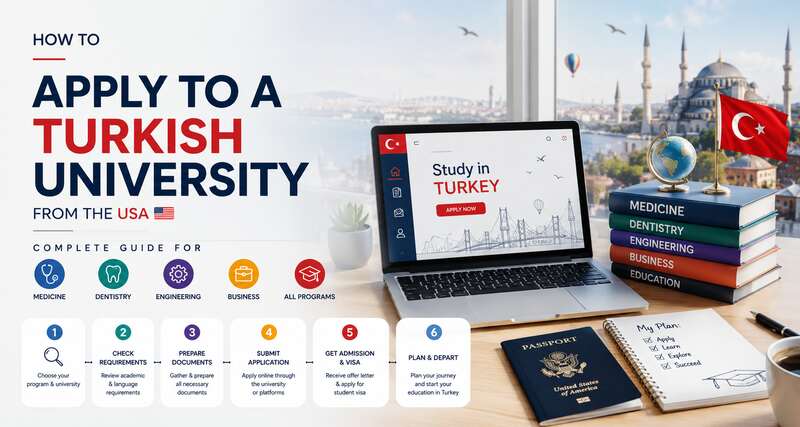
How to apply to a Turkish university from the USA is a process that most guides bury under generic international student advice. The actual US-specific pathway apostille for documents, Turkish consulate D-visa from US consular posts, FAFSA inapplicability, English proficiency waiver for native speakers, scholarship mechanisms that differ from US financial aid is rarely covered in one complete, current document.
This guide covers every program type and every step. Whether you're looking to study medicine in Turkey from the USA, pursue dentistry, engineering, computer science, business, pharmacy, nursing, or architecture the core application mechanics are the same, with program-specific variations noted throughout.
Imtiyaz Education has processed over 100,000 applications since 2005, including applications from American students across all major program types. We know exactly how to apply to a Turkish university from the USA for each program and what goes wrong when students try to navigate it alone.
Why American Students Choose Turkish Private Universities; By Program
The reasons vary by field, but the pattern is consistent: quality English-medium education at a fraction of US cost, with internationally recognized degrees, in one of the world's most interesting cities.
Medicine: No MCAT required. WDOMS-listed degrees eligible for USMLE and ECFMG. Total 6-year all-in cost: $165,000–$280,000 (including living). US private medical school: $524,000+ total. The financial gap is not marginal.
Dentistry: No DAT required. Turkish DDS-equivalent degrees eligible for INBDE licensing pathway in the US. 5-year program. Total cost: $130,000–$230,000 vs $350,000–$500,000+ for US dental school.
Engineering: English-medium programs at $3,000–$8,000/year vs $30,000–$70,000/year at US private universities. MUDEK accreditation pathway for Washington Accord recognition. Istanbul's active construction and tech sectors create internship pipelines.
Computer Science and Software Engineering: $3,500–$8,000/year for English-medium CS programs. Istanbul's growing startup ecosystem (Trendyol, Getir, Insider, Peak Games all major Turkish tech companies based in Istanbul) creates employment pathway value. For American students interested in international tech careers, Istanbul is an underrated hub.
Business and MBA: English-medium programs from $2,500/year to internationally accredited MBA tracks at $15,000–$25,000 for the full program. Istanbul as a business gateway between Europe and the Middle East/Central Asia creates genuine career positioning for business students.
Pharmacy (Eczacilik): 5-year Turkish pharmacy programs are available at several Istanbul private universities including Yeditepe, Bahcesehir, Biruni, and IAU. Annual fees: $6,000–$15,000. Turkish pharmacy degrees require denklik evaluation for recognition outside Turkey confirm the pathway for your target country before enrolling.
Nursing: 4-year nursing programs in English are available at Uskudar University, Bahcesehir, and others. For American nursing applicants, NCLEX licensing eligibility from a Turkish nursing degree requires NMC verification confirm current requirements with your target state board before enrolling.
Architecture and Design: Istanbul's design scene is globally recognized, and Turkish architecture programs have strong connections to the regional construction industry (one of the world's largest). English-medium architecture programs available at Bahcesehir, Istanbul Bilgi, and others. Fees: $5,000–$12,000/year.
The Turkish Private University Landscape for American Students
Turkey has approximately 80+ private (foundation/vakif) universities, all registered with YOK (Yuksekogretim Kurulu Turkey's Higher Education Council). YOK registration is mandatory and publicly searchable at yok.gov.tr.
Quality varies significantly more than in the US system. The safest approach for American students is to focus on universities with:
YOK accreditation (confirmed at yok.gov.tr, non-negotiable)
WDOMS listing for medical and dental programs (confirmed at wdoms.org)
Relevant program-specific accreditation: TEPDAD (medicine), DEPAD (dentistry), MUDEK (engineering), AACSB or EQUIS (business)
QS or THE global ranking, not necessary but provides a quality benchmark. Koc, Sabanci, Bilkent lead Turkish private universities globally.
Istanbul vs Ankara vs other cities: Istanbul is the primary destination for international students. Ankara (Baskent University, Hacettepe) and Izmir (Yasar University) offer alternatives. For American students, Istanbul's international infrastructure, English-language environment, and direct flight connectivity make it the most practical choice.
Step-by-Step: How to Apply to a Turkish University from the USA
Step 1; Program Research and University Selection (8–12 Weeks Before Intended Application)
Before contacting any agency, be specific about:
Program type: which degree? 6-year medicine, 5-year dentistry, 4-year engineering, 4-year business, 4-year CS, 5-year pharmacy, 4-year nursing?
Language of instruction: English-medium, Turkish-medium, or bilingual? English-medium programs at Istanbul private universities:
Medicine: Biruni, BAU, Istinye, IAU, Uskudar, Medipol, Atlas, Altinbas, Okan
Dentistry: Yeditepe, Bahcesehir, Biruni, IAU, Altinbas
Engineering: Most major Istanbul private universities
Business: Almost all major Istanbul private universities
CS: Most major Istanbul private universities
Turkish-medium programs are available at lower tuition (typically 30–50% lower than English-medium equivalent), but require completing a Turkish Preparatory Year (Hazirlik Yili) first if you don't already have Turkish proficiency at B2 level. The prep year costs approximately $3,000–$6,000 and is available at most universities, counted as year 0, not as program credit.
Foundation/preparatory year vs regular admission: the foundation year (or hazirlik) is for students who need language preparation. It is different from a remedial academic year it's purely language acquisition, and students who complete it successfully enter the program at Year 1 alongside direct-entry students.
Step 2; Verify Accreditation (Not Optional)
For medicine: wdoms.org + yok.gov.tr + tepdad.org.tr For dentistry: wdoms.org + yok.gov.tr + depad.org.tr For engineering: yok.gov.tr + mudek.org.tr (for MUDEK-ABET equivalent programs) For business: yok.gov.tr + aacsb.edu or efmd.org (for EQUIS/AACSB) For all programs: yok.gov.tr as the baseline
Step 3; Document Preparation (6–10 Weeks Before Application)
All programs - US students:
US high school diploma + apostille from Secretary of State (state where school is located). Processing: 2–4 weeks standard; 2–5 business days expedited at most states.
US high school transcript + apostille, official, sealed, then apostilled
Valid US passport, minimum 6 months validity past entry date
English proficiency documentation, US-educated students are generally exempt from TOEFL/IELTS; confirm with target university
Biometric photographs (35×45mm, white background, 10–12 copies)
Medical certificate (health report), some programs require this
For transfer applicants (students with US college credits): Include your full university transcript. Apostille required for final registration. Important: for medical and dental programs, you almost universally start from Year 1 regardless of prior college Turkish medical programs do not recognize pre-med coursework as equivalent to their preclinical years. For engineering, business, and CS, partial credit recognition is possible, confirm with the specific university at application.
The YOS exam for Turkish programs: Some Turkish universities require the YOS (Foreign Student Exam Yabanci Uyruklu Ogrenci Sinavi) for certain programs, particularly for Turkish-medium programs or for programs that are heavily oversubscribed. For English-medium programs at major Istanbul private universities, YOS is generally not required for direct admission — the diploma and GPA are the primary admission criteria. Confirm whether your specific program requires YOS at the application stage.
Step 4; Apply Through Imtiyaz Education (Don't Skip This Step)
Learning how to apply to a Turkish university from the USA independently is possible but the practical reasons to work through a licensed agency are specific and real.
The locked application rule: under Turkish university admissions rules, once your application is submitted through one agency, that application is assigned to that agency in the university's enrollment system. No second agency can refile for the same student in the same intake year. The first agency contact you make is the only agency contact that counts for that cycle. If the first agency misrepresents scholarship rates or services, you have no mechanism to transfer mid-cycle.
What applying through Imtiyaz gives you:
Direct university partnership priority channel: 24–48 hour admission decisions for complete applications
Scholarship negotiation at the point of application — not after enrollment
Document review before submission (we catch issues before they cause rejection)
Zero application fees we are compensated by universities
Written rate guarantee: same nationality, same program, same year, lower verified rate found we cover the difference and issue a $1,000 payment card
US-specific guidance: apostille process, Turkish consulate visa questions from US consular posts, arrival procedures
Our CGPA scholarship briefing at final registration is particularly valuable for all program types not just medicine. Turkish private universities offer institutional fee reductions for strong academic performers from as early as Semester 2. We document the ECTS thresholds for every enrolled student at registration.
turkeyuniversity.org — contact us first.
Step 5; Acceptance Letter Review
Once your application is processed, you receive an acceptance letter (kabul mektubu). Read it carefully:
Program name: confirm it matches exactly what you applied for, including language track (English or Turkish)
Scholarship percentage: confirm the offered rate matches what was negotiated at application not a reduced offer substituted post-acceptance
Start date and academic year: confirm Fall semester (most programs have Fall-only intake; some offer Spring for non-medical programs)
Enrollment deposit amount: typically $1,000–$5,000 depending on program, deducted from total tuition
Step 6; Enrollment Deposit Payment
Pay the enrollment deposit to secure your place. Payment is made directly to the university's bank account never through a third-party agency. Imtiyaz provides the verified bank wire transfer details for every partner university. If any agency asks you to pay a deposit to their account rather than the university directly stop and contact us.
Step 7; Turkish Student Visa from the USA
With your acceptance letter and deposit receipt, apply for the Turkish D-type long-stay national visa from the relevant US consular post:
New York Consulate: northeastern US states
Washington D.C. Embassy: DC, VA, MD, WV and surrounding states
Los Angeles Consulate: CA, NV, AZ, OR, WA, AK, HI
Houston Consulate: TX, OK, LA, AR, MS, and Gulf states
Chicago Consulate: IL, MI, OH, IN, WI, MN, IA, MO
Required documents: passport, visa application form, acceptance letter, deposit receipt, bank statement (3–6 months), health insurance, photographs, visa fee (~$50–$80). Processing: 2–4 weeks. Full visa guide in our enrollment checklist.
Step 8; Pre-Departure Preparation
Financial setup:
Open a Wise account and link your US bank account
Order a Charles Schwab Bank debit card (for fee-free global ATM withdrawals)
Do NOT exchange large amounts at US banks or airport kiosks rates are poor
Insurance:
Activate Turkey-valid health insurance before departure
Confirm whether your US insurance covers Turkey (almost certainly not)
Communication:
Notify your US bank of international travel to prevent card blocks
Check your phone plan — most US plans offer add-on Turkey coverage; Turkish SIM on arrival is cheaper for long-term use
Related Guides
Medicine from the USA
No MCAT. No pre-med required. Apply after high school. 6-year program combining preclinical and clinical phases. English-medium at Biruni, BAU, Istinye, IAU, Uskudar, Medipol, and others. WDOMS-listed programs are ECFMG-eligible for USMLE pathway to US residency. See our full guides: Can Americans Study Medicine in Turkey?
Dentistry from the USA
No DAT. 5-year Dis Hekimligi program. Apply after high school. English-medium programs available. WDOMS-listed dental schools: verify at wdoms.org. US dental licensing pathway involves INBDE (Integrated National Board Dental Examination). Leading programs: Yeditepe University (most established private dental school in Turkey), Bahcesehir, Altinbas, Biruni.
Engineering from the USA
YOS generally not required for English-medium programs. MUDEK accreditation relevant for Washington Accord recognition. Strong programs at: Bahcesehir University (engineering + tech focus), Istanbul Bilgi (creative engineering programs), Koc University (premium, higher fees), Yeditepe. Annual fees: $3,000–$12,000 for English-medium programs. Transfer credit possible for students with US college engineering coursework confirm at application.
Computer Science / Software Engineering from the USA
Among the strongest value propositions in Turkish higher education for Americans. $3,500–$8,000/year English-medium. Istanbul's tech sector creates genuine internship and employment pathways during study years. No specific accreditation framework analogous to ABET YOK registration is the baseline. Top programs: Istanbul Bilgi (design and tech focus), Bahcesehir, Yildiz Technical University (state, cheaper fees but competitive admission).
Business / MBA from the USA
AACSB-accredited programs: Koc University Dogan School of Business, Sabanci School of Management. Both are Istanbul's premium private universities with fees to match ($15,000–$25,000/year). Non-AACSB programs widely available at $2,500–$7,000/year appropriate for students prioritizing cost and Istanbul experience over international accreditation signaling. MBA programs targeted at working professionals with 3–5 years of experience: Bahcesehir, Bilgi, Kadir Has.
Pharmacy from the USA
5-year Eczacilik programs. English-medium available at Biruni, Bahcesehir, IAU. Annual fees: $7,000–$15,000. Turkish pharmacy licensure pathway (Eczaci) is the primary post-graduation route. For US pharmacy licensing, Turkish pharmacy degrees require NABP (National Association of Boards of Pharmacy) evaluation confirm current NABP recognition status before enrolling if US practice is your goal.
Turkish private universities offer scholarships primarily based on academic GPA — not financial need, not US athletic scholarships, not demographic considerations. The scholarship percentage offered at acceptance is based on your high school GPA and, for higher-competition programs, the relative performance of your application cohort.
Typical GPA-to-scholarship mapping for major Istanbul private medical schools:
GPA 3.8–4.0 (US 4.0 scale): 50%–75% scholarship at most programs
GPA 3.4–3.7: 25%–50%
GPA 3.0–3.3: 10%–25%
GPA 2.5–2.9: minimal or no scholarship; standard rate
For non-medical programs: fees are lower, so the absolute dollar value of scholarships is smaller but the same GPA framework applies. A 50% scholarship on a $4,000/year CS program saves $2,000/year.
The CGPA success scholarship (separate from admissions scholarship): every Turkish private university operates an academic performance-based fee reduction from within the program available from Semester 2 of Year 1 for students who hit CGPA thresholds. This is separate from the admissions scholarship and most students never find out it exists in time to qualify. We brief every enrolled student at final registration with the specific CGPA thresholds, ECTS weighting, and grade targets.
FAFSA and US federal aid: not applicable to programs at non-US-accredited institutions. Students fund Turkish programs through family support, personal savings, or private international student loans (not federally backed). The institutional scholarship system which can reduce fees by 25%–75% is the primary financial aid mechanism.
Q: How to apply to a Turkish university from the USA if I have no prior Turkish language knowledge? A: You apply to English-medium programs no Turkish required at the application stage. For Turkish-medium programs at lower cost, you first complete a 1-year Turkish Preparatory Year (Hazirlik). Most American students choose English-medium tracks. Basic conversational Turkish develops naturally during the first year in Istanbul.
Q: Can I transfer my US college credits to a Turkish university? A: For medicine and dentistry: generally no you start from Year 1 regardless of prior college science courses. For engineering, business, and CS: partial credit recognition is possible. Confirm the transfer policy with your specific target university at application it varies by institution and program.
Q: Do I need the YOS exam to apply from the USA? A: For most English-medium programs at major Istanbul private universities: no. YOS is primarily required for Turkish-medium programs and for certain high-competition programs at specific universities. Confirm with your target program at application. Your US high school diploma and GPA are the primary admission criteria for English-medium programs.
Q: How long does it take to get an acceptance letter after applying through Imtiyaz? A: For complete applications, typically 24–48 hours for medicine and dentistry, 24 hours for other programs. The bottleneck is always document completeness we review your file before submitting to prevent delays.
Q: Can I apply to multiple Turkish universities simultaneously? A: Yes you can have applications pending at multiple universities simultaneously. However, once you accept a specific university's offer and pay the enrollment deposit, that university's application is active. We can help you apply to 2–3 programs in parallel and then choose the best offer.
Q: Is a Turkish university degree valid in the USA for employment? A: For most employment purposes: Turkish degrees are evaluated through WES (World Education Services) for US credential equivalency. WES-evaluated Turkish degrees are accepted by most US employers and graduate schools. For licensed professions (medicine, dentistry, pharmacy, nursing, engineering PE): profession-specific licensing pathways apply. See our article on Is a Medical Degree from Turkey Valid in the USA? for the medical licensing pathway in detail.