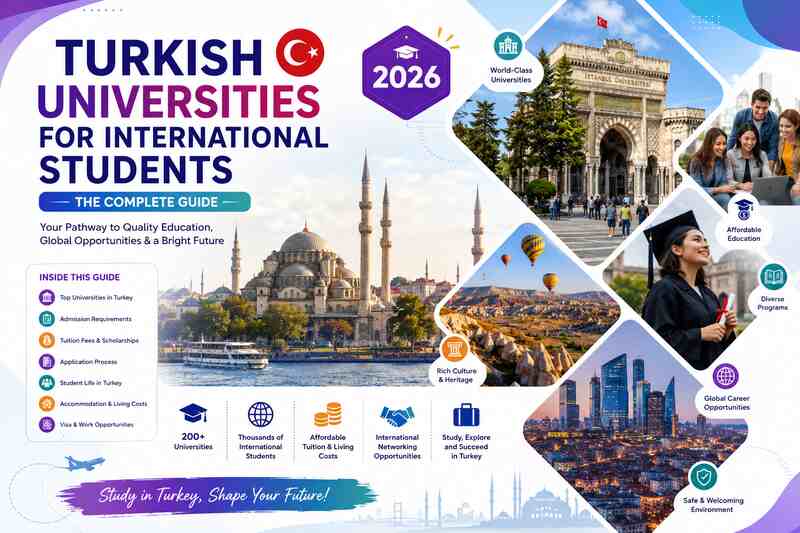
Turkish Universities for International Students 2026 - The Complete Guide

AI Snapshot
Turkish Universities for International Students 2026 - The Complete Guide — a quick summary from Turkey University to help students researching study options in Türkiye. Turkish universities for international students: fees, rankings, accreditations, city guide. 350,000+ students. Free application. Apply today. Imtıyaz Education
Turkish universities for international students are not a niche option anymore. According to a British Council and Studyportals report published in late 2025, Turkey now hosts approximately 350,000 international students from more than 200 countries, making it the most popular destination for students from the Middle East and North Africa - and the sixth-largest host country for international students worldwide. That is not a marketing claim. It comes directly from YOK, Turkey's Council of Higher Education, which cited the report in an official statement.
The numbers tell you something, but not everything. A growing number of students from Nigeria, Pakistan, Egypt, Libya, Iraq, and across Sub-Saharan Africa are choosing Turkey not because it is the cheapest option on the table, but because it gives them something harder to find: a recognized degree, real hospital or engineering training, an English-medium curriculum, and a city - particularly Istanbul - that opens doors that smaller academic towns simply can't.
We have been working with international students applying to Turkish universities since 2005. In our experience, the students who succeed here are the ones who choose their institution carefully, understand what the degree actually qualifies them to do, and arrive prepared. This guide gives you that foundation: rankings, accreditations, fees, city comparisons, and why Istanbul specifically stands apart for students who care about what comes after graduation.
Why Turkey Has Become a Top Destination for International Students
The growth of Turkish universities for international students over the past decade has been extraordinary. In 2013, Turkey enrolled roughly 48,000 international students. By the 2024-2025 academic year, that number had crossed 340,000 - a more than six-fold increase in just over a decade, according to data tracked by EduTurkiye and corroborated by YOK enrollment statistics.
What drove that growth is worth understanding, because it points to what actually works about studying here.
First, the academic infrastructure improved substantially. In the QS World University Rankings 2026, six Turkish universities placed within the top 500 globally: METU at 269th, ITU at 298th, Koc University at 323rd, Bogazici at 371st, Sabanci at 404th, and Bilkent at 415th. More striking is the QS Europe University Rankings 2026 result: Turkey became the second most represented country in Europe with 103 universities listed, surpassing Germany, France, Italy, and Spain in terms of institutional representation. That was a YOK headline in January 2026, and it is a credible data point - not a promotional stat.
Second, the English-medium option expanded. A decade ago, finding a genuine English-medium undergraduate program outside of METU and Bogazici was difficult. Today, dozens of private universities in Istanbul, Ankara, and Izmir offer full-degree programs in English covering medicine, engineering, business, health sciences, and computer science. That shift made Turkey accessible to a much wider international audience.
Third - and this is what competitors' articles consistently miss - the cost-to-quality ratio improved while the UK, Australia, Canada, and the US made international student access harder. Visa restrictions tightened, fees rose, and post-study work rights became less predictable in the Big Four destinations. Turkey's position as an affordable, accessible alternative strengthened exactly when students needed it most.
QS and THE Rankings - What They Mean for International Students
Rankings matter to international students for two reasons: they signal academic quality, and they affect how employers in your home country respond to your degree. Here is what the 2026 data actually shows.
Public universities - globally ranked:
Middle East Technical University (METU) - QS World rank 269th, QS Europe rank 116th. METU, Bogazici, and ITU all ranked in the world's top 100 in the QS "Employer Reputation" indicator - meaning international employers specifically recognize their graduates. That is a significant and underreported data point.
Istanbul Technical University (ITU) - QS World rank 298th, QS Europe rank 124th. One of the oldest technical universities in the world (founded 1773), particularly strong in engineering and architecture.
Bogazici University - QS World rank 371st, QS Europe rank 153rd. Fully English-medium instruction, strong research culture, one of the most selective universities in Turkey.
Hacettepe University - QS World rank 364th, QS Europe rank 199th. Led Turkish universities in Medicine and Life Sciences in the QS Subject Rankings 2026 at 308th globally. The strongest nursing faculty in Turkey.
Istanbul University - QS World rank 628th. One of the oldest universities in Turkey (1453), strong in law, medicine, and pharmacy.
Ankara University - QS World rank 697th. Strong in veterinary, dentistry, and political science.
Private universities - globally ranked:
Koc University - QS World rank 323rd. Turkey's highest-ranked private university, Triple Crown accredited business school (AACSB, AMBA, EQUIS) - placing it among less than 1% of business schools worldwide.
Sabanci University - QS World rank 404th. Innovation-focused, interdisciplinary approach.
Bilkent University - QS World rank 415th. Fully English-medium, strong across engineering, business, and communications.
Bahcesehir University (BAU) - ranked in QS Europe top 500 2026. Ranked 5th among Turkish universities in Times Higher Education. Five international campuses including Berlin and Washington.
Istanbul Gelisim University (IGU) - QS Europe rank 441st. Holds ABET accreditation for engineering programs.
For the 2026-2027 academic year, private university fees for international students range from approximately $2,450 to $9,000 per year for most bachelor programs. Medicine and dentistry sit higher at $12,500-$44,000 per year depending on language of instruction and university prestige. Public universities cost significantly less - $300 to $6,000 per year - but require TR-YOS exam results for competitive programs.
Understanding Accreditations - What They Mean and Which Programs Hold Them
One of the most important things international students overlook when evaluating Turkish universities is program-level accreditation. University rankings are one signal. Accreditations are a different, often more reliable one - especially for students who plan to work internationally after graduation.
Here is how to read them:
ABET (Accreditation Board for Engineering and Technology) - the most recognized international standard for engineering education. Accepted by employers and licensing boards in the UAE, Saudi Arabia, USA, and Europe. Istanbul Aydin University and Istanbul Gelisim University both hold ABET accreditation for engineering programs. If you are an engineering student planning to work in the Gulf, this matters significantly - regional engineering licensing bodies use ABET recognition in credential evaluation.
AACSB, EQUIS, AMBA - the three international accreditations for business schools. Koc University is the only institution in Turkey and its surrounding region to hold all three simultaneously (Triple Crown), putting it among fewer than 1% of business schools globally. Sabanci and Bilkent hold individual accreditations as well.
MUDEK - Turkey's national accreditation body for engineering programs (Engineering Education Programs Evaluation and Accreditation Association). Recognized as an affiliate member of the EUR-ACE framework. MUDEK accreditation is the domestic equivalent of what ABET provides internationally - programs holding both give graduates the strongest credential foundation.
TEPDAD - Turkey's medical education accreditation body. Medical programs holding TEPDAD accreditation alongside a WDOMS (World Directory of Medical Schools) listing give graduates the clearest pathway to international licensing exams including USMLE and PLAB.
YOK recognition - the base requirement. Every legitimate Turkish university and program must be registered with YOK, Turkey's Higher Education Council. Before evaluating anything else, verify the university is in the YOK database at yok.gov.tr. If it is not listed there, the degree has no legal standing in Turkey and will not be recognized abroad. All universities listed on turkeyuniversity.org are YOK-registered - that is a non-negotiable filter we apply before listing any institution.
Internal Resources to Help You Plan
If you want to go deeper on specific programs or areas covered in this guide, these articles from our site give you the detailed picture:
University | Type | QS World Rank | Key Strength | Annual Fees (Intl.) | English Programs |
|---|---|---|---|---|---|
METU | Public | 269 | Engineering, sciences, employer reputation | $1,500-$5,000 | Yes (all programs) |
ITU | Public | 298 | Engineering, architecture, technical fields | $1,500-$4,500 | Partial |
Koc University | Private | 323 | Business (Triple Crown), medicine, law | $15,000-$25,000 | Yes |
Bogazici University | Public | 371 | Social sciences, English education, research | $1,500-$3,500 | Yes (all programs) |
Sabanci University | Private | 404 | Engineering, management, interdisciplinary | $12,000-$22,000 | Yes |
Bilkent University | Private | 415 | Engineering, business, communications | $8,000-$16,000 | Yes (all programs) |
Hacettepe University | Public | 364 | Medicine, pharmacy, health sciences | $3,000-$12,000 | Partial |
Medipol University | Private | -- | Medicine, dentistry, health sciences | $3,600-$44,000 | Yes |
Bahcesehir (BAU) | Private | THE top 5 Turkey | Business, engineering, architecture | $5,172-$28,000 | Yes |
Istanbul Aydin (IAU) | Private | -- | ABET engineering, health sciences | $4,000-$25,000 | Yes |
Istanbul Gelisim (IGU) | Private | QS Europe 441 | ABET engineering, health sciences | $3,500-$9,000 | Yes |
Istanbul Kent | Private | -- | Affordable programs, Arabic country recognition | $2,900-$7,000 | Yes |
This is where most guides for Turkish universities for international students miss a critical point. They compare fees and rankings. They rarely explain why Istanbul specifically produces different outcomes than studying at the same university in Ankara or Izmir.
Istanbul is not just Turkey's largest city. It is the economic capital of a country of 85 million, spanning two continents, with the fourth-busiest airport in the world by passenger volume. More than half of Turkey's Fortune 500 equivalent companies are headquartered in Istanbul. Trendyol - one of Europe's largest e-commerce companies by market cap - is Istanbul-based. The city hosts the regional headquarters of dozens of international banks, logistics firms, media companies, and technology groups.
For international students, this translates into something concrete: internship availability. Students studying engineering, business, computer science, or healthcare management in Istanbul have access to a job market that students in Ankara or Izmir, however strong their universities, cannot match in volume or variety.
The startup ecosystem specifically is worth mentioning. Istanbul ranks among the top 20 startup hubs globally, with active venture capital, accelerator programs, and a growing tech sector. Computer science and software engineering students who network actively during their degree regularly convert internships into job offers - including remote positions paying in USD or EUR while they finish their studies.
There is also the cultural and professional network dimension. Istanbul has large, active communities of students from Nigeria, Pakistan, Egypt, Libya, and every major sending country. Student associations, alumni networks, and professional communities are more developed here than in any other Turkish city. The connections students build in Istanbul during their degree frequently prove useful after graduation - the person you study with in Year 2 may be working in Dubai or London when you are applying for jobs.
That said, Istanbul is the most expensive city to study in Turkey. Monthly living costs for a student run $450-$750. Accommodation near university campuses in the European side costs $150-$350 per month for a room in a shared apartment. Students with tight budgets who do not need the Istanbul network for their career goals may genuinely be better served by Ankara or Izmir.
Choosing where to study in Turkey is a decision that shapes your entire experience - not just academics, but social life, mental health, career access, and total cost. Here is an honest comparison.
Istanbul - Scale, Opportunity, and Energy
Istanbul has the highest density of universities in Turkey - more than 60 institutions including ITU, Bogazici, Medipol, BAU, Aydin, Gelisim, and Kent. It also has the most English-medium programs, the largest international student community, and the most direct links to the global job market.
Best for: medicine and health sciences students (most private medical universities are here), business and tech students who want internship access, and anyone who wants to be connected to a global city during their studies.
Honest drawback: cost. Istanbul is noticeably more expensive than Ankara or Izmir, and the pace of the city can be overwhelming for students who need a quieter environment to focus.
Monthly living cost: $450-$750
Ankara - Affordable, Academic, and Underrated
Ankara hosts Turkey's highest-ranked public universities - METU, Hacettepe, Bilkent, and Ankara University among them. It is quieter than Istanbul, more affordable, and genuinely strong for medicine (Hacettepe is the premier medical school in Turkey), engineering (METU), and political science or international relations (the capital city proximity to government institutions and embassies is a real academic advantage for those fields).
Best for: students aiming for METU or Hacettepe, students in political science or international relations, and students on tight budgets who want strong public universities.
Honest drawback: fewer English-medium private university options, less international community density outside the major universities, and a social scene that students coming from major cities sometimes find flat.
Monthly living cost: $350-$550
Izmir - Quality of Life and a Growing Academic Scene
Izmir is Turkey's third-largest city and its most Mediterranean. Ege University, Dokuz Eylul, and Izmir University of Economics are its main institutions. The city has a genuinely pleasant quality of life - coastal, sunny, progressive, and significantly less crowded than Istanbul. International student communities exist but are smaller.
Best for: students who prioritize lifestyle alongside academics, architecture and urban planning students (Izmir's built environment is interesting), and students who want a lower-cost English-medium business program.
Honest drawback: the fewest English-medium private university options among the three cities, and less internship market depth than Istanbul.
Monthly living cost: $300-$500
International students at Turkish universities have access to several funding options that are worth understanding before you make a financial plan.
Turkiye Burslari (Government Scholarship) is the most comprehensive. It covers full tuition at the assigned university, accommodation in government dormitories, a monthly stipend (currently valued at $300-$400/month equivalent), health insurance, and a round-trip flight each academic year. Applications open every January through the official YTB portal at turkiyeburslari.gov.tr. For medicine and engineering, competition is intense - acceptance rates in popular fields are in the low single digits. But for students with strong academic records, applying costs nothing and the upside is significant.
University merit waivers at private universities are available to students with strong high school GPAs. Several private universities offer 25-50% tuition reductions for qualifying international students. These are mostly available at the time of first application. Students who apply through authorized agencies like ours sometimes have access to pre-negotiated discount agreements. On a $20,000/year medicine program, even a 25% discount represents $5,000 saved annually that adds up to $30,000 over a six-year degree.
Early registration discounts of 5-10% are commonly offered by private universities for students who pay tuition before the academic year starts. Not a scholarship, but worth factoring into your financial planning.
Getting accepted to a Turkish university is step one. What follows is what separates students who settle quickly from those who spend their first two months stressed and disoriented.
Documents that need to be translated and authenticated before you travel: high school certificate, official transcript, and depending on your country of origin, potentially your national identity documents. Translation must be done by a certified translator - not just any translator, but one officially recognized by Turkish authorities. We have our own court-accredited sworn translation service in Istanbul, which means documents we authenticate are accepted by university registration offices and government agencies without any additional steps. Students who sort their translations through unqualified translators before arrival often have to redo everything.
The residence permit (ikametgah) must be applied for within 30 days of arrival. You need health insurance, your university enrollment letter, a rental contract or dormitory confirmation, your passport, a tax number (vergi numarasi obtained quickly from any tax office), and a bank statement. The appointment is booked through e-ikamet.goc.gov.tr. Processing takes 2-6 weeks. Without a valid ikametgah, you cannot access many services, so this has to happen early.
The university registration itself typically happens in the first week of term and requires your original documents, translated certificates, and admission letter. For students applying through our agency, we accompany you to registration in person and assist with course selection and academic planning on the same day.
When our team picks students up at the airport with VIP transfer service, the first thing most of them say is that they had not realized how much there was to handle in the first week. That is exactly why having on-ground support makes a difference not as a luxury, but as a practical matter of getting settled without losing academic days to administrative chaos.
In late 2025, YOK announced an updated accreditation and quality framework that is already affecting how Turkish universities recruit and process international students. Understanding it helps you avoid common problems.
The reform requires universities enrolling more than 500 international students to operate dedicated multilingual advising offices. Major Istanbul and Ankara universities already had this. Some regional universities are still catching up. If you are considering a university outside the major cities, ask specifically about their international student support infrastructure before applying.
The reform also tightened document verification requirements. YOK now requires apostilled certificates for nearly all document types, and verification protocols for diplomas from certain countries became stricter after cases of credential fraud were identified. This has pushed processing times from 3-4 weeks to 6-8 weeks for some applicants. Starting your application earlier January or February for September intake is more important than ever.
For students applying through our agency, we track these requirements closely and update our document preparation process accordingly. That means you submit the right documents in the right format the first time, rather than receiving rejection notifications two months into the process.
Q: How many international students study at Turkish universities? A: According to a British Council and Studyportals report cited by YOK in December 2025, Turkey hosts approximately 350,000 international students from more than 200 countries. This makes Turkey the sixth-largest host country for international students worldwide and the most popular destination for students from the Middle East and North Africa.
Q: Are Turkish universities recognized internationally? A: Yes, for most purposes. Universities registered with YOK issue degrees that are legally valid in Turkey and recognized in many countries through bilateral recognition agreements or formal equivalence (denklik) processes. For specific professional recognition - such as practicing medicine, nursing, or engineering abroad - the relevant licensing body in your target country is the final authority. Turkish medical schools listed in WDOMS are recognized for USMLE and PLAB eligibility. Engineering programs with ABET accreditation are recognized by Gulf and US licensing bodies. Always verify with the specific country's licensing authority before enrolling in a professional program.
Q: Do I need to know Turkish to study in Turkey? A: Not for English-medium programs in the first years of study. However, for health sciences programs (medicine, dentistry, nursing, physiotherapy), clinical rotations from Year 3 onward happen in Turkish hospitals with Turkish patients. Basic clinical Turkish becomes practically necessary. Most universities include Turkish language courses - taking them seriously makes a significant difference. For purely English-taught non-clinical programs, functional Turkish is helpful for daily life but not strictly required for academic work.
Q: What are the cheapest Turkish universities for international students? A: Public universities are the most affordable option, with fees ranging from $300 to $6,000 per year for international students depending on the program. However, competitive programs like medicine and engineering require TR-YOS exam results. Among private universities, Istanbul Kent University, Istanbul Gelisim University, and Halic University offer the lowest English-medium fees, starting from approximately $2,900 per year for programs like nursing, physiotherapy, and business.
Q: Is Istanbul the best city to study in Turkey as an international student? A: Istanbul is the best city for students who want maximum internship opportunities, international networking, access to a global job market during and after their studies, and the widest range of English-medium programs. It is also the most expensive. For students prioritizing academic prestige at lower cost, Ankara (METU, Hacettepe, Bilkent) is a strong alternative. For quality of life and an Aegean lifestyle, Izmir is appealing. The right answer depends on your field of study and career goals.
Q: Can I work part-time while studying in Turkey? A: Yes, after completing your first year of study, international students can apply for a work permit allowing part-time work up to 24 hours per week. In practice, the workload of health sciences programs makes this difficult alongside studies. Engineering and business students more often manage part-time work or internships. Graduating students can continue working in Turkey by transitioning their residence status to a work permit.
Q: What English-medium programs are available at Turkish universities? A: English-medium programs are widely available at private universities, particularly in Istanbul. Fields covered include medicine, dentistry, pharmacy, nursing, physiotherapy, engineering (all major specializations), computer science, business administration, architecture, psychology, and law. Among public universities, METU teaches all programs in English, Bogazici offers most programs in English, and Bilkent runs most programs in English. Other public universities typically offer Turkish-medium instruction with English as a secondary language.
Q: What is ABET accreditation and which Turkish universities have it? A: ABET (Accreditation Board for Engineering and Technology) is the internationally recognized accreditation body for engineering and technology education. An ABET-accredited engineering degree is recognized by employers and licensing bodies in the UAE, Saudi Arabia, USA, and Europe. In Turkey, Istanbul Aydin University and Istanbul Gelisim University hold ABET accreditation for their engineering programs. This is specifically relevant for students planning to work in Gulf engineering firms or seek professional engineering registration in countries that use ABET as a benchmark.
Q: How do I apply to Turkish universities as an international student? A: At private universities, the process is straightforward: submit your high school diploma, official transcript, and passport. No entrance exam is required for most programs. Documents need to be translated and authenticated. Admission letters are typically issued within days to weeks of a complete application. Public universities additionally require TR-YOS exam results for competitive programs. Applications for September intake should begin in January or February - health sciences programs in particular fill early.
Q: What documents do I need to apply? A: The standard document set is: valid passport (minimum 6 months validity), high school certificate, official transcript, translated and certified copies of both, and passport-size photos. Some universities require a personal statement or proof of English proficiency - ask your specific university. For students whose countries require apostille authentication on documents, this must be arranged before submission. Our agency handles certified translation and authentication in-house through our court-accredited Istanbul service.
Q: How long does it take to receive an admission letter from a Turkish university? A: At private universities, once your documents are complete, admission letters are typically issued within 3-10 working days through the university's standard process. Through our agency, we have direct relationships with admissions offices at 75+ partner universities and consistently deliver admission letters within 24 hours of a complete document file. This matters for students on tight visa application timelines.
Q: Is the Turkiye Burslari scholarship hard to get? A: Yes, it is competitive - particularly for high-demand programs like medicine, engineering, and business. Applications open each January through the official YTB portal (turkiyeburslari.gov.tr) and are reviewed based on GPA, motivation letter, and interview. Acceptance rates are low in popular fields. That said, the scholarship is free to apply for and covers tuition, accommodation, stipend, health insurance, and flights - so applying costs nothing and the potential upside is significant. Students who don't receive Turkiye Burslari still have access to university-specific merit discounts, which can reduce fees by 25-50%.
Q: What is TR-YOS and do I need it? A: TR-YOS is Turkey's centralized university entrance exam for international students, administered by OSYM. It tests reasoning and mathematical ability across 80 questions in 100 minutes and is offered in multiple languages. Private universities do not require TR-YOS - they admit students based on high school grades only. Public universities use TR-YOS scores for admission into competitive programs. If you are applying to METU, Hacettepe, Bogazici, or other top public universities for programs like medicine or engineering, you will need a strong TR-YOS score. Exam dates fall in May and November each year.
Q: What is the residence permit process for students in Turkey? A: Every international student must apply for a student residence permit (ikametgah) within 30 days of arriving in Turkey. The application is submitted through e-ikamet.goc.gov.tr and requires: valid passport, university enrollment letter, rental contract or dormitory confirmation, health insurance, tax number, and a bank statement. Processing takes 2-6 weeks. The permit is valid for one year and renewable. Our agency guides students through the full ikametgah process as part of our arrival support services.
Q: How is the quality of hospital and lab training at Turkish private universities? A: It varies significantly by university. The strongest clinical training infrastructure is at universities with their own hospital networks - Medipol (Medipol Mega University Hospital, 700+ beds), Istinye (IstinyePark hospital network), Altinbas (Altinbas Hospital), and Aydin (partner hospital agreements in Istanbul). At these institutions, medical, dental, nursing, and physiotherapy students rotate through real hospital departments with real patients from Year 3. Smaller private universities without their own hospitals rely on external partner agreements, which can mean shorter rotation hours and less consistent clinical exposure. When evaluating health sciences programs specifically, ask directly: how many hospital-based clinical hours does the curriculum provide, and at which specific facilities?
Q: Are Turkish university degrees recognized in Arab countries? A: Generally yes, for universities listed in the relevant recognition databases. Turkey has bilateral educational recognition agreements with Jordan, Egypt, Saudi Arabia, UAE, Libya, Iraq, Algeria, and several other Arab countries. Graduates from YOK-registered Turkish universities applying for degree equivalence in Arab countries follow their country's Ministry of Higher Education recognition process, which is typically straightforward for graduates from accredited programs. Some universities - such as Istanbul Kent University - explicitly list the Arab countries that recognize their degrees (Jordan, Iraq, Egypt, Algeria, Lebanon, Yemen, Palestine, Syria), which can be a useful filter for students from those specific countries.
We have been placing students in Turkish universities for over 21 years, processed more than 100,000 applications, and enrolled more than 10,000 students across every field covered in this guide. Our team is on the ground in Istanbul - not in a remote office somewhere guessing at your situation.
When you apply through us, there are no application fees on our side - ever. Once your documents are complete, you receive your admission letter within 24 hours. After you are accepted, we support you through the student visa process, sworn document translation and authentication through our court-accredited Istanbul translation service, VIP airport pickup on arrival day, residence permit appointment guidance, university registration, and academic course selection.
Start your application at turkeyuniversity.org. Tell our team your field of interest, your grades, and your budget and within 24 hours you will receive a personalized comparison of the programs and universities that fit your profile.