Turkish Universities for Americans 2026 - Full Guide to Studying in Turkey as a US Student

AI Snapshot
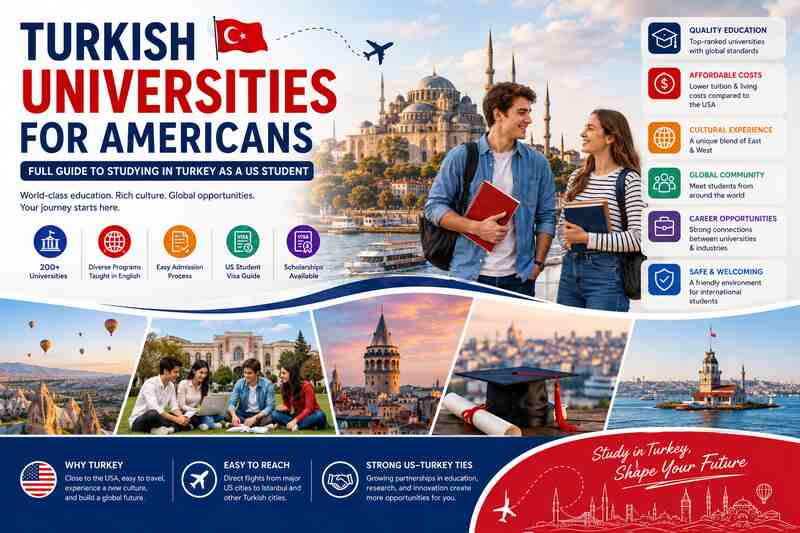
Turkish Universities for Americans 2026 - Full Guide to Studying in Turkey as a US Student — a quick summary from Turkey University to help students researching study options in Türkiye. Turkish universities for Americans: fees $2,900-$9,000/yr, student visa guide, WES recognition, top programs. Apply Free today with Imtiyaz Education
If you are an American student looking at Turkish universities, you are probably approaching this from a very different angle than most international applicants. You already know what higher education costs at home. You know what $45,000 or $60,000 a year looks like on a student loan statement. So when you see that a private English-medium university in Istanbul charges $3,000 to $9,000 a year for a bachelor's degree, the first reaction is usually suspicion, not excitement. Fair enough. The question is not "is it cheap?" The real question is: what are you actually getting for that price, and what happens to your degree when you are done?
This guide is written specifically for American students thinking seriously about Turkish universities whether for a full four-year degree, a gap year, a master's program, or a semester abroad. We cover the financial reality comparison, which universities make sense for which goals, how the US student visa process works (it's different for Americans than most nationalities), what happens to your Turkish degree if you want to return to the US for graduate school or employment, and the practical on-ground reality of living and studying in Istanbul as someone from the United States.
Why Americans Are Starting to Look at Turkish Universities
The US college debt crisis is not a new conversation. But the numbers keep getting harder to ignore. Average annual tuition at a US private four-year university now exceeds $40,000 before room and board. Total costs including living frequently push past $60,000 per year at many institutions. A four-year bachelor's at a mid-tier private US university can leave a student with $150,000-$200,000 in debt before they have earned a single paycheck.
Against that backdrop, Turkish private universities charging $3,000-$9,000 per year for English-medium programs look less like an outlier and more like a rational alternative worth examining. Over four years, even at the higher end of Turkish private university fees, you are looking at $12,000-$36,000 total tuition roughly what one semester costs at a US private university.
That cost difference is the starting point. But American students specifically need to ask three questions before it becomes a real comparison: Is the degree recognized back in the US if you want graduate school or professional employment? Is the academic quality real? And is the English environment strong enough for someone who has never studied abroad?
We will answer all three honestly. The short version: for the right student with the right goals, Turkish universities are a serious option. For students expecting a US-style campus experience, easy transfer credits, or access to federal financial aid there are important limitations worth knowing upfront.
What Turkish Universities Actually Cost for American Students
Turkey currently has over 200 universities 104 public and more than 90 private (foundation) institutions registered with YOK, Turkey's Council of Higher Education. For American students specifically, private universities with English-medium programs are usually the more relevant option, since public university English programs are limited and admission requires competitive TR-YOS exam scores.
Private university fees 2026-2027, English-medium programs:
Program Category | Annual Fee Range |
|---|---|
Business, computer science, communications | $2,450-$8,000 |
Engineering (all specializations) | $2,600-$8,500 |
Architecture, fine arts, psychology | $3,000-$7,000 |
Health sciences (nursing, physiotherapy, pharmacy) | $2,900-$9,000 |
Dentistry | $13,000-$67,000 |
Medicine | $12,500-$44,000 |
Living costs in Istanbul for a student budget run $450-$750 per month total, covering shared accommodation ($150-$350), food ($120-$250), transport ($20-$30 with student card), health insurance ($8-$15 per month for a basic private plan), phone, and personal expenses. Total annual cost including living at a mid-range Istanbul private university: approximately $8,000-$16,000.
Compare that to $60,000-$75,000 at a US mid-tier private university with room and board, or $25,000-$50,000 at an out-of-state public university. Over four years, that difference can exceed $150,000 before interest on US student loans.
One important thing to know upfront about financial aid: US federal student loans and Pell Grants are generally not available for enrollment at foreign institutions. Federal Title IV aid does not follow you to Turkish universities. Some private scholarships and 529 plan funds can be used for foreign study under specific conditions check with your individual fund administrator. If your current US college funding is primarily federal loans, this is a significant practical consideration. That said, Turkiye Burslari (the Turkish government scholarship) is open to Americans and covers full tuition, accommodation, monthly stipend, health insurance, and flights. It is competitive but worth applying for applications open every January through turkiyeburslari.gov.tr at zero cost.
American Transcripts and GPA - How Turkish Universities Read Your Documents
One thing American students consistently appreciate: the Turkish private university admission process is genuinely simpler than applying to US institutions. No SAT or ACT. No IELTS or TOEFL for most programs. No Common App, no personal essays, and no alumni interviews. Turkish private universities assess American applicants primarily on their academic record.
What you submit as an American applicant:
Official high school transcripts (for undergraduate admission) or college transcripts (for graduate admission)
Diploma or degree certificate
Valid passport copy
Apostilled and sworn-translated copies of all academic documents
The GPA conversion: Turkish universities work in percentage systems (out of 100). American GPA does not convert directly. As a rough guide: a 3.0/4.0 GPA converts to approximately 75-80% in Turkish terms. A 2.5/4.0 converts to roughly 65-70%. Most private universities require 60-70% minimum for general programs, and 70-80% for medicine and dentistry. Our team helps American applicants understand exactly how their specific grades position them for each program.
The apostille step: US documents need either an apostille stamp or notarized translation to be legally recognized in Turkey. Apostille stamps for American documents are obtained from your state's Secretary of State office (not the federal government). Turnaround times vary by state -- California takes 5-10 business days, some states take 2-3 weeks. Start this step early, ideally 4-6 weeks before your application deadline.
We handle sworn Turkish translation in-house through our court-accredited translation service in Istanbul. Documents we authenticate are accepted by Turkish university registration offices and government agencies without additional steps. Students who use unofficial translation services often have to redo documents when they arrive.
Related guides:
The right university depends on your field, budget, and what you want to do after graduation. Rather than a promotional list, here is how we match different American student profiles to specific options.
Budget-focused with English instruction priority
Istanbul Kent University offers English-medium programs from approximately $2,900/year among the lowest in Istanbul from an accredited institution. Strong for business, health sciences, and engineering. Kent is specifically recognized in Jordan, Iraq, Egypt, Algeria, Lebanon, Yemen, Palestine, and Syria, which matters if your career plans include the Middle East.
Istanbul Gelisim University (IGU) holds ABET accreditation for engineering programs and ranks 441st in QS Europe 2026. English-medium programs start around $3,500/year. The ABET accreditation is particularly relevant for American students in engineering US state licensing boards recognize ABET internationally, which is the strongest bridge between a Turkish engineering degree and US professional registration.
Istanbul Aydin University (IAU) holds both MUDEK and ABET accreditation for engineering, has a strong health sciences faculty, and runs English-medium programs from approximately $4,000/year. IAU has one of the largest international student bodies in Turkey, with strong administrative support including document processing assistance.
Prestige and US graduate school recognition
Koc University ranks 323rd globally in QS 2026 and holds Triple Crown business accreditation (AACSB, AMBA, EQUIS) -- placing it among fewer than 1% of business schools worldwide. Graduates from Koc regularly gain admission to graduate programs at MIT, Columbia, NYU, and other US institutions. Fees run $15,000-$25,000/year, still significantly below comparable US private university costs.
Bahcesehir University (BAU) ranks 5th among Turkish universities in Times Higher Education and maintains international campuses including in Washington DC and Berlin. The Washington DC campus relationship specifically gives BAU an unusual connection to the US academic ecosystem. English-medium, Erasmus+ partnerships throughout Europe. Fees approximately $5,172-$12,000/year depending on program.
Bilkent University ranks 415th in QS 2026, operates fully in English, and has strong engineering and business programs. It is selective and research-active. Fees $8,000-$16,000/year.
Health sciences with real clinical training
Istanbul Medipol University has the strongest clinical infrastructure among private Istanbul universities it operates its own 700-plus bed hospital where medicine, dentistry, nursing, and physiotherapy students rotate from Year 3 onward. For American students specifically interested in medicine or health sciences who want strong clinical exposure at significantly lower cost than US programs, Medipol is the relevant name. Fees range from $3,600 for nursing to $44,000 for medicine.
Public university track (for competitive applicants)
METU (Middle East Technical University) ranks 269th in QS 2026, teaches all programs in English, and places in the world's top 100 for employer reputation on QS indicators. Fees are approximately $1,500-$5,000/year. The catch: admission requires a strong TR-YOS exam score and competition is intense. For American students with strong math backgrounds, TR-YOS is a multiple-choice exam in reasoning and mathematics no prior Turkish knowledge needed.
Bogazici University ranks 371st in QS 2026, is fully English-medium, and is highly selective. One of the most respected institutions in Turkey and broadly recognized internationally.
Factor | Turkish Private University | US Private University (Mid-Tier) | US State University (Out-of-State) |
|---|---|---|---|
Annual tuition | $2,900-$9,000 | $35,000-$55,000 | $10,000-$30,000 |
Total 4-year tuition | $12,000-$36,000 | $140,000-$220,000 | $40,000-$120,000 |
Annual living costs | $5,400-$9,000 (Istanbul) | $15,000-$25,000 | $12,000-$20,000 |
Total 4-year all-in cost | $33,600-$72,000 | $200,000-$320,000 | $88,000-$200,000 |
US federal financial aid | Not eligible | Eligible | Eligible |
English instruction | Yes (English-track programs) | Yes | Yes |
Admission requirements | GPA + documents, no SAT | SAT/ACT + essays + GPA | SAT/ACT + GPA |
International exposure | Very high (350,000+ intl. students) | Varies | Varies |
Erasmus+ exchange access | Yes | No | No |
US degree recognition | Via WES credential evaluation | Direct | Direct |
Professional accreditation | ABET (engineering), AACSB (Koc business) | Varies | Varies |
QS world ranking | Some in top 500 (Koc 323rd, METU 269th) | Varies widely | Varies widely |
Post-study work in Turkey | Possible (work permit after Year 1) | N/A | N/A |
Most American students who have studied in Istanbul describe the same arc: disorienting for the first two weeks, exciting by week four, and genuinely hard to leave by the end of the first year. We have watched this pattern often enough to say it is reliable but there are specifics worth knowing before you land.
The physical reality of the city. Istanbul is not a college town. It is a megacity of 15 million people spanning two continents, connected by suspension bridges, ferries, a metro system, and one of the world's busiest airports. The neighborhoods near major private universities Beylikduzu and Esenyurt on the European side for Aydin and Gelisim, Bagcilar and Eyup for Kent and several others, Kagithane for Medipol's main campus, Besiktas for Bogazici are not generic urban sprawl. They are distinct urban environments with their own characters, restaurants, and student cultures.
Language in daily life. On campus in English-medium programs, you will not need Turkish for academic work. Off campus is different. Grocery stores, local restaurants, transit systems, and government offices operate in Turkish. Most American students pick up survival Turkish within 2-3 months without formal study but taking a formal Turkish language course (TOMER courses are offered at many Turkish universities) from the start is consistently something students wish they had done earlier. It makes every part of daily life easier and opens more of the city to you.
The international community. Turkey hosts approximately 350,000 international students, and Istanbul has the highest concentration. Students from Nigeria, Pakistan, Egypt, Sudan, Germany, Indonesia, and dozens of other countries are all in the same university system. For American students used to diverse campuses, the international environment will feel familiar and for students looking to build genuinely global professional networks during their degree years, Istanbul is unusually rich in that respect.
Career and internship access. Istanbul is Turkey's economic capital and the regional headquarters for a large number of multinational companies tech, finance, logistics, media, energy. Students in business, engineering, and computer science who actively pursue internships during their degree have access to a job market that universities in smaller cities simply cannot offer. The Istanbul startup ecosystem specifically attracts US-trained founders and investors, which creates a small but growing community of American professionals in the city who are often open to connecting with American students.
Safety. Istanbul is a city of 15 million people, and standard urban safety awareness applies the same judgment you would use in New York, Chicago, or Los Angeles. The major university neighborhoods are established residential and student areas. The US State Department maintains a current travel advisory for Turkey at travel.state.gov we recommend American students and families read it directly, as it is updated regularly and provides the most current official US government assessment. The advisory primarily references areas near Turkey's southeastern borders, not Istanbul or Ankara.
This is the central question for American students, and it deserves a direct, layered answer not a vague "yes, generally recognized."
For US graduate school admission: Most American universities accept foreign degree evaluations from NACES-member credential evaluation services. The two most widely recognized are WES (World Education Services, wes.org) and ECE (Educational Credential Evaluators, ece.org). A WES Course-by-Course evaluation costs approximately $186 and converts your Turkish bachelor's degree into US equivalency terms -- confirming it equals a US bachelor's degree and providing GPA conversion on a 4.0 scale. The process takes 4-7 weeks from when WES receives documents from your Turkish university. Most US graduate programs accept WES evaluations. Turkish graduates from Koc University, METU, and Bogazici specifically have established reputations among US graduate admissions committees, and their graduates regularly gain admission to programs at MIT, Columbia, and other top institutions.
For US professional licensing: This is profession-specific and matters a lot to answer correctly.
Engineering graduates from ABET-accredited Turkish programs (Istanbul Gelisim University and Istanbul Aydin University both hold ABET accreditation) are in the strongest position. US state engineering licensing boards recognize ABET internationally, so the pathway to Professional Engineer (PE) licensure in the US follows the same process as for ABET graduates from any country.
Medicine: Turkish medical school graduates from WDOMS-listed universities can sit the USMLE (United States Medical Licensing Examination), but passing the boards and completing a US residency match are required. It is a real, navigable pathway but a long one -- plan for it from Day 1 if this is your goal.
Nursing: Turkish BSN graduates can apply for the NCLEX-RN through a US state Board of Nursing using the CGFNS credential evaluation pathway. The US nursing pathway from a Turkish degree is well-established.
Law: Turkish legal education does not qualify you for US bar admission. If US legal practice is your goal, Turkey is not the right choice for an undergraduate law degree.
Business and other non-licensed fields: US employers in most industries accept foreign degrees evaluated by WES or ECE. A degree from a Triple-Crown-accredited business school like Koc is competitive with US employer expectations in finance, consulting, and management.
For US employment generally: Having a degree from a well-ranked Turkish university particularly one with ABET or AACSB accreditation combined with fluent English and genuine international experience is a competitive package in many US industries. The international experience specifically is increasingly valued by employers who need staff familiar with Middle Eastern, European, or South Asian markets.
This question matters most for American students considering a semester or year in Turkey rather than a full degree.
Turkey follows the Bologna Process and uses ECTS (European Credit Transfer and Accumulation System). Most Turkish university credits are expressed in ECTS units, and most Turkish universities issue official English-language transcripts. Whether those ECTS credits count toward your US degree depends entirely on your US home institution there is no universal policy.
Three steps to protect yourself if you are planning a semester in Turkey:
First, confirm in writing with your US institution's registrar which specific Turkish courses will count toward your degree, at what credit value, before you enroll in Turkey. Do not assume. Get it in writing before you leave.
Second, choose a Turkish university with a formal exchange agreement with your US school, or one that participates in Erasmus+ with transatlantic partnerships. BAU (with its Washington DC campus connection) and several Istanbul private universities have bilateral agreements that make credit transfer more predictable.
Third, request official ECTS transcripts from your Turkish university. Keep every syllabus and course outline from Turkey US registrars frequently ask for them when evaluating foreign courses for transfer.
For students doing a full four-year degree in Turkey with no intention of returning to a US institution for further study, credit transfer is irrelevant.
Applying to a Turkish private university as an American student is genuinely simpler than the US college application process. Here is the full sequence:
Step 1 - Choose your program first, then the university. Start from what you want to study, not from university names. Identify which Turkish universities have strong English-medium programs in your field, then compare fees and accreditations.
Step 2 - Get your documents apostilled. Contact your state's Secretary of State office for apostille stamps on your high school diploma and official transcripts. Turnaround varies by state start this step 4-6 weeks before your application deadline.
Step 3 - Submit your application. Turkish private universities accept applications year-round for September enrollment, with soft deadlines typically in March-May. Through our agency, applications reach partner universities directly and admission letters arrive within 24 hours of a complete document file.
Step 4 - Apply for your student visa at the Turkish Consulate. Use your acceptance letter as the anchor document. Bring your apostilled transcripts and diploma, financial proof, health insurance, passport photos, and completed visa application form. Apply at least 6 weeks before your travel date. Current visa fees for US citizens are approximately $54-$65 -- confirm at the official Turkish Ministry of Foreign Affairs website.
Step 5 - Arrange health insurance valid in Turkey. Basic approved private plans covering you for the Turkish residence permit application cost $90-$180 per year. This can often be arranged before travel through international student insurance providers.
Step 6 - Arrive and complete university registration. Bring original documents plus sworn Turkish translations. Our team accompanies students to university registration in person, handles course selection on the same day, and ensures document files are complete for the residence permit application.
Step 7 - Apply for your residence permit within 30 days. Submit through e-ikamet.goc.gov.tr with your enrollment letter, rental contract, health insurance, tax number, and bank statement. The residence permit is valid one year and renewable.
When you land at Istanbul Airport, our team is there. We pick up arriving students with VIP transfer service and spend the first week making sure the practical pieces mobile SIM, bank account, tax number, campus registration, accommodation setup are handled before academic life starts. Zero fees on our side for any of this.
Q: Can Americans attend Turkish universities? A: Yes. Turkish universities welcome students from all countries, and private universities admit American applicants based on high school or university transcripts without requiring SAT scores, standardized entrance exams, or personal essays. English-medium programs are widely available across Istanbul and Ankara, making Turkey a realistic option for American students seeking an internationally recognized degree at significantly lower cost than US institutions.
Q: Do American students need a student visa for Turkey? A: Yes. US citizens can enter Turkey visa-free for up to 90 days for tourism, but study is a different visa category. American students enrolling in Turkish universities must apply for a student visa at a Turkish consulate in the US before traveling not after arriving. The main Turkish Embassy is in Washington DC, with consulates in New York, Los Angeles, Chicago, and Houston. After arriving with your student visa, you then apply for a student residence permit within 30 days.
Q: Are Turkish degrees recognized in the United States? A: Turkish degrees from YOK-registered universities can be evaluated for US equivalency through NACES-member credential evaluation services, primarily WES (World Education Services) or ECE (Educational Credential Evaluators). A WES Course-by-Course evaluation typically confirms Turkish bachelor's degrees equal US bachelor's degrees and provides GPA conversion on a 4.0 scale. Most US graduate programs and employers accept these evaluations. For licensed professions, specific US boards apply: ABET-accredited engineering programs are in the strongest position, while medicine requires USMLE and nursing requires NCLEX-RN regardless of where you graduated.
Q: Can I use US federal financial aid at a Turkish university? A: Generally no. Federal student loans and Pell Grants require enrollment at US Department of Education-eligible institutions. Most Turkish universities do not qualify for Title IV federal aid. Some private scholarships, employer tuition benefits, and 529 plan funds may be usable for foreign institutions under specific conditions verify with your fund administrator. The Turkiye Burslari government scholarship is open to Americans and covers full tuition, accommodation, and a monthly stipend.
Q: Do I need to know Turkish to study at a Turkish private university? A: Not for English-medium academic programs in the classroom. Most private Istanbul universities deliver bachelor's programs fully in English. Off campus, Turkish is the working language of daily life, and for health sciences programs, clinical rotations involve Turkish-speaking patients from Year 3. Turkish language courses are offered at most universities through TOMER language centers taking them from the start makes a genuine difference in daily life and is something most students wish they had prioritized earlier.
Q: How does the cost of a Turkish university compare to a US university for Americans? A: The gap is substantial. English-medium Turkish private universities charge $2,900-$9,000 per year in tuition. Living costs in Istanbul add $5,400-$9,000 annually. Total all-in annual cost: $8,000-$16,000. Compare that to $60,000-$75,000 at a typical US private university with room and board, or $25,000-$50,000 at an out-of-state public university. Over a four-year degree, the total savings for an American student can exceed $150,000 before interest on US student loans.
Q: Which Turkish universities are best for American students? A: It depends on your field. For engineering accreditation recognized in the US: Istanbul Gelisim University and Istanbul Aydin University (both ABET-accredited). For business with US employer recognition: Koc University (Triple Crown accredited, graduates admitted to MIT and Columbia). For affordable English-medium general programs: Kent University and Gelisim. For health sciences with real clinical training: Medipol. For maximum prestige at lower cost than US alternatives: Koc, METU, Bilkent, Bogazici. We recommend matching by program first, then by what post-graduation recognition you specifically need.
Q: Can I transfer credits from a Turkish university back to my US institution? A: Possibly, but it is institution-specific. Turkey uses the ECTS credit system (European standard). Whether your US home institution accepts ECTS credits depends on their own policies and any existing exchange agreements. Confirm credit transfer terms in writing with your US institution before enrolling in Turkey do not assume. Universities with Erasmus+ partnerships or bilateral US agreements (like BAU with its Washington DC campus) have smoother transfer pathways.
Q: How does the apostille process work for American documents? A: Apostille stamps authenticate US documents for use in countries that are signatories to the Hague Convention (Turkey is one). For most US documents, you contact your state's Secretary of State office, submit the original document, and pay a small fee. Turnaround is typically 5-15 business days depending on your state. You will need apostilles on your high school diploma and official transcripts. We then arrange sworn Turkish translation of apostilled documents through our Istanbul translation service.
Q: What is the social experience like for Americans studying in Istanbul? A: Most American students describe Istanbul as demanding at first and genuinely rewarding after settling in. The city's history, food culture, and urban energy are unlike anything in the US. On campus at major private universities, English is everywhere. Off campus, Turkish is the working language. The international student community is large and active Turkey hosts 350,000 international students and Istanbul has the highest concentration of them, including organized communities from dozens of countries. Americans typically find social connections quickly within the first month.
Q: Can American students apply for the Turkiye Burslari scholarship? A: Yes. Turkiye Burslari is open to students from virtually all countries including the United States. The scholarship covers full tuition at the assigned university, free government dormitory accommodation, a monthly stipend, health insurance, and a round-trip flight. Applications open each January at turkiyeburslari.gov.tr. Competition is strong particularly for popular programs, but applying costs nothing and the potential benefit is significant for qualified students.
Q: How do American GPA scores convert for Turkish university admission? A: Turkish universities work in percentage systems (out of 100). A 3.0/4.0 GPA converts to approximately 75-80% in Turkish terms. A 2.5/4.0 converts to roughly 65-70%. Most Turkish private universities require 60-70% minimum for general programs, and 70-80% for medicine and dentistry. Documents need apostille stamps and sworn Turkish translation. Our team helps American applicants understand how their specific grades position them for each program without guessing.
Q: Is Istanbul safe for American students? A: Istanbul is a city of 15 million people, and standard urban awareness applies the same judgment you would use in New York, Chicago, or Los Angeles. The major university areas are established residential and student neighborhoods with active communities. The US State Department maintains a current travel advisory for Turkey at travel.state.gov -- read it directly before making decisions, as it is updated regularly. The advisory primarily references Turkey's southeastern border regions, not Istanbul or Ankara.
Q: What is the residence permit process for American students? A: American students must apply for a student residence permit (ikametgah) within 30 days of arriving in Turkey. The application goes through e-ikamet.goc.gov.tr and requires your passport, university enrollment letter, rental contract or dormitory confirmation, health insurance, Turkish tax number (obtained quickly at any tax office), and a bank statement. Processing takes 2-6 weeks. The permit is valid one year and renewable annually while you remain enrolled.
Q: Can American students work in Turkey while studying? A: After completing their first year of study, international students can apply for a work permit allowing part-time work up to 24 hours per week. The work permit is a separate application from the residence permit. In practice, students in intensive programs (medicine, engineering) find it difficult to work alongside studies. Business, social science, and computer science students more commonly manage internship placements particularly in Istanbul, where access to the job market is broader than in any other Turkish city.
We have been placing students in Turkish universities for over 21 years, processed more than 100,000 applications, and enrolled more than 10,000 students from over 40 countries including American students who came specifically looking for a recognized English-medium degree and genuine international experience at a fraction of US tuition costs.
Our Istanbul team handles the process on the ground, not remotely. We manage sworn translation and apostille document authentication through our court-accredited Istanbul translation service documents we certify are accepted by Turkish universities and government offices without additional steps. We know the documentation requirements at each Turkish consulate location in the US for student visa applications. We have done this specifically for American applicants before.
When you land at Istanbul Airport, our VIP transfer team is there to pick you up. We walk you through university registration and course selection in person on Day 1. Your residence permit appointment, tax number registration, and accommodation setup we handle all of it in the first week.
Zero application fees on our side. Admission letter within 24 hours of a complete document file for our partner universities.
Apply at turkeyuniversity.org. Share your transcripts, budget, and program goals, and our team will send you a personalized university comparison within 24 hours.