Studying Medicine at Bahçeşehir University: The Complete Guide for International Students

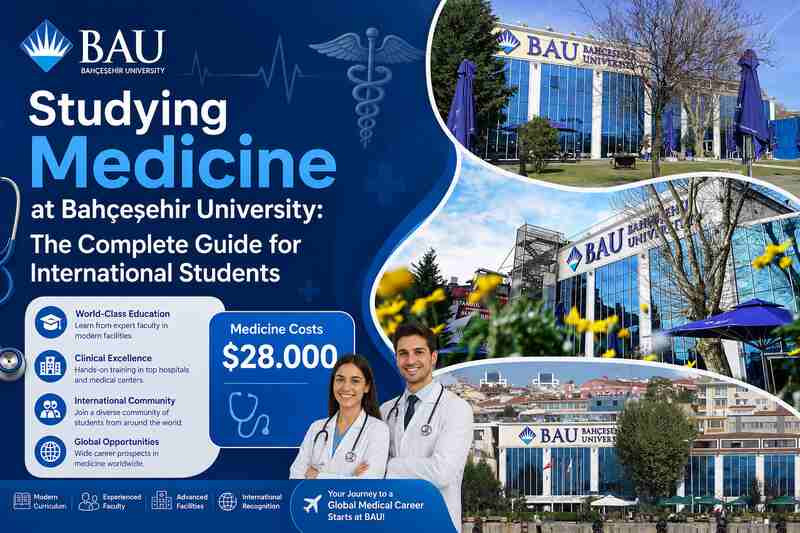
Studying medicine at Bahçeşehir University means enrolling in a 6-year, English-medium Tıp Doktoru (MD) program at BAU's dedicated health campus in Göztepe, Istanbul. The program is fully accredited by YÖK (Turkey's Higher Education Council), structured across 12 semesters, and delivers clinical training inside an integrated hospital-research complex. Annual tuition for international students is $28,000, and the degree qualifies at EQF Level 7 recognized across European qualification frameworks and eligible for equivalency processes in most countries worldwide.
Every year we receive applications from students across Nigeria, Egypt, Pakistan, Libya, and Yemen who have one specific question: can I study medicine in Istanbul at a real English-medium program, with proper lab infrastructure and a degree that travels? For BAU, the honest answer is yes. This guide covers the full picture curriculum, labs, fees, degree recognition, and what the application process actually looks like.
We've been placing students in Turkish medical programs since 2005. So what's below isn't a brochure. It's the kind of detail we give students in our office.
What Is Bahçeşehir University and Why Does It Matter for Medicine?
Bahçeşehir University (BAU) is a private foundation university established in Istanbul in 1998. It's registered with YÖK - Turkey's Higher Education Council at yok.gov.tr and has built one of the more research-active medical faculties among Istanbul's private universities. The medical faculty sits within the BAU Sağlık (Health) Göztepe Campus, a purpose-built complex that combines an education building, a hospital, and a research building in a single integrated environment.
That last point matters more than it might look. A lot of private medical schools in Turkey separate where students learn theory from where they do clinical work. At BAU's Göztepe campus, students move between lecture rooms, labs, and the hospital in the same complex. The integration of theory and hospital-based training isn't just a marketing line it's baked into how the campus was designed when the research building opened in June 2014, following the education and hospital complex which opened in June 2013.
The medical faculty is led by Prof. Dr. Adnan Kaya as Dean, with a faculty structure that covers Basic Medical Sciences, Internal Medical Sciences, and Surgical Medical Sciences. Department heads include senior professors in Neurology, Cardiology, General Surgery, Pathology, Psychiatry, Radiology, Ophthalmology, Gynecology, and Forensic Medicine, among others.
Accreditation and YÖK Standing
Bahçeşehir University's Faculty of Medicine holds accreditation that gives its graduates the Tıp Doktoru (Doctor of Medicine) degree a Level 7 qualification on the Turkish Qualifications Framework (TYYÇ), equivalent to a Second Cycle degree under the QF-EHEA (European Qualifications Framework for the European Higher Education Area), and EQF-LLL Level 7. This is the standard framework used across European higher education systems to assess degree equivalency, which matters for students who want their Turkish MD recognized abroad after graduation.
Research Laboratories: What Sets BAU Medicine Apart
This is the section that most competing guides completely skip. And it's actually where BAU Medicine earns its credibility most clearly.
The medical faculty operates out of the BAU Sağlık Göztepe research building, which houses a series of specialized laboratories with international partnerships that are genuinely unusual for a private Turkish university of this size.
The Stanford-BAU Biomechanics Research Laboratory
Established in 2013 as a direct partnership between BAU's Faculty of Medicine and the Robotics Department at Stanford University, this lab was the first center in Turkey capable of real-time 3D motion analysis. Beyond 3D imaging at ultra-high speed, the lab can simultaneously examine joint ranges, movement symmetry, neuromuscular junction function, and electrophysiological measurements. Research focuses on movement analysis in healthy individuals and athletes, diagnosis of movement disorders, biomechanical testing of spinal prosthetics, motor analysis per muscle group, and joint range studies. Turkish and American faculty, doctoral students, physiotherapists, and researchers all work here together.
Advanced Medical Technologies Laboratory
Founded in 2014, this lab works at the intersection of engineering and medicine what the faculty calls Translational Medicine, converting basic science into clinical applications. The international network is extensive: contributors include researchers and labs from Boston University, MIT, the Italian National Research Council, and EPFL Switzerland. The lab focuses on two core research streams: Molecular Diagnostics (developing diagnostic kits for viral diseases, food allergies, and biomarker-traceable conditions) and Cell Characterization (identifying and characterizing rare cells in body fluids relevant to immune disorders, with applications in pharmaceutical development). Techniques include microfabrication, microarray methods, microfluidic systems, and advanced optical systems.
Stem Cell and Regenerative Medicine Research Laboratory
This lab produces biological products for both research and treatment under regulatory authorization. Work includes preparation of stem cells from autologous adipose tissue and bone marrow, culture of mesenchymal stem cells, fibroblast and corneal cell cultures, chondrocyte culture, and dendritic cell preparation. Applications already in clinical use include treatment of diabetic foot wounds, burn and scar management, ischemic limb problems, colorectal fistula treatment, and cartilage repair. Students receive both theoretical and practical exposure to GMP (Good Manufacturing Practice) techniques skills that most undergraduate medical programs don't offer at this level.
Additional Research Laboratories
The full laboratory portfolio at BAU Medicine includes: Prof. Rhoton Microsurgery Anatomy Laboratory, Genetic Diagnosis Research Laboratory, Angiogenesis Research Laboratory, Pathology Laboratory, Pituitary Tumors Research Laboratory, Neurophysiology and Behavioral Research Laboratory, Basic Medical Sciences Research Laboratories, and a Multidisciplinary Student Laboratory. The Video Atlas system allows students to access archived surgical and anatomical recordings.
So when a student chooses studying medicine at Bahçeşehir University, they're not just entering an exam-and-lecture program. They're entering a research campus with active international partnerships at Stanford, MIT, Boston University, and EPFL.
What the Research Says About English-Medium Medical Education in Turkey
Choosing to study in a foreign country especially for a six-year medical program raises real questions about educational quality and student experience. The academic evidence here is worth knowing.
A 2024 qualitative study published in Nurse Education in Practice by Ünsal et al., examining international health professional students studying in Turkey, identified that while language barriers and cultural adjustment are real challenges in the early months, students reported meaningful gains in intercultural competence, language skills, and personal independence. The study recommends structured orientation programs and mentoring both of which are things we provide through our agency's on-ground support services from day one.
On the curriculum side, BAU's use of integrated, problem-based modules in the first years connects to a strong evidence base. A 2023 meta-analysis of 22 randomized controlled trials by Song Ren et al., published in Worldviews on Evidence-Based Nursing, found that problem-based learning approaches in medical education produced significantly better knowledge acquisition and practical performance outcomes compared to traditional lecture-based teaching, with higher student satisfaction rates. BAU's Year 1 and Year 2 integrated block structure aligns with this approach.
Studying medicine at Bahçeşehir University means completing a 6-year, 12-semester undergraduate medical program, the Tıp Lisans fully delivered in English. The official AKTS credit catalogue confirms the program code is 09012101, and the curriculum is structured into three main phases:
Phase 1; Years 1 and 2: Normal Structure and Function of the Human Body
The first two years build the biomedical science foundation. Students work through integrated block modules rather than isolated subjects. Year 1 covers:
Semester 1: Molecular Basis of the Cell (MED1001), Cell, Tissue and Organ Systems (MED1003), Musculoskeletal System (MED1005), Cardiovascular and Respiratory System (MED1007), plus Communication Skills and Academic Reporting I (ENG1003) and Philosophy and Ethics in Medicine I (MED1011).
Semester 2: Gastrointestinal System and Metabolism (MED1002), Urogenital System (MED1004), Nervous System (MED1006), Sense Organs and Endocrine System (MED1008), plus Communication Skills II and Philosophy and Ethics in Medicine II.
Each semester totals 22 credit hours within the integrated block module, carrying 30 AKTS credits. The language throughout is English. This is worth underscoring because some Turkish private universities claim "English-medium" but deliver most classes in Turkish at BAU Medicine, the AKTS catalogue confirms English is the medium of instruction for all core medical modules.
Year 2 shifts to pathologies of human body systems, covering Tissue Damage and Host Response, Infection Agents and Immunological Disorders, Musculoskeletal Disorders, Circulatory and Respiratory Disorders (Semester 3), then Hematology and Oncology, GI System Disorders, Neurological and Psychiatric Disorders, and Endocrinology and Urogenital Disorders (Semester 4). Medical Genetics I and II run across both semesters.
Phase 2; Year 3: Elective Deepening and Clinical Integration Preparation
The third year is where BAU's curriculum design becomes genuinely distinctive. Alongside the core integration blocks, students select departmental electives from an extensive menu. These include: Cancer Molecular Biology, Bioinformatics, Machine Learning in Drug Design, AI Design in Medicine, Translational Medicine, Medical Epigenetics, Histopathology Techniques, Advanced Cadaveric Dissection, Microsurgery Instruments, Biomedical Imaging Principles, and even Python Programming in Medicine. This isn't a standard medical curriculum. BAU has built in technology and research literacy from Year 3 onward which reflects the faculty's research identity in translational medicine and biomedical engineering.
Phase 3; Years 4, 5, and 6: Clinical Tıp Entegrasyonu (Clinical Medicine Integration)
Year 5 starts the full clinical phase with TMED3000 (Clinical Medicine Integration), integrating basic sciences with clinical medicine through internal medicine, clinical integration blocks I–III, and a dedicated Research Methodology and Biostatistics course. The final two years are hospital-based rotations across all major specialties. Students train in the BAU hospital complex at Göztepe campus directly.
Graduation Requirements
Per the AKTS programme information, graduates of the Tıp Lisans at BAU receive a Tıp Doktoru degree. The program requires completion of all compulsory modules plus the required credit load across all 12 semesters. There is no separate thesis requirement at undergraduate level the degree is conferred on successful completion of the full clinical training program.
The published annual tuition for BAU Faculty of Medicine for international students is $28,000 per year. This is among the higher end for private medical schools in Turkey but it reflects what the program actually delivers: a fully English-medium curriculum, hospital-integrated training, and active research lab infrastructure with international partnerships.
Here's how it stacks up across the full 6-year program:
Total tuition across 6 years: approximately $168,000 at the standard rate, paid annually at $28,000 per year. Per semester, that works out to roughly $14,000.
For context, comparable English-medium private medical programs in Turkey price as follows for 2026:
Istanbul Medipol University (English): $44,000/year
Istanbul Altinbas University (English): $20,000/year
Istanbul Biruni University (English): $21,000/year
Istanbul Okan University (English): $20,500/year
Bahçeşehir University (English): $28,000/year
So BAU sits above the budget end of the Turkish market but well below the premium tier. The key differentiator is the English-medium delivery combined with verified research lab infrastructure which at $20,000–$21,000/year competitors is often weaker or less consistent.
Scholarships and Discounts
BAU does offer institutional scholarships to international students, though the medicine faculty scholarship amounts are not published as a fixed percentage the way undergraduate scholarships at other BAU programs are. Scholarship eligibility is assessed case by case, typically based on academic record and country of origin. Students who apply through a licensed agency partner which we are may have access to scholarship confirmation at the point of offer.
Payment Structure
BAU accepts tuition payments per semester. The registration deposit to secure your place after acceptance is $1,000, which is deducted from the first semester fee. Payment is made directly to the university bank account never through a third-party intermediary. This is worth knowing because some unofficial agents collect fees themselves, which is not permitted. We always direct students to pay the university directly.
Living Costs in Istanbul for Medical Students
Beyond tuition, plan for roughly $700–$1,000 per month in living costs covering a shared student apartment near campus ($300–$500/month in the Göztepe or Kadıköy area), food ($150–$250/month), transport ($35–$45/month with a student pass), and health insurance. Over 12 months, that's an additional $8,400–$12,000 per year. Total annual cost of studying medicine at BAU, all in, is therefore approximately $36,000–$40,000 per year still far below the $70,000–$100,000 annual cost of medical school in the UK, US, or Australia.
Read more at: Bahcesehir university Fees for International Students
This is the question we get asked most often after fees, and it deserves a direct answer not a vague "it depends."
YÖK Registration and WDOMS Listing
Bahçeşehir University is registered with YÖK, Turkey's national higher education authority. All YÖK-accredited medical degrees are listed in the World Directory of Medical Schools (WDOMS) at wdoms.org the reference database used by licensing authorities worldwide to verify whether a medical school meets minimum standards. BAU's Faculty of Medicine is on this list. You can verify this directly at wdoms.org before you apply.
WDOMS listing is the baseline requirement for graduates to sit licensing exams in most countries, including the USMLE (United States), PLAB (United Kingdom), AMC (Australia), HPCSA (South Africa), and national medical council exams across the Middle East and Africa. Without WDOMS listing, a medical degree cannot be used to apply for these pathways. BAU clears this bar.
The Denklik (Equivalency) Process in Turkey
After graduating, foreign-national graduates who want to practice medicine in Turkey go through the denklik process administered by YÖK. For graduates who want to return to their home country, the relevant process is their home country's own equivalency or licensing examination.
Country-by-Country Recognition- Practical Reality
Here's what we tell students based on 21 years of experience placing medical graduates:
Nigeria: The Medical and Dental Council of Nigeria (MDCN) evaluates foreign medical degrees on a case-by-case basis. Graduates of YÖK-accredited Turkish medical schools have obtained MDCN recognition, but the process involves documentation, verification, and in some cases a qualifying examination. It is not automatic but it is achievable.
Egypt: The Egyptian Medical Syndicate requires a full credential evaluation. Turkish university degrees from YÖK-registered institutions are generally eligible for this process. Egyptian students studying at Turkish medical schools have returned and practiced, but confirmation before enrollment is advisable.
Pakistan: The Pakistan Medical Commission (PMC) maintains a list of recognized foreign medical institutions. Turkish YÖK-accredited universities with WDOMS listing are typically eligible. Graduates must pass the PMDC/PMC qualifying exam to practice in Pakistan. Check the current PMC approved institutions list directly.
Libya, Yemen, Sudan, Iraq: These countries generally recognize Turkish medical degrees from YÖK-accredited institutions. The process involves degree authentication through the Ministry of Education and registration with the national medical syndicate. Practical experience shows this is manageable, though timelines vary.
GCC countries (Saudi Arabia, UAE, Kuwait, Qatar): Recognition pathways exist through the Saudi Commission for Health Specialties (SCFHS) and equivalent bodies. YÖK-accredited Turkish degrees are eligible for evaluation. In practice, many BAU graduates have entered postgraduate training and practice in GCC countries.
Europe: Within the European Higher Education Area, BAU's Tıp Doktoru at EQF Level 7 / QF-EHEA Second Cycle meets the qualification framework requirements. Country-level recognition still involves national medical authority processes (e.g. GMC in the UK, BÄK in Germany), and graduates typically need to pass national licensing examinations.
Our Honest Advice
The degree from BAU Medicine is real, accredited, and WDOMS-listed. But no Turkish medical degre or any foreign medical degree gives you automatic practicing rights abroad without going through your home country's licensing process. Anyone who tells you otherwise isn't being straight with you. What BAU gives you is a degree that is eligible for those processes, which is the correct starting point. We walk students through the recognition pathway specific to their country as part of our full placement service.
University | Annual Tuition (Int'l) | Language | Duration | Hospital Integration | Key Strength |
|---|---|---|---|---|---|
Bahçeşehir University (BAU) | $28,000/yr | English | 6 years | BAU Göztepe (on-site) | Stanford, MIT, EPFL lab partnerships |
Istanbul Medipol University | $44,000/yr | English/Turkish | 6 years | Medipol Mega Hospital | Largest private hospital network |
Istanbul Altinbas University | $20,000/yr | English | 6 years | Altinbas Hospital | Budget English-medium option |
Istanbul Biruni University | $21,000/yr | English | 6 years | Biruni Hospital | Affordable, growing research profile |
Istanbul Okan University | $20,500/yr | Mostly Turkish | 6 years | Okan Hospital | Lower cost, limited English delivery |
Acıbadem Mehmet Ali Aydınlar | $35,000+/yr | Turkish | 6 years | Acıbadem chain | Premium clinical exposure, Turkish only |
BAU sits in a distinct position in this market: it's not the cheapest English-medium option, but it's the only one at this price range with verifiable international research lab partnerships at Stanford, MIT, Boston University, and EPFL. Medipol costs significantly more and its program language is more mixed in practice. Altinbas and Biruni are cheaper, but their research infrastructure is considerably thinner. For students where English delivery and lab credibility matter not just the lowest number BAU is the strongest case in Istanbul's private medical sector.
For a detailed breakdown of BAU's tuition fees for international students, including scholarship options, see our dedicated fee guide. And for a broader look at how BAU ranks among Turkish private universities, our ranking analysis covers QS-cited indicators, research output, and YÖK compliance.
The admission pathway for international students to BAU's Faculty of Medicine is straightforward but requires specific documentation. Based on current YÖK requirements and BAU's official programme information:
Academic Requirements
Applicants must hold a high school diploma with strong scores in science subjects particularly Biology, Chemistry, and Physics or Mathematics. Turkey does not require MCAT for international applicants. A minimum GPA equivalent, typically around 70-75% in secondary education, is generally expected. Students with outstanding scores may receive merit consideration.
Language Requirements
Since BAU Medicine is English-medium, students need proof of English proficiency. Acceptable documents include TOEFL iBT (minimum typically around 72–80), IELTS Academic (typically 6.0–6.5), or equivalent certifications. Students who don't yet meet the language requirement can enter BAU's English Preparatory Year program before starting the medical curriculum.
Required Documents for Application
Certified copy of high school diploma and full transcript
Passport copy (and a certified Turkish translation)
English proficiency certificate
Passport-size photographs
Health insurance documentation
All documents in languages other than English or Turkish require sworn (certified) translation. This is where we come in our Istanbul office holds court-accredited sworn translation authority, which means translations we produce are accepted by Turkish authorities and universities without additional verification steps.
Application Timeline
BAU accepts applications only for fall intake. For the 2026–2027 academic year, Fall semester applications typically open in spring and close by late summer. Getting documentation in order early makes a significant difference.
A few things students ask us directly: why use an agency, and why us specifically?
Here's what actually happens when you apply for medicine in Turkey without an agent. You gather documents, you translate them yourself or find a local translation office, you submit to the university's international office, you wait for a decision, and then you arrive in Istanbul with an acceptance letter and no idea where to go next. You find accommodation on your own. You miss residence permit filing deadlines because nobody told you about them. You show up to registration with the wrong version of a notarized document and get sent away.
We've been doing this since 2005. We have direct partnerships with Bahçeşehir University and 75+ other YÖK-registered institutions. When you apply through us, there are no application fees. When your acceptance letter comes and for straightforward applicants, it can come within 24 hours of submission we walk you through every subsequent step.
Our services don't stop at the admission letter. When you land at Istanbul Airport, a member of our team is there for your VIP transfer. Our Istanbul office handles your sworn document translations, your final university registration, your ikametgah (residence permit) application, and your course selection support. We're available 24/7 in the weeks around arrival. Students from Nigeria, Yemen, Libya, Egypt, and Sudan many of whom arrive not speaking Turkish and not knowing anyone in the city consistently tell us that the first week experience made all the difference.
The sworn translation service alone, when done externally, can take days and cost money. We handle it in-house, with court-accredited translators, on the same day in most cases.
Twenty-one years of operating in Istanbul, 10,000+ students enrolled, over 100,000 applications processed. That's what we bring to every new student who comes through our door.
Read more at: Best University Admission Offices in Turkey for International Students
Q: Is studying medicine at Bahçeşehir University fully in English? A: Yes. The BAU Faculty of Medicine curriculum is delivered in English across all core modules throughout the six years, as confirmed by the official AKTS programme catalogue. Students who need to strengthen their English proficiency before starting can complete BAU's preparatory year program.
Q: Is a Tıp Doktoru degree from BAU recognized internationally? A: BAU's medical degree is YÖK-accredited, WDOMS-listed, and classified at EQF Level 7 / QF-EHEA Second Cycle the standard used across European qualification frameworks. For international students, recognition depends on your home country's medical licensing body. Countries including Nigeria (MDCN), Egypt (Egyptian Medical Syndicate), Pakistan (PMC), GCC countries (SCFHS and equivalents), and most African nations have established processes for evaluating YÖK-accredited Turkish degrees. In most cases, graduates need to pass a national qualifying exam in addition to credential verification. The degree is eligible for these processes but no Turkish MD, or any foreign MD, gives automatic practice rights without your home country's licensing step. See the full recognition section in this article for country-by-country detail.
Q: What are the tuition fees for BAU Medicine for international students? A: BAU medicine tuition for international students is $28,000 per year for the English-medium program, as published on the official BAU fee schedule. Over the full 6-year program, total tuition comes to approximately $168,000 before any scholarship reduction. Some institutional scholarships are available the amount varies by applicant profile and intake cycle. There are no additional hidden program fees, but students should budget separately for health insurance, accommodation, and living costs in Istanbul. See our full Bahçeşehir University tuition guide for a complete breakdown.
Q: Can I apply to BAU medicine without a YÖS exam? A: International students applying directly from high school typically do not need YÖS for BAU's direct admission process. Students already in Turkish universities transferring between programs may need to follow different requirements. Our advisors confirm the exact pathway based on your specific background.
Q: How long does it take to get an admission letter after applying? A: For students with complete documentation submitted through our agency, admission decisions from Bahçeşehir University can come within 24 hours. Incomplete documentation always causes delays which is why having a licensed agency review your file before submission matters.
Q: What happens after I receive the acceptance letter? A: After acceptance, you'll need to pay a registration deposit to secure your place, obtain a student visa from the Turkish consulate in your country, arrive and complete final in-person registration at the university, and file your ikametgah (residence permit) within the required window. Our team handles the translation, registration, and residence permit stages with you directly.
Q: Is BAU medicine listed in WDOMS and recognized for licensing exams abroad? A: Yes. Bahçeşehir University's Faculty of Medicine is listed in the World Directory of Medical Schools (WDOMS) at wdoms.org the reference database used by medical licensing authorities in the US (USMLE), UK (PLAB/GMC), Australia (AMC), and most national medical councils worldwide. WDOMS listing is a prerequisite for applying to these licensing pathways, and BAU meets it. That said, WDOMS listing does not mean automatic practice rights every country has its own equivalency or licensing exam process, which our team walks each student through based on their target country before enrollment.
BAU Medicine isn't the cheapest option in Turkey. It's not trying to be. But it has something many cheaper options don't: an English-medium curriculum that's been structured thoughtfully, research laboratories with genuine international partnerships, and a hospital integration model that puts students inside a functioning clinical environment from early in their training.
That combination is why we recommend it for students whose priority is a credible, internationally-oriented medical education in Istanbul not just the lowest price point.
If you want to apply, reach out to our team. There are no fees on your side no agency application charge, nothing. We cover the full process from first inquiry to your first day at the Göztepe campus.