Studying Medicine at Biruni University Istanbul: Full Guide for International Students

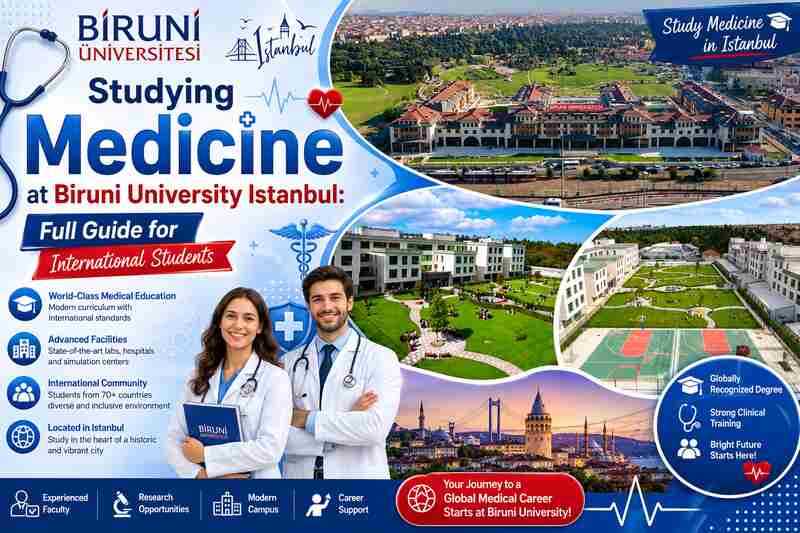
Studying medicine at Biruni University means enrolling in a 6-phase (6-year), English-medium Tıp Doktoru (MD) program delivered across Biruni University's main campus and its dedicated university hospital in Istanbul. The program is registered with and accredited by YÖK Turkey's Higher Education Council structured across 360 ECTS credits, and uses a system-based integrated curriculum that connects basic sciences with clinical training from the very first year. Annual tuition for international students is approximately $21,000, and the degree qualifies at the level required for WDOMS listing and international licensing pathway eligibility in most countries.
This guide covers everything a prospective international student needs to know: the full curriculum phase by phase (sourced directly from Biruni's official müfredat), the labs and facilities, tuition and scholarships, degree recognition, and how Imtiyaz Education manages the complete application and arrival process so you can focus entirely on your medical studies.
We've been placing students in Turkish medical programs since 2005. What's below is the kind of detail we walk students through in our Istanbul office.
What Is Biruni University and Why Medicine Here?
Biruni University is a private foundation university established in 2014 in Istanbul, named after the 11th-century Islamic polymath Al-Biruni a scientist whose work spanned medicine, mathematics, and astronomy. The name isn't just branding; the faculty takes it seriously. The emphasis on research, evidence-based thinking, and scientific method runs through how the medical program is actually structured and taught.
The university is based in the Zeytinburnu district of Istanbul, with the medical faculty operating across the main campus and Biruni University Hospital a full university teaching hospital in Küçükçekmece, Istanbul.
This is not a small private clinic. Biruni Hospital is a 617-bed, 80,000 m² health campus opened at its current location in 2023, built on AI-supported smart building architecture and operating across 10 floors. The headline figures: 100 ICU beds, 20 operating theatres (including a hybrid OR for minimally invasive vascular and oncological procedures), 150+ specialist polyclinic rooms, and a permanent staff of 1,250+ healthcare professionals. The hospital performs more than 50,000 surgical interventions annually, operates a 32-bed neonatal ICU, and holds TEMOS International Healthcare Accreditation the same framework used by internationally benchmarked hospitals plus ISO certifications meeting Turkish Ministry of Health regulations.
Active clinical departments where students rotate include: Cardiology, Internal Medicine, General Surgery, Orthopedics and Traumatology, Neurology, Neurosurgery, Pediatrics, Obstetrics and Gynecology, Emergency Medicine, Radiology, Radiation Oncology, Nuclear Medicine, Rheumatology, Infectious Diseases, Psychiatry, Urology, Ophthalmology, ENT, Dermatology, Cardiovascular Surgery, Anesthesiology, Physical Medicine and Rehabilitation, Medical Genetics, and Medical Oncology. The hospital also holds licensed center status for bone marrow transplantation (BMT) and organ transplantatio which means students in clinical years encounter complex, high-acuity cases that most private hospital-affiliated programs in Turkey simply don't see.
The SGK contract means the hospital treats all patient categories not just self-paying or private insurance patients so the clinical diversity students encounter is genuinely broad. The hospital also runs an International Patient Center serving patients from 118+ countries, meaning English-speaking clinical staff are regularly present a practical benefit for international students whose Turkish is still developing in the early years.
The Faculty of Medicine is led by Prof. Dr. Esra Kaytan Sağlam as Dean, with a departmental structure covering Basic Medical Sciences, Internal Medical Sciences, and Surgical Medical Sciences across more than 30 speciality departments from Anatomy and Medical Biology through to Neurosurgery, Cardiovascular Surgery, and Nuclear Medicine.
For a full profile and current ranking data, see our Biruni University university page on turkeyuniversity.org.
YÖK Accreditation and Program Standing
Biruni University's Faculty of Medicine holds YÖK accreditation, which means the Tıp Doktoru degree it confers is a recognized Level 7 qualification under Turkey's national qualifications framework (TYYÇ), aligned with EQF-LLL Level 7 and QF-EHEA Second Cycle the same international framework used across European higher education systems. This alignment is what makes the degree eligible for equivalency evaluations in most countries worldwide.
What the Research Says About Biruni's Educational Model
The approach Biruni has built integrated system-based learning, early hospital exposure, longitudinal research training, and small group bedside work is strongly supported by peer-reviewed evidence in medical education.
A 2026 study by Ennab et al. published in PLOS ONE, examining students' perceptions of a mandatory longitudinal research curriculum in undergraduate medical education, found that 85.7% of students agreed that structured research training was directly relevant to their clinical development and career readiness. The study, conducted in a Middle Eastern university setting directly comparable to Biruni's international student population, found that compulsory embedded research rather than optional elective research produced the strongest research orientation among graduates. Biruni's phase-by-phase research curriculum (Medical Research I in Phase I, Medical Research II in Phase II, and the full Project Course in Phase III) reflects exactly this integrated design.
On the pedagogy side, a 2020 paper by Gonzalo et al. in Academic Medicine, titled Health Systems Science in Medical Education: Unifying the Components to Catalyze Transformation, argues that the most effective medical curricula integrate health systems science including clinical training, systems thinking, and patient-centered practice as a third pillar alongside basic and clinical sciences. Biruni's structure, which combines Introduction to Clinics in Phase III, system-integrated committee courses throughout, and small-group hospital bedside training from Phase IV, is consistent with this model.
Studying medicine at Biruni University means completing 360 ECTS credits across 6 phases, each phase running approximately one academic year. The curriculum is officially bilingual offered in both Turkish and English and the English track is independently structured with its own course codes (EMSE prefix) as confirmed by the official 2025–2026 müfredat.
The curriculum uses a system-based integrated model basic sciences and clinical sciences are not taught in isolation but organized around body systems and diseases from the start. This approach, supported by evidence in medical education research, is increasingly standard among internationally benchmarked medical schools.
Phase I, Foundations of Medical Science (Year 1)
The first phase is built around an integrated committee course structure (EMSE100: Phase I Committee Courses, Integrated 32 ECTS) supplemented by five discrete Medical Sciences modules: Medical Sciences I through V (EMSE101–105), carrying 5, 5, 7, 9, and 6 ECTS respectively across the year. Students also begin German language I and II (GER101, GER102) a distinctive feature aimed at expanding students' international practice options plus Turkish Language I and II (TDI161, TDI162), Career Planning, and a Special Operations Module (EMSE001, 8 ECTS elective). Total: 60 ECTS.
What makes Phase I genuinely different from most private medical programs in Turkey is the hospital exposure from week one. From the very start, Year 1 students attend university hospital polyclinics and operating rooms as observers. They meet patients and clinical environments before they've completed a single semester of basic science — so by the time they reach the clinical years, the hospital isn't foreign territory.
Phase II, Body Systems (Year 2)
Phase II deepens into organ system pathophysiology through another integrated committee course (EMSE200, 46 ECTS) alongside six system-specific modules: Hematopoietics and Circulatory System – Basic (EMSE202, 7 ECTS), Respiratory System – Basic (EMSE201, 10 ECTS), Gastrointestinal System – Basic (EMSE203, 7 ECTS), Endocrine and Urogenital System – Basic (EMSE204, 9 ECTS), Central Nervous System and Skin Sensory Organs – Basic (EMSE205, 9 ECTS), and The Basis of Diseases (EMSE206, 4 ECTS). Medical Research II (RES200), Volunteer Studies, and elective courses complete the year. Total: 60 ECTS.
The research thread started with Medical Research I in Phase I continues across every phase. Students aren't handed a research module in Year 5 as an afterthought. From Year 1, they learn research methodology, ethics committee applications, how to present at conferences, and how to prepare publications. By Phase III, students are expected to produce research projects they have designed and run themselves. This is the institutional expectation at Biruni, not an optional track.
Phase III, Clinical Integration Begins (Year 3)
Phase III represents a turning point: clinical sciences enter the core curriculum. The integrated committee courses (EMSE300, 44 ECTS) are supplemented by system-specific clinical modules: Hematopoietics – Infection (EMSE301, 6 ECTS), Musculoskeletal – Skin and Sensory Organs (EMSE302, 4 ECTS), Neuroendocrine System (EMSE303, 8 ECTS), Gastrointestinal System Clinics (EMSE304, 5 ECTS), Respiratory – Circulation Systems (EMSE305, 8 ECTS), Urogenital System (EMSE307, 8 ECTS), Introduction to Clinics (EMSE306, 5 ECTS), Evidence-Based Medicine (elective, 2 ECTS), and the Behavioral, Social and Human Sciences Special Operations Module (EMSE003, 8 ECTS). Total: 60 ECTS.
Phase III also introduces the Project Course the formal research publication pathway described earlier. Students select a research topic, file an ethics committee application, present at a congress, and work toward journal publication all before graduation. This is part of the curriculum structure, not an extracurricular activity.
Phase IV, Full Clinical Rotations Begin (Year 4)
From Phase IV onward, students rotate through the hospital in 3-to-8-person small groups for bedside patient work alongside theoretical input. Core clinical rotations include: Internal Medicine (EMSE401, 9 ECTS), Pediatrics (EMSE402, 9 ECTS), Obstetrics and Gynecology (EMSE403, 7 ECTS), General Surgery (EMSE404, 7 ECTS), Cardiology (EMSE405, 7 ECTS), and Pulmonary Diseases (EMSE406, 5 ECTS). An elective clinical internship (EMSE407, 8 ECTS) and Special Operations Module complete the year. Total: 60 ECTS.
The small group bedside model is worth dwelling on. Groups of 3–5 students working with a supervising academic at a patient's bedside produce a fundamentally different learning quality than lecture-hall clinical medicine. Students at this stage aren't watching; they're actively participating in consultations and clinical decision-making under academic supervision.
Phase V, Specialty Rotations (Year 5)
Phase V is the broadest clinical year, covering 13 compulsory specialty rotations: Orthopedics and Traumatology (EMSE501, 3 ECTS), Physical Medicine and Rehabilitation (EMSE502, 3 ECTS), Urology (EMSE503, 3 ECTS), Psychiatry (EMSE504, 2 ECTS), Forensic Medicine (EMSE505, 3 ECTS), Infectious Diseases (EMSE506, 5 ECTS), Eye Diseases (EMSE507, 3 ECTS), Ear Nose Throat (EMSE508, 5 ECTS), Skin and Venereal Diseases (EMSE509, 5 ECTS), Anesthesia and Reanimation (EMSE510, 3 ECTS), Neurology and Neurosurgery (EMSE511, 5 ECTS), Radiology (EMSE512, 5 ECTS), and Emergency Medicine (EMSE513, 5 ECTS). Plus a Surgical Block elective and Elective Clinical Internship. Total: 60 ECTS.
This year represents the most intensive clinical breadth across the entire program students rotate through every major specialty in a single academic year.
Phase VI, Internship Year (Year 6)
The final year is the internship (intörnlük): direct, hands-on patient management under supervision, structured around the major departments. Core rotations: Internal Diseases (EMSE601, 8 ECTS), Public Health and Family Medicine (EMSE602, 8 ECTS), Emergency Medicine (EMSE603, 8 ECTS), Child Health and Diseases (EMSE604, 8 ECTS), General Surgery (EMSE605, 4 ECTS), Gynecology and Obstetrics (EMSE606, 4 ECTS), Elective Internship I Clinical Pharmacology, Psychiatry, or Basic Sciences (EMSE607, 6 ECTS), and Elective Internship II (EMSE608, 14 ECTS). Total: 60 ECTS.
Phase VI is the year students function as near-independent clinicians. The Elective Internship II block carries 14 ECTS the single largest credit block in the curriculum reflecting how seriously Biruni treats the final clinical development period.
Annual tuition for the English-medium medicine program at Biruni University is approximately $21,000 per year for international students, as confirmed by current published figures. Over the 6-year program, total tuition is approximately $126,000.
Let's be direct about the value question students always ask privately: is $21,000 a fair price for what Biruni offers? Honestly, it's underpriced. A 617-bed TEMOS-accredited teaching hospital with 100 ICU beds, 20 operating theatres, BMT and organ transplant center status, an integrated USMLE preparation track, phase-by-phase research curriculum, proprietary digital learning platforms, and a fully English-medium delivery this combination would justify a significantly higher fee. The $21,000 figure reflects Biruni's strategic decision to attract strong international students with competitive pricing, not a reflection of what the program is actually worth.
At $21,000, Biruni is the most fully-featured English-medium medical program in Istanbul at this price point. No similarly priced competitor offers USMLE integration, an SGK-contracted hospital of this scale, and a research publication pathway built into the curriculum from Year 1. That's a factual statement, not marketing language.
Here's how it sits against the Istanbul English-medium medical landscape:
University | Annual Tuition (Int'l) | Language | Hospital Scale | Key Differentiator |
|---|---|---|---|---|
Biruni University | ~$21,000/yr | Full English | 617 beds, 100 ICU, TEMOS accredited | USMLE prep built in, BMT center |
Istanbul Altinbas | ~$20,000/yr | English | Altinbas Hospital | Similar price, weaker curriculum integration |
Istanbul Okan | ~$20,500/yr | Mostly Turkish | Okan Hospital | Limited English delivery |
Bahçeşehir (BAU) | $28,000/yr | Full English | BAU Göztepe (integrated) | Stanford/MIT lab partnerships |
Istanbul Medipol | $44,000/yr | English/Turkish | Medipol Mega Hospital | Largest hospital network in Turkey |
Acıbadem MAAU | $35,000+/yr | Turkish only | Acıbadem chain | Premium clinical exposure, Turkish only |
The comparison is clear: Biruni delivers significantly more than its price implies. Altinbas and Okan are cheaper on paper, but Altinbas lacks the hospital scale and curriculum integration, and Okan's English delivery is inconsistent in practice. Medipol costs more than double and is largely Turkish-medium. BAU has impressive lab partnerships but charges $7,000/year more. Biruni's $21,000 price point with everything it includes is genuinely one of the best propositions in Turkish private medical education right now.
Scholarships and Discounts
Biruni University offers merit scholarships for qualifying international students. Scholarship reductions of 25%–50% are available for high-achieving applicants potentially bringing annual fees down to $10,500–$15,750. We work directly with the university's admissions team and have access to the best available scholarship offers for our students at the point of application, not after. This is one of the concrete advantages of applying through a university-partnered agency rather than applying directly.
Living Costs in Istanbul
Beyond tuition, a student living moderately in Istanbul near Biruni's Zeytinburnu campus can expect approximately $600–$900 per month covering shared accommodation ($250–$450/month), food ($150–$250/month), transport ($35–$45/month on a student pass), and daily expenses. All-in annual cost including tuition: roughly $28,200–$31,800 per year at standard rates, or significantly less with a scholarship. For reference, comparable UK medical programs with accommodation run $60,000–$90,000+ per year.
For the detailed and up-to-date fee breakdown, see our Biruni University fees guide on turkeyuniversity.org.
Biruni University is YÖK-accredited, its Faculty of Medicine is listed in the World Directory of Medical Schools (WDOMS) at wdoms.org, and the Tıp Doktoru degree carries EQF Level 7 / QF-EHEA Second Cycle status. But the most important thing to understand about Biruni's recognition story isn't the framework compliance it's the USMLE integration.
Most articles on Turkish medical degrees treat recognition as a passive question: "is it listed?" The better question is: what did the program actively do to prepare graduates for licensing exams? Biruni is the only Istanbul private medical school that has built USMLE-ECFMG preparation into the curriculum structure from Year 1. That is a meaningful difference.
The USMLE Pathway (United States)
WDOMS listing is the ECFMG eligibility requirement. Biruni clears it. Graduates of Biruni's Faculty of Medicine are eligible to sit USMLE Steps 1, 2 CK, and 2 CS (now integrated), and upon passing, to apply for residency programs in the US through the NRMP Match. The path exists. What makes Biruni different is that the curriculum actively prepares students for this exam integrated from the first year rather than leaving students to self-study after graduation. For any student with a long-term US career goal, this is the most important single fact about Biruni's program design.
United Kingdom (PLAB and GMC Registration)
Graduates from WDOMS-listed YÖK-accredited institutions are eligible to sit the PLAB exam (Professional and Linguistic Assessments Board), which is the standard route to GMC registration and NHS practice in the UK. After passing PLAB 1 and PLAB 2, Biruni graduates can apply for full GMC registration and begin foundation year placements. English-medium delivery at Biruni directly reduces the language preparation burden for PLAB 2's clinical skills assessment.
European Union (Country-Level Processes)
Within the EQF framework, Biruni's Tıp Doktoru qualifies as a Level 7 degree. However, EU medical practice recognition operates at the national level, not the EU level. Processes include: German BÄK recognition (Approbation process, requires German language), French equivalency evaluation (DFMS/DFMSA pathways), Dutch BIG-register, and similar national authority evaluations in each EU country. In most cases, a language qualification and sometimes a practical evaluation period is required. The degree framework is correct; the language and process hurdles are country-specific. We advise students on these pathways based on their target country before they enroll.
India (NMC Screening Test)
Indian students who graduate from a foreign medical school must pass the NMC (National Medical Commission) Foreign Medical Graduate Examination (FMGE), now called the NExT examination under the reformed framework. Biruni's WDOMS listing makes graduates eligible to sit this exam. Historically, FMGE pass rates for graduates of Turkish medical schools have been comparable to other foreign-trained Indian doctors. Students from India considering Biruni should confirm the current NMC recognized institutions list before enrolling.
Nigeria (MDCN)
The Medical and Dental Council of Nigeria evaluates foreign medical degrees case by case. Graduates of YÖK-accredited, WDOMS-listed institutions are eligible to apply for MDCN verification and provisional registration. The process involves credential authentication and, in most cases, a qualifying assessment before full registration. It is achievable we have placed Nigerian students at Turkish universities who returned to practice but it requires planning and documentation from graduation.
Egypt (Egyptian Medical Syndicate)
Turkish university degrees from YÖK-registered institutions are eligible for Egyptian Medical Syndicate evaluation. Egyptian students studying at Turkish medical schools have returned and practiced. Pre-enrollment confirmation with the Syndicate is advisable to ensure the most current requirements are met.
Pakistan (PMC)
The Pakistan Medical Commission requires a qualifying exam for foreign medical graduates from WDOMS-listed institutions. Biruni qualifies for PMC eligibility evaluation. Students should verify the current PMC approved institutions list directly at pmc.gov.pk before applying, as the list is updated periodically.
GCC Countries (Saudi Arabia, UAE, Kuwait, Qatar, Bahrain)
The Saudi Commission for Health Specialties (SCFHS) and equivalent bodies in the UAE (DHA/HAAD), Qatar (QC), and Kuwait evaluate foreign medical degrees from WDOMS-listed institutions. Biruni graduates are eligible for these evaluation processes. In practice, Biruni's English-medium delivery and USMLE preparation track are positively viewed by Gulf licensing authorities, since US-style medical education frameworks are well understood in the GCC credentialing system.
Sub-Saharan Africa (Nigeria, Libya, Sudan, Ethiopia, Kenya)
Most African countries recognize Turkish medical degrees from YÖK-accredited institutions through Ministry of Education degree authentication and national medical council registration. The process typically requires notarized degree documents, certified transcripts, and registration fees. Timelines vary by country but the pathway is established.
Australia and New Zealand (AMC)
Biruni graduates are eligible to sit the Australian Medical Council (AMC) examination, which is the pathway to registration with the Medical Board of Australia (AHPRA). The AMC MCQ examination and clinical examination are both open to graduates of WDOMS-listed schools. New Zealand Medical Council (MCNZ) operates a similar process. These are among the more rigorous licensing pathways globally but the eligibility door is open.
The Honest Summary
Biruni's Tıp Doktoru is a real, internationally eligible medical degree from a WDOMS-listed, YÖK-accredited institution. No foreign medical degree not even a UK or US degree gives automatic practice rights in another country without going through that country's licensing process. What Biruni gives you is eligibility for those processes, and a curriculum that actively prepares you for the most internationally important one (USMLE) from Year 1. We walk every student through the recognition pathway specific to their country before they apply, so there are no surprises at graduation.
The Biruni Faculty of Medicine houses a dedicated laboratory complex supporting basic science and clinical research. The laboratory portfolio includes: Anatomy Laboratory, Histology and Embryology Laboratory, Physiology Laboratory, Medical Biochemistry Laboratory, Medical Biology Laboratory, Medical Microbiology Laboratory, Simulation Center, and a Multidisciplinary Research Laboratory.
The Simulation Center deserves specific mention. Clinical simulation where students practice procedures and clinical scenarios on high-fidelity mannequins before working with real patients is a standard feature at internationally benchmarked medical schools. Research confirms that simulation-based training significantly improves procedural safety and student confidence before first independent clinical exposure. For international students who may not have had clinical observation opportunities before arriving, the simulation center provides a structured entry point before real bedside work begins.
The Anatomy Laboratory works with real cadaveric material alongside modern imaging visualization a combination that produces significantly better spatial anatomical understanding than digital-only approaches.
This is a feature most competing articles on Biruni medicine don't mention at all, and it's one of the most important signals of how the program is positioned.
The faculty explicitly integrates preparation for the Tıpta Uzmanlık Sınavı (TUS) Turkey's medical specialization exam and for USMLE-ECFMG (the US licensing pathway) into the curriculum from the first year. Students who want to pursue residency in Turkey after graduation, and students who want to specialize in the United States, are both supported within the same curriculum structure. Dedicated TUS and USMLE preparation courses run alongside the standard academic program.
This is not a common feature at Turkish private medical schools. Most offer generic exam prep as optional. Biruni has made it a structural part of the educational design which reflects the faculty's stated goal of training physicians who can work anywhere in the world.
Technology-Enhanced Learning: BirDeHa and BirBilginOl
Biruni's Faculty of Medicine runs two proprietary learning platforms that most competing universities don't have:
BirDeHa (Biruni Derse Hazırlık): A pre-class preparation system. Before each session, students receive structured preparatory materials through BirDeHa, ensuring they arrive with baseline knowledge already activated. The interactive lectures then build on this preparation rather than starting from zero.
BirBilginOl: A post-class reinforcement and self-assessment platform. After each session, students test and consolidate what they've learned. The cycle of prepare-attend-consolidate is built into the weekly rhythm of the program.
These platforms aren't extras. They're part of how the curriculum manages the shift from traditional lecture-heavy teaching toward active, self-directed learning which the evidence in medical education consistently supports as superior for long-term clinical competency.
Academic Requirements
Applicants need a secondary education certificate (high school diploma) with strong performance in Biology and Chemistry. A minimum GPA equivalent of around 70–75% is generally expected for direct entry. Students with outstanding academic profiles may receive priority scholarship consideration.
Language Requirements
The English-medium program requires proof of English proficiency, TOEFL iBT (typically 72+) or IELTS Academic (6.0+) or equivalent. Students who need additional preparation can contact us about options.
Required Documents
Certified high school diploma and full transcript
Passport copy (plus certified Turkish translation)
English proficiency certificate
Passport-size photographs
Health insurance documentation
All documents not in English or Turkish require sworn (certified) translation. Our Istanbul office produces these in-house with court-accredited authority same-day in most cases, accepted by Turkish universities and authorities without additional steps.
Application Timeline and Intake Dates - Act Early
Biruni University Faculty of Medicine has one annual intake: Fall semester only. There is no spring intake for the medicine program. This is a hard constraint. if you miss the Fall cycle, you wait a full year.
Applications typically open in February each year. Seats fill progressively through spring. Historically, most available places are allocated by June, with the remaining seats going quickly through July. By August, the program is typically full for that academic year.
This is not a university where you can decide in August and still expect an available place. Students who approach us in February or March are in the best position for scholarship consideration as well the best discount rates are available early in the cycle, not at the end when competition for remaining places is highest.
Our strong advice: if you are considering Biruni for the 2026–2027 Fall intake, submit your documents now. The application process through Imtiyaz takes as little as 24 hours once documentation is complete. Waiting costs you either your place or your scholarship.
Students ask us this directly: "Can't I just apply to Biruni myself?" Technically yes. Practically, there are real differences.
Fastest admission processing. We have a direct partnership with Biruni University. For applicants with complete documentation, admission decisions can come within 24 hours of submission through our office. Applying directly through the university's general portal takes longer, and you won't have an advisor reviewing your file for completeness before it's submitted.
Best available scholarship rates. We negotiate access to the best scholarship offers at the point of application not after. Students who apply through us frequently receive scholarship reductions that are not publicly advertised. The difference between the standard rate and our negotiated rate can be $2,000–$5,000 per year.
Zero application fees. There is no cost to apply through Imtiyaz. The university pays us directly for successful placements. You don't pay us anything.
On-ground support that changes your first weeks. When your acceptance letter comes, that's where most agents stop. We don't. Our team meets you at Istanbul Airport with VIP transfers. We handle your sworn document translations in our office (court-accredited, same-day). We support your final university registration, course selection, and academic planning for the first semester. We file your ikametgah (residence permit) application with you, so you don't miss the deadline or show up with the wrong documents.
24/7 availability around arrival. The weeks around arrival in Istanbul involve a lot of administrative pressure accommodation, tax ID, health insurance, residence permit, bank account, university card, course registration. We're reachable around the clock during this period. Students from Nigeria, Egypt, Libya, Yemen, and Pakistan arrive without knowing anyone in the city. Our job is to make the transition smooth enough that by the time your first lecture starts, you're not stressed about logistics you're thinking about medicine.
21 years and over 100,000 applications processed. That's not a number we put in a brochure. It's what it means to have institutional relationships with every major university, to know which documents each registrar office actually needs, and to have resolved the kinds of complications that happen when you've done this long enough.
When you apply through Imtiyaz, your only job is to focus on your degree.
Read more at: Best Study in Turkey Agency for University Admissions
Q: Is Biruni University good for medicine? A: Yes, and the reasons are specific, not generic. Biruni's Faculty of Medicine is the only Istanbul private medical school at the $21,000 price point that combines: a fully English-medium curriculum with a USMLE preparation track built in from Year 1, a 617-bed TEMOS-accredited teaching hospital with 100 ICU beds and 20 operating theatres, a mandatory phase-by-phase research and publication pathway, and proprietary digital learning platforms (BirDeHa, BirBilginOl) used in every phase. Hospital exposure starts in Week 1 of Year 1. Small-group bedside training in groups of 3–5 begins in Year 4. The program is designed to produce physicians who can practice internationally, not just hold a Turkish degree.
Q: How does Biruni University medicine compare to other Turkish universities? A: Against similarly-priced English-medium programs in Istanbul, Biruni stands apart on three points: curriculum integration (USMLE prep and research are structural, not optional), hospital scale (617 beds, 100 ICU, BMT center significantly larger than competitors at this price), and digital infrastructure (BirDeHa/BirBilginOl platforms that no other university at this price point runs). Against more expensive programs like BAU ($28,000/yr) or Medipol ($44,000/yr), Biruni offers comparable English-medium delivery and stronger clinical volume at $21,000. The honest difference: BAU has international research lab partnerships (Stanford, MIT) that Biruni doesn't match. Medipol has the largest hospital network in Turkey. Biruni's advantage is the complete package clinical, curriculum, research, and USMLE pathway at the best price in Istanbul for genuine English-medium delivery.
Q: Is studying medicine at Biruni University fully in English? A: Yes. Biruni offers parallel Turkish and English-medium medicine programs. The English track uses independent course codes (EMSE prefix throughout all 6 phases) and is delivered entirely in English, confirmed by the official 2025–2026 müfredat. German is included as a language course giving students a third language that opens European practice options but instruction across all medical subjects is in English.
Q: What are Biruni University medicine fees for international students? A: Annual tuition for the English-medium program is approximately $21,000, making it the most fully-featured English-medium medical program in Istanbul at this price. Total tuition over 6 years is approximately $126,000. Scholarships of 25%–50% are available for qualifying students, potentially reducing annual fees to $10,500–$15,750. There is no application fee when applying through Imtiyaz Education. The best scholarship rates are available early in the admissions cycle from February not in July when seats are nearly full.
Q: Does Biruni prepare students for USMLE? A: Yes, and uniquely so among Turkish private medical schools. USMLE-ECFMG preparation is a structural feature of the curriculum from Year 1, running alongside TUS preparation for students interested in Turkish residency. No other Istanbul private medical school at this price point has integrated USMLE prep into the core curriculum rather than offering it as an optional course. For students with US residency ambitions, this is the single most important program differentiator at Biruni.
Q: When do applications open and is there a deadline? A: Applications for the Fall intake open in February each year. Biruni has Fall-only intake for the medicine program there is no spring entry. Seats are allocated progressively and most available places are filled by June. July is the last realistic window, and by then scholarship availability is reduced. If you are serious about Fall 2026 entry, February–April is the target window. Apply early, not last minute.
Q: Is a Biruni Tıp Doktoru degree recognized internationally? A: Biruni's Faculty of Medicine is YÖK-accredited and WDOMS-listed, making graduates eligible for licensing exam pathways in the US (USMLE/ECFMG), UK (PLAB/GMC), Australia (AMC), India (NMC/NExT), Nigeria (MDCN), Pakistan (PMC), GCC countries (SCFHS), Egypt, and most other countries worldwide. Recognition requires passing each country's own licensing exam automatic practice rights don't exist for any foreign medical degree anywhere. What Biruni gives you is full eligibility for those processes, plus a curriculum that actively prepares you for the most internationally recognized one (USMLE). Full country-by-country detail is in the recognition section above.
Q: How long does admission take when applying through Imtiyaz? A: For applicants with a complete documentation package, admission decisions from Biruni University typically come within 24 hours of submission through our office. We review your file before submitting, catching any issues that would cause delays. Applying directly through the university's general portal takes significantly longer and you won't have an advisor preparing your file.
Q: What support does Imtiyaz provide after acceptance? A: Everything between acceptance letter and first day of class. VIP airport transfer on arrival, sworn document translations produced in our court-accredited Istanbul office (same-day), final university registration, course selection support, ikametgah (residence permit) application filing, health insurance guidance, and 24/7 availability during the first weeks. We've placed students from over 40 countries the whole process is something we've done thousands of times.
Q: Can I study Year 1 in Turkish and switch to the English program? A: No. The Turkish and English medicine programs are separate tracks with different course structures, codes, and academic staff assignments. Switching after enrollment is not standard procedure. Choose your track before applying, and confirm with us if you're uncertain.
Q: Does Biruni have Erasmus+ exchange opportunities? A: Yes. Biruni is an Erasmus+ member and has bilateral student mobility agreements with institutions in Europe. Students can complete one or two semesters abroad at partner universities during their degree. This is particularly relevant for students considering European practice options after graduation, as it provides both clinical exposure and language immersion in target countries.
Biruni is founded in 2014 which in Turkish private university terms makes it relatively young. Some students scroll past it on that basis alone, assuming newer means weaker. That's worth addressing directly.
In 10 years, Biruni has built a 617-bed, TEMOS-accredited university hospital with 20 operating theatres and 100 ICU beds. It has created an English-medium medical curriculum with USMLE preparation integrated from Year 1, a mandatory research publication pathway, and digital learning infrastructure that older universities haven't matched. It has recruited an internationally experienced academic faculty and built proprietary learning tools most programs its age don't have.
The $21,000 annual fee is genuinely below what this program should cost. Universities with half the clinical infrastructure charge more. For a student whose goal is to graduate clinically competent, internationally licensed, and research-capable not just to hold a degree from a recognizable name Biruni delivers more per dollar than any comparable program in Istanbul right now.
Seats fill by June. Applications open in February. If you're reading this in the early part of the year, the decision window is open. If you're reading this in the summer, move quickly.
Reach out to our team at turkeyuniversity.org. There are no fees on your side. We handle everything from first document review to the moment you walk into your first Phase I lecture.