Study in Turkey vs UK 2026: Honest Comparison for International Students

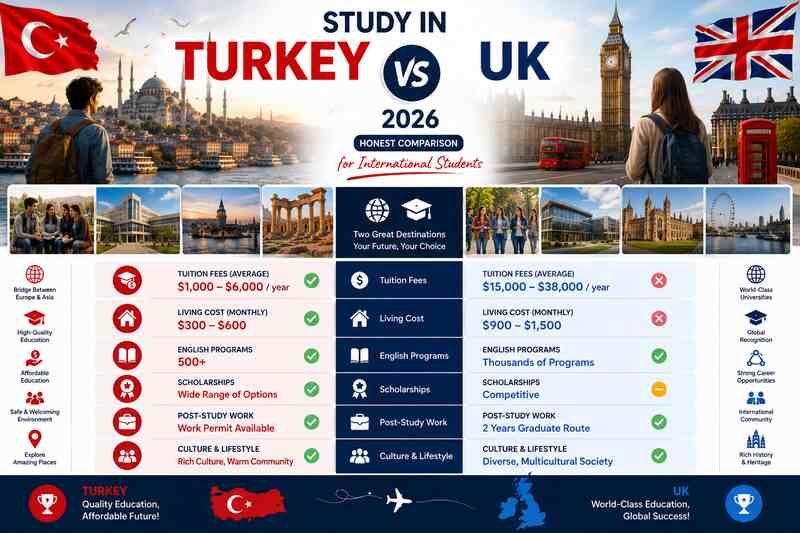
The gap between studying in Turkey and studying in the UK is larger than people expect in both directions.
In cost, the UK is roughly five to eight times more expensive than Turkey for most programs. A student who spends three years at a Turkish private university on a medicine-adjacent program, fully funded out of pocket, will spend less than a single year's tuition at a mid-tier UK university. That's not an exaggeration it's the arithmetic of current fee schedules.
But cost isn't the whole story, and anyone who tells you it is isn't being straight with you. A UK degree from a Russell Group university carries a level of global name recognition that no Turkish institution currently matches at scale. The post-study work visa situation in the UK is dramatically better. And for specific programs particularly graduate medicine, law at the top end, and MBA at globally recognized business schools the UK has credential advantages that Turkey genuinely can't replicate.
So the real question isn't "which country is better." It's whether the credential differential is worth the cost differential and for which students, in which programs, that calculation actually favors the UK.
We've been working with international students at Imtiyaz Education since 2005. We specialize in Turkey admissions, so we don't place students in UK universities. That means we have no commercial reason to steer this comparison one way or the other. What follows is as honest an assessment as we can give.
Tuition Fees: The Most Visible Difference
The numbers here are stark.
UK; international student tuition 2026/27:
Standard undergraduate programs: £11,400 to £22,000/year at most UK universities
Russell Group universities (Manchester, Edinburgh, Birmingham, etc.): £20,000 to £29,000/year
Oxford and Cambridge overseas fees: £37,380 to £70,554/year depending on subject
Medicine (MBBS): typically £35,000 to £58,000/year for international students at UK medical schools
Engineering: £20,000 to £32,000/year at most universities
UK domestic students pay a capped £9,250/year. International students pay between 2x and 6x that rate, with no access to UK government student loan schemes. According to a 2023 study published in BMJ Open, international medical students in the UK pay on average four to six times the tuition of domestic students, and only 54% of graduates ultimately felt the degree was value for money at those prices — with satisfaction dropping significantly between the pre-enrollment stage and post-graduation (Li et al., 2023).
Turkey; international student tuition 2026/27:
Standard undergraduate programs at private universities: $3,000 to $9,000/year
Medicine at private universities: $8,000 to $20,000/year (English-taught)
Engineering (MÜDEK-accredited programs): $4,000 to $10,000/year
Dentistry: $7,000 to $15,000/year
State (public) university programs: $500 to $3,000/year (requires TR-YÖS exam)
Merit scholarships of 25-50% are commonly available at Turkish private universities. For students applying through Imtiyaz Education, scholarship eligibility is assessed at application no separate process required.
The cost gap over a full degree:
A three-year undergraduate program at a mid-tier UK university costs roughly £60,000-£87,000 in tuition alone. The same three-year program at a comparable Turkish private university costs $9,000-$27,000. At current exchange rates, the difference is $50,000-$90,000 before you've counted a single month of living expenses.
For medicine — a six-year program in Turkey vs typically five or six years in the UK the total tuition gap can exceed $150,000-$200,000.
Living Costs: Istanbul vs UK Cities
UK living costs 2026:
The UK government requires international students to demonstrate they can cover at least £1,023/month (outside London) or £1,334/month (in London) for visa purposes. Actual costs run higher:
London: students realistically spend £1,400 to £2,000+/month including rent, food, transport
Major UK cities outside London (Manchester, Birmingham, Edinburgh): £900 to £1,400/month
Smaller university cities: £800 to £1,200/month
London rent alone often £800 to £1,200/month for a shared room consumes most of the budget before food and transport. Students who live outside central London spend meaningfully less, but the city's cost pressure is real.
Istanbul living costs 2026:
Shared apartment in a student-friendly district (Fatih, Eyüp, Esenyurt): $200 to $400/month
Food (cooking + occasional restaurants): $150 to $250/month
Transport (Istanbulkart): $20 to $40/month
Health insurance for residence permit: $50 to $100/year
Realistic total: $400 to $700/month
Istanbul is a city of 17 million people with enormous variation in cost by neighborhood. Students who cook and use public transit can live on $400-450/month without significant sacrifice. Students who eat out regularly and live closer to campus in higher-demand areas spend closer to $700.
The living cost gap over three years:
At £1,200/month (modest UK city estimate) vs $550/month (mid Istanbul estimate), the three-year living cost gap is approximately £43,200 UK vs $19,800 Turkey, roughly a $34,000 difference at current rates. Combined with tuition, a mid-tier UK program can cost $100,000-$120,000 more than a comparable Turkish program over three years.
Accreditation and Degree Recognition
This is where Turkey-vs-UK comparisons usually get oversimplified. Let's break it down by field.
For medicine:
UK medical degrees (MBBS, MBChB) are among the most globally recognized healthcare credentials in existence. They're recognized for licensing in most Commonwealth countries, across much of Africa and South Asia, in the Gulf, and increasingly in parts of Europe. The UK's GMC (General Medical Council) registration pathway and the UKMLA (UK Medical Licensing Assessment) make UK-trained doctors competitive globally.
Turkish medical degrees are recognized through a different framework. TEPDAD (Turkey's WFME-accredited medical education accreditor) and WDOMS listing are the critical checks. Turkish medical degrees are recognized in many countries but the automatic recognition that a UK MBBS carries doesn't exist at the same scale. Students planning to practice in countries with strong Commonwealth ties should verify recognition requirements carefully before choosing Turkey over the UK for medicine.
For engineering:
Both countries are Washington Accord signatories, which puts them on equivalent footing for engineering credential recognition globally. Turkey's MÜDEK-accredited programs and the UK's Engineering Council-accredited programs are both recognized as meeting international engineering standards in Washington Accord countries including the US, Canada, Australia, and others. At this level, the gap between countries largely disappears what matters is whether the specific program is accredited, not which country it's in.
For business:
The UK has a higher concentration of AACSB and EQUIS-accredited business schools than Turkey. If you need those specific accreditations for certain professional paths in finance, management consulting, or international business the UK has more options. Most Turkish private universities don't hold these accreditations, though a small number do. For general business degrees without these specific credential requirements, the gap matters less.
For law:
UK law degrees carry unique practical value for students planning careers in jurisdictions that follow common law systems. Turkish law degrees are based on civil law traditions. If practicing law in a common law country is the goal, the UK is the only choice between these two. If the goal is practicing law in the student's home country (most of the Middle East, Central Asia, or Africa), both qualifications require additional local qualification processes anyway, and neither has a clear structural advantage.
For all other fields:
YÖK (Turkey's Council of Higher Education) registration of a university is recognized in most countries for non-professional degrees. A Turkish bachelor's degree in psychology, social sciences, communications, architecture, computer science, or most non-licensed fields is generally accepted for graduate admissions and employment in most countries. The UK Russell Group name premium exists and matters for certain elite graduate programs and employers but for the majority of graduate pathways, a good Turkish university degree works fine.
Rankings: What the Numbers Actually Show
International rankings matter but they're often used misleadingly in country comparisons.
UK ranking picture:
The UK dominates global rankings at the top tier. Oxford (ranked 1 globally in QS 2026), Cambridge (5), Imperial (8), UCL (9), and Edinburgh (27) are genuine world-class institutions. Beyond the top 10-15, UK universities are still strong most Russell Group institutions sit within the top 200 globally.
But students admitted to mid-tier UK universities ranked 100 to 300 globally are not getting a substantively different education from comparable programs elsewhere. The brand premium exists mainly at the very top of the UK ranking table, not throughout it.
Turkey ranking picture:
Turkey has 109 universities in the 2026 Times Higher Education World University Rankings. Koç University (Istanbul), Middle East Technical University (Ankara), Boğaziçi University, and Sabancı University are consistently in the global top 500 and often top 300. These are genuinely competitive research universities.
Most Turkish private universities that serve international students Medipol, BAU, Istanbul Aydin, Gelisim, Biruni, etc. are not in the global top 500. They're regionally recognized institutions with solid program-level accreditations but without the research output that drives global ranking positions.
What this means in practice: If your target is a top-20 global university, Turkey can't match the UK. If your target is a solid international degree at a fraction of the cost, Turkey offers that. The question is which category describes your realistic situation.
Comparison Table: Turkey vs UK Key Factors
Factor | Turkey (Private Universities) | United Kingdom |
|---|---|---|
Undergraduate tuition (international) | $3,000 - $9,000/year | £11,400 - £29,000/year |
Medicine tuition (international) | $8,000 - $20,000/year | £35,000 - £58,000/year |
Total 3-year degree cost (tuition + living) | $30,000 - $60,000 | £70,000 - £120,000+ |
Monthly living costs | $400 - $700 | £900 - £2,000 |
Global ranking (top institutions) | Top 300-500 (select universities) | Top 1-200 (Russell Group) |
Medicine degree recognition | TEPDAD/WDOMS (verified case-by-case) | GMC/WFME global recognition |
Engineering accreditation | MÜDEK (Washington Accord) | Engineering Council (Washington Accord) |
Post-study work rights | No dedicated visa | 2-year Graduate Route |
Scholarship availability | 25-50% merit discounts, common | Chevening, Commonwealth (competitive) |
Admission speed | 24-72 hours (most programs) | Weeks to months (UCAS process) |
IELTS/English test required | Not always (many internal tests accepted) | Yes, IELTS 6.0-7.0 typically |
Agency support (free) | Yes, Imtiyaz Education for Turkey | Not applicable |
The Role of Scholarships in This Decision
The cost calculation above assumes self-funded study. Scholarships can change the math.
UK scholarships for international students:
Chevening Scholarships (UK government): full funding for master's degrees. Highly competitive, typically for candidates with 2+ years of work experience and leadership potential.
Commonwealth Scholarships: for students from Commonwealth countries. Fully funded, highly selective.
University scholarships: most Russell Group universities offer partial scholarships ranging from £2,000 to £10,000 meaningful but not transformative against £25,000+/year fees.
If you receive a full Chevening or Commonwealth scholarship, the UK becomes a genuinely different proposition. If you're relying on partial university merit awards, the gap with Turkey remains large.
Turkey scholarships:
Türkiye Bursları (Türkiye Scholarships): Turkish government full scholarship covering tuition, accommodation, monthly stipend, health insurance, and return flight. Competitive, applied for independently through turkiyeburslari.gov.tr.
University merit discounts through partner agency agreements: 25-50% tuition reductions. Imtiyaz Education arranges these for eligible students at no charge.
Medicine
Turkey, Istanbul Medipol University TEPDAD-accredited, WDOMS-listed, hospital-integrated. One of the most recognized Turkish medical schools among international students. English-taught MD program. Tuition approximately $15,000-$18,000/year.
Turkey, Biruni University WDOMS-listed. Newer campus with modern infrastructure. English and Turkish MD tracks. Approximately $10,000-$14,000/year.
UK, University of Glasgow (Medicine) Internationally recognized. GMC-regulated. International tuition approximately £36,000-£40,000/year. Strong research output.
UK, University of Manchester (Medicine) Top-20 UK medical school. International tuition approximately £37,000-£42,000/year. Very high graduate employment in NHS and internationally.
For medicine, the UK offers broader automatic global recognition but at 2-4x the price of Turkey. Students who need UK-caliber recognition for specific target markets should factor that in. Students whose licensing goal is in their home country should verify requirements independently before paying UK prices for that reason alone.
Engineering
Turkey, Bahçeşehir University (BAU) MÜDEK-accredited on select programs. English-taught. Modern Istanbul campus. $8,000-$12,000/year.
Turkey, Istanbul Technical University (İTÜ) Turkey's premier engineering university. Public institution, state pricing. Some English-taught programs. Very strong regional reputation. TR-YÖS required.
UK, University of Sheffield (Engineering) Russell Group, Engineering Council accredited. Internationally strong. £22,000-£26,000/year for international students.
UK, Heriot-Watt University (Edinburgh) Strong in engineering and applied sciences. More affordable than many UK peers at around £19,000-£22,000/year.
Both countries deliver Washington Accord-equivalent engineering accreditation. The decision here comes down to cost tolerance and whether specific UK employer brand recognition matters for your post-graduation plans.
Business
Turkey, Istanbul Aydin University (IAU) Large campus, strong English-taught business programs. Cost-accessible at $4,000-$7,000/year.
Turkey, Kadir Has University Istanbul location, strong business faculty, reasonable tuition. Good research record for a mid-sized private university.
UK, University of Warwick (Business School) AACSB-accredited, top-10 UK business school. International tuition approximately £26,000-£31,000/year.
UK, University of Leeds (Business School) AACSB-accredited. Strong employer connections. Approximately £22,000-£25,000/year.
If AACSB accreditation is a strict requirement for your career path, the UK has better coverage at non-Russell Group universities than Turkey does. If it's not a strict requirement, the cost differential is hard to justify on business program quality alone.
The UK introduced its Graduate Route (post-study work visa) in 2021, and it remains one of the most significant structural advantages the UK holds over Turkey.
UK Graduate Route:
International graduates from UK universities can stay and work (or look for work) for:
2 years after an undergraduate or master's degree
3 years after a PhD
During this period, they can work in any job at any skill level. This is a meaningful buffer for career building, job searching, and in some cases, a pathway to longer-term UK visa status.
Turkey:
Turkey does not have an equivalent post-study work visa. International graduates who want to remain and work in Turkey need employer-sponsored work permit. This is possible and happens Istanbul is a significant employer of international professionals but it requires active job placement and employer cooperation rather than the automatic right to stay that the UK offers.
For students whose goal is building a career in the UK after graduation especially in finance, technology, or healthcare the Graduate Route is a concrete benefit that Turkey can't replicate. For students who plan to return to their home country or use their degree for postgraduate study elsewhere, this advantage is much less relevant.
Based on the full picture, here's how we see the decision breaking down in practice.
Turkey is likely the right choice if:
Budget is the primary constraint and you're self-funding
You're studying engineering the accreditation is equivalent through Washington Accord
You're studying medicine and your licensing target is in a country that recognizes TEPDAD/WDOMS-listed schools
You want fast admissions without a standardized exam process
You want on-ground support in Istanbul from day one (which Imtiyaz Education provides at zero cost)
You plan to return to your home country after graduation
Your program isn't in a field where UK brand recognition creates a clear career payoff
The UK is likely worth considering if:
You're targeting a top-10 UK university specifically Oxford, Cambridge, Imperial, LSE where the credential premium is real and employers notice
You want the Graduate Route post-study work visa as part of your career plan
You're studying medicine and your career target requires UK/Commonwealth-automatic recognition
You need AACSB or EQUIS for a specific professional path and price is not the deciding factor
You can access Chevening, Commonwealth, or university-specific scholarship funding that reduces the actual cost difference substantially
At Imtiyaz Education, we've been operating in Istanbul since 2005 two physical offices on the European side of the city, a staff that includes former international students who went through exactly what you're considering, and direct agreements with more than 75 partner universities across Turkey and Northern Cyprus.
For students who choose Turkey through us, the process works like this: we submit your application directly to universities and receive offer letters typically within 24-72 hours. We verify TEPDAD and WDOMS status for medicine programs, MÜDEK status for engineering, and YÖK registration for every institution before we recommend it. We don't charge you anything the universities pay us a commission after you enroll.
When you arrive in Istanbul, we coordinate airport pickup, accompany you to the university for final registration, and help you with your first residence permit appointment. Our sworn translation office handles any document needs throughout your studies. And we stay available by WhatsApp, email, or in person for the duration of your time in Turkey.
Study in Turkey vs UK is a question we hear constantly at Imtiyaz Education, and we've watched the full range of outcomes. Students who choose Turkey with the right program and the right university leave with a degree that serves them well and a budget that wasn't destroyed in the process. Students who go to the UK at full international price for a mid-tier institution sometimes wonder, years later, whether it was worth it.
If Turkey fits your goals and your situation, apply through turkeyuniversity.org. The process is free, the offer letter is fast, and our team in Istanbul is the support system you need from the first day.
Q: Is studying in Turkey cheaper than studying in the UK? A: Substantially yes. Turkish private university tuition for international students runs $3,000-$9,000/year for most programs, compared to £11,400-£29,000/year at UK universities. Over a three-year degree including living costs, Turkey is typically $70,000-$100,000 cheaper than the UK. For medicine the gap is even larger.
Q: Is a Turkish degree recognized in the UK? A: For most non-professional fields, a degree from a YÖK-registered Turkish university is recognized for UK graduate admissions and general employment. For regulated professions medicine, law, engineering recognition depends on the specific profession's UK regulatory body and whether the Turkish program meets its requirements. Engineering from MÜDEK-accredited programs is generally recognized through Washington Accord equivalence. Medicine from WDOMS-listed schools may be considered but UK GMC registration for internationally qualified doctors involves an additional assessment process.
Q: Is a UK degree worth the extra cost compared to Turkey? A: It depends entirely on the program and the student's goals. A degree from Oxford, Cambridge, Imperial, or LSE carries global prestige that genuinely opens specific doors particularly in finance, consulting, and academia. A degree from a mid-ranked UK university at international prices (£60,000-£90,000 in tuition over three years) is harder to justify purely on credential grounds compared to a well-accredited Turkish alternative. According to a 2023 study in BMJ Open, only 54% of international medical students in the UK felt their degree was value for money and this satisfaction dropped significantly after graduation when the full cost of the investment became clear (Li et al., 2023).
Q: Can international students work while studying in the UK? A: Yes. International students in the UK on a Student visa can typically work up to 20 hours per week during term time and full-time during vacation periods. This doesn't cover a meaningful fraction of the cost, but it helps. Turkish student residence permit holders can also work, though part-time student employment is less formalized in Turkey's market.
Q: What are UK universities' IELTS requirements for international students? A: Most UK universities require IELTS 6.0-6.5 for standard programs and IELTS 7.0-7.5 for medicine, law, and some postgraduate programs. This is a firm requirement the UCAS application process includes English proficiency documentation. Turkish private universities often accept internal English proficiency tests or preparatory year enrollment instead of IELTS, making Turkey more accessible for students without test scores.
Q: Does Imtiyaz Education help with UK university admissions? A: No. Imtiyaz Education specializes in Turkey and Northern Cyprus university admissions. For UK admissions, the process runs through UCAS (Universities and Colleges Admissions Service) for undergraduate programs and directly through universities for postgraduate. We can advise on the Turkey side of this comparison, but UK admissions are outside our service scope.
Q: How does the UK's Graduate Route affect the study abroad decision? A: The UK Graduate Route (2 years post-study work for undergraduates and master's graduates, 3 years for PhD) is a significant advantage for students who want UK work experience after graduation. Turkey has no equivalent. For students whose post-graduation plan involves building a career in the UK, this is a genuine differentiator that can justify a portion of the cost premium.