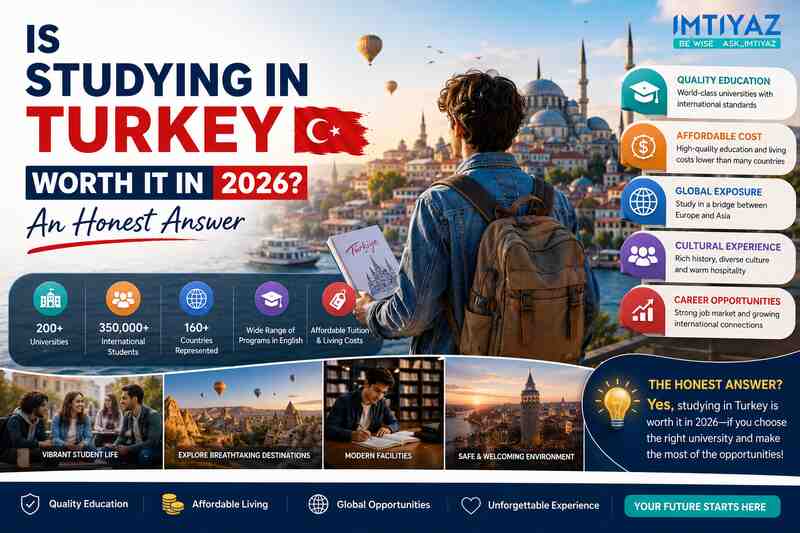
Every year, students ask us the same question before applying: "Is studying in Turkey worth it?" And every year, we give the same answer it depends, and it depends on specific things we can walk you through.
We've been placing international students in Turkish universities since 2005. Over 10,000 students have completed university registration through our agency. We've seen students thrive in Turkey. We've also seen students who chose Turkey for the wrong reasons and found it harder than expected. So when we say "honest answer," we mean it this isn't a sales pitch for a destination we happen to operate in. It's a genuine assessment based on 21 years of watching what actually works.
Studying in Turkey is worth it for the right student. This article tells you whether you are that student.
The Case For: What Turkey Genuinely Offers That Competitors Don't
Let's start with the real advantages not the marketing version, but the ones that actually affect student experience and career outcomes.
Tuition that is genuinely competitive, denominated in hard currency. Private university tuition at English-medium programs in Turkey ranges from $3,500 to $18,000 per year depending on the program and institution. Medical programs sit at the higher end; engineering and business at the lower. These fees are published and collected in US dollars or euros at most private universities which means students funded from abroad benefit from the current exchange rate between hard currencies and the Turkish lira. Living costs, paid in lira, are extremely favorable for dollar-or-euro-funded students. A comfortable student lifestyle in Istanbul is achievable on $500–$750/month in 2026. Outside Istanbul, $350–$550/month covers most students well.
Compare this to the UK: $240,000+ in tuition alone for a medical degree, $90,000+ for engineering. Turkey's total four-year engineering cost tuition plus living typically lands between $35,000 and $60,000. The math is hard to argue with.
English-medium programs that have matured significantly. Five years ago, "English-medium" at some Turkish private universities meant the syllabus was translated but lectures were partly Turkish. That's changed at the established programs. Universities like Bahçeşehir, Istanbul Aydin, Medipol, Biruni, and Istinye now run genuine English-medium faculties with English-language exams, international faculty members, and course materials sourced from global publishers. Students at these institutions spend four to six years in English which has real career value.
Accreditation that opens international doors. Turkey's engineering programs carry MÜDEK accreditation aligned with European EUR-ACE standards, recognized by engineering licensing boards in GCC countries and across Europe. Medical programs at WDOMS-listed universities give graduates access to USMLE, PLAB, and equivalent licensing exam eligibility. Dentistry programs at ADEE member faculties align with European dental education standards. These aren't marketing claims they're verifiable from the accreditation bodies' published lists, and they matter for what graduates can do after finishing.
A location that is genuinely useful. Istanbul is a 3–4 hour flight from West Africa, 5–6 hours from South Asia, and 3–4 hours from the Arab world. It is a genuine international hub with one of the world's busiest airports. For students who travel home during breaks, or whose families visit them, Turkey's geography matters. It's also a city a major one with strong internship and career networking opportunities for students who plan to work in the region.
A large, established international student community. Turkey hosts over 300,000 international students, and the major university cities particularly Istanbul have large, organized communities from Nigeria, Pakistan, Egypt, Indonesia, Morocco, Jordan, and dozens of other countries. For students arriving alone in a new country, having an established community from home can make the first semester significantly easier. This isn't nothing. Social integration affects academic performance, and Turkey's established communities make integration faster.
The Case Against: What Turkey Gets Wrong
Honesty requires covering this section too. Here's what doesn't work well, so you can decide whether it applies to your situation.
The clinical language barrier for health science students. This is the most significant practical challenge for medicine, dentistry, pharmacy, and nursing students. Pre-clinical years in English-medium programs are genuinely English throughout. But clinical training happens in Turkish hospitals with Turkish-speaking patients, Turkish nursing staff, and Turkish-language documentation. Most universities offer Turkish language courses, and students generally develop enough functional Turkish for clinical communication within 1–2 years. But it is a real challenge, not a minor inconvenience, and students who don't take Turkish language seriously from Day 1 will find Years 4–6 harder than necessary.
Degree recognition requires active verification. A Turkish medical degree from a WDOMS-listed university gives the graduate eligibility to sit licensing exams not automatic recognition. Each country's medical licensing body has its own process: India requires NEXT, Pakistan requires PMC screening, Nigeria requires MDCN registration. These processes exist and graduates navigate them successfully, but they require time and preparation after graduation. Students who assume a Turkish degree automatically allows them to practice in their home country without further steps are sometimes surprised. It doesn't but the pathway is real and navigable.
Istanbul's cost of living has increased. Istanbul is more expensive than it was three years ago, particularly for rent. Students on tight budgets who assumed Istanbul would be very cheap based on older guides sometimes find the reality is more like a mid-tier European city for housing costs. Other Turkish cities Ankara, Izmir, Trabzon, Konya remain significantly cheaper. Students whose priority is budget minimization should consider universities outside Istanbul.
Public university admission is genuinely competitive. METU, Boğaziçi, and Istanbul Technical University are strong universities with low fees — but getting into them as an international student requires a YÖS score and high academic performance. Most international students end up at private universities for this reason, which is fine, but students who have unrealistic expectations about public university admission should recalibrate.
Not every program deserves equal trust. Turkey has over 80 private universities. The quality gap between the best and the rest is substantial. A MÜDEK-accredited engineering program at a well-established institution and an unaccredited program at a new university are very different investments. Students who don't verify accreditation before enrolling, or who choose based on the lowest tuition alone, sometimes find their degree recognized in fewer places than expected. Accreditation verification takes 30 minutes and matters enormously.
What the Data Says About Turkish University Graduates
YÖK data shows that international student enrollment in Turkey grew from under 30,000 in 2010 to over 300,000 in 2025 a tenfold increase that reflects genuine demand, not just marketing. The countries sending the most students Syria, Azerbaijan, Turkmenistan, Iran, Iraq, Afghanistan, Yemen, Nigeria, Pakistan, Somalia are countries where Turkey's accreditation pathways align with post-graduation employment markets.
WDOMS-listed Turkish medical universities now produce thousands of graduates per year who go on to sit and pass USMLE, PLAB, and equivalent exams. MÜDEK-accredited engineering graduates are working in Gulf infrastructure projects, European technical firms, and African construction sectors. These aren't hypothetical pathways — they're documented outcomes for graduates of properly accredited programs.
Research published in Higher Education Policy and Management on international student satisfaction in non-traditional destinations found that Turkey scored consistently high on cost-value satisfaction students reported that actual costs were at or below what they had budgeted before arrival, a finding that held across multiple source countries.
Turkey works best for students who match this profile:
You are from a country where domestic university admission is intensely competitive or prohibitively expensive. Nigeria, Pakistan, India, Egypt, Indonesia, Bangladesh students from these countries face either extremely competitive domestic admissions or very high costs in traditional Western destinations. Turkey offers a credible, accredited alternative pathway that wouldn't otherwise exist.
Your target career is in the Middle East, Africa, or within Turkey itself. Turkish degrees carry the most direct recognition in these markets. GCC licensing boards accept MÜDEK-accredited engineering degrees. Gulf and African healthcare systems routinely employ graduates of WDOMS-listed Turkish medical programs. Students who want to work in London or New York after graduation face longer recognition processes.
You want a real English-medium education, not just an English-language syllabus. The best Turkish private university English-medium programs are genuinely international in delivery. Students who want to improve their English proficiency while earning a degree in their field get both simultaneously.
You have done proper research on accreditation for your specific program. Students who choose Turkey because it's affordable and then discover their specific program isn't properly accredited for their target country are in a difficult position. Students who verified MÜDEK for engineering, WDOMS for medicine, ADEE for dentistry before enrolling are in a strong position.
You are prepared for cultural adjustment. Turkey is genuinely cosmopolitan, especially Istanbul. But it is not the UK or Canada the culture, language, and daily life are different. Students who approach this with curiosity rather than resistance consistently report positive experiences. Students who expected a Western experience are sometimes disappointed.
We've seen Turkey's higher education system develop from a period where English-medium programs barely existed to a point where the best institutions can credibly compete internationally for accreditation and graduate outcomes. The improvement over 21 years is real and documentable.
But we've also seen the shortcuts universities that advertise accreditation they don't yet hold, agencies that place students without verifying program quality, students who chose based on the cheapest tuition and found themselves in programs their home country doesn't recognize.
Our job is to make sure none of those things happen to the students we work with. That means recommending Turkey only when it's genuinely the right fit, matching students to properly accredited programs, and being honest when a student's profile or career goals suggest a different destination might serve them better.
If Turkey is right for you and for the majority of students who contact us, it is we handle every step from application to arrival to residence permit to 30-day follow-up. Zero application fees. The refund clause in your offer letter if your visa is rejected. And a team that has done this for 21 years, with students from every country in the world.
Apply through turkeyuniversity.org or contact us for a free assessment of whether Turkey is the right choice for your specific goals.
Read more at: Why Choose Imtiyaz Education for Your Turkish University Application - Best Education Agency in Turkey
Q: Is a Turkish university degree recognized internationally? A: Recognition depends on the field and the specific program. Medical degrees from WDOMS-listed universities are eligible for licensing exam application in most countries. Engineering degrees from MÜDEK-accredited programs carry EUR-ACE recognition across Europe and are accepted by GCC engineering licensing boards. Business degrees from AACSB-affiliated programs carry international recognition. Non-accredited programs require country-specific bilateral recognition verification. Always check accreditation for your specific program before enrolling.
Q: Is Turkey a good place to study medicine? A: For the right student, yes. WDOMS-listed medical programs at universities like Medipol, Acıbadem, Biruni, and Istinye provide genuine clinical training in large Istanbul hospitals, English-medium instruction for pre-clinical years, and a recognized pathway to licensing exam eligibility. The main challenges are the clinical language environment (Turkish hospitals with Turkish-speaking patients) and post-graduation licensing processes that require country-specific steps. Students who research these in advance and take Turkish language seriously are consistently successful.
Q: How does studying in Turkey compare to studying in Eastern Europe? A: For non-medical bachelor's programs, Turkey is generally comparable to or cheaper than Poland, Hungary, and Czech Republic, with better urban infrastructure and a larger international student community. For medical education, Turkey is competitive with Hungary and Georgia on cost while offering stronger urban hospital environments for clinical training. Eastern European medical programs often have stronger name recognition for EU licensing, so students targeting EU practice specifically should evaluate both carefully.
Q: Will I be able to find a job after graduating from a Turkish university? A: This depends on where you want to work. Turkish degree holders work across the Middle East, Africa, and within Turkey in significant numbers. For GCC employment UAE, Saudi Arabia, Qatar MÜDEK engineering degrees and WDOMS medical degrees are well-recognized. For EU employment, recognition processes exist but require more active navigation. For North American employment, Turkish degrees require the same foreign credential evaluation process as any non-Western degree. Know your target market before choosing.
Q: Is Turkey safe for international students? A: Generally yes. Istanbul, Ankara, and Izmir are large, cosmopolitan cities with established international student communities. Standard urban safety awareness applies. The large international student community in Turkey means well-established social networks, active nationality-based student associations, and a support environment that most students find better than expected. We provide students arriving through our agency with on-ground support from arrival day, which reduces the adjustment period significantly.
Turkey, in 2026, is worth it for students who approach it with realistic expectations and proper research. The value is real. The pathways are real. The community is real. But it rewards students who choose it deliberately not those who choose it because it was the easiest option without doing the homework.
If you want a genuine assessment of whether Turkey is right for your specific profile, contact us at turkeyuniversity.org. The consultation is free, the application is free, and we'll tell you honestly if Turkey is the right fit or if it isn't.