Where Do Medicine Students in Turkey Actually Train? Hospital Infrastructure at Private Universities

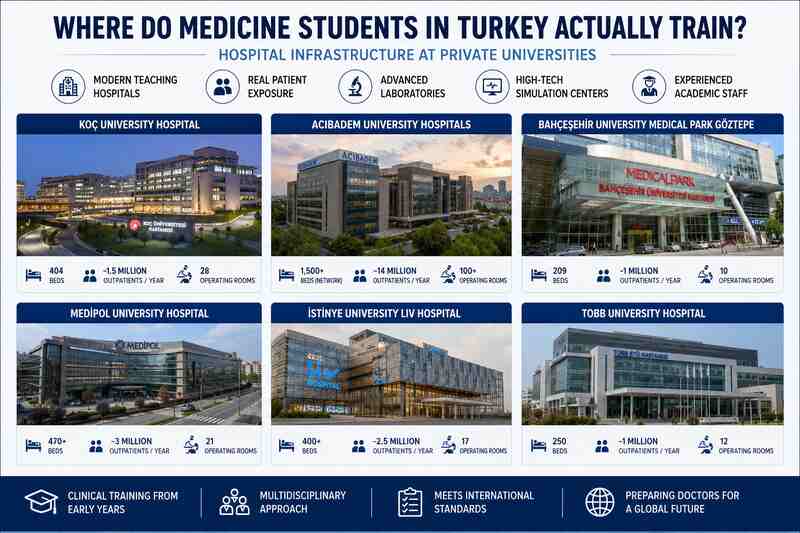
Most students researching medicine in Turkey focus on the wrong thing first. They compare tuition fees, check rankings, look at campus photos. What they should be asking and almost no university website makes easy to find is: where will I actually spend years three, four, five, and six? What hospital will I be rotating through? How many beds does it have? Is it JCI-accredited? What does a day look like when I'm in surgical rotation?
Clinical training in Turkey is the core of a medical degree. The first two years are lectures and labs important, but manageable across most programs. The defining difference between a strong medical education and a mediocre one happens in the hospital. How many real patients will you see? How diverse are the cases? What is the student-to-senior-doctor ratio in a busy surgical ward? Is the hospital a genuine teaching environment, or is student presence tolerated rather than integrated?
We've visited and assessed clinical training setups at multiple Turkish private universities. This is what we found.
Why Hospital Infrastructure Matters More Than Tuition
Before the university comparison, it's worth establishing why this question deserves such specific attention.
International medical education research is consistent on this point. A 2026 study published in BMC Medical Education found that structured workplace-based learning in clinical settings specifically combining direct observation of procedural skills with formative feedback significantly outperformed traditional clerkship models in both knowledge acquisition (MCQ exam scores: 85.3 vs 80.2) and clinical performance. Students in the structured hospital-based group also reported substantially higher satisfaction with their learning experience. The researchers concluded that integrating formal clinical competency frameworks directly into hospital rotations improves measurable outcomes across multiple domains of medical training.
A separate 2025 BMC Medical Education study comparing competency-based education with real-patient clerkship models found that while structured learning enhanced student satisfaction, the combination of both approaches direct patient interaction with competency-based assessment — produced the strongest outcomes. The implication for choosing a medical university is clear: the quality of the hospital environment and the degree to which faculty formally integrate students into real clinical teams matters enormously. An affiliated hospital that treats students as observers rather than participants produces a very different graduate.
This is why two medical programs at similar-ranked universities can produce very different doctors and why the hospital question deserves at least as much attention as the tuition comparison.
Istanbul Medipol University; Medipol Mega Hospital
Beds: 5,000+ | Operating Theatres: 32 | Type: Own university mega hospital
Medipol Mega Hospital is, by almost any measure, the most clinically substantial teaching hospital attached to a Turkish private university. 5,000 beds across a single facility is a genuinely exceptional number most university teaching hospitals in Western Europe operate at 600–1,200 beds. 32 operating theatres means continuous surgical activity across multiple specializations simultaneously.
For medicine students, what this translates to practically: breadth of case exposure that simply cannot be replicated at a smaller facility. A student in their fourth year rotating through internal medicine at Medipol Mega Hospital will encounter the full clinical spectrum rare presentations, complex multi-morbidity cases, emergency presentations that a 300-bed hospital might see once or twice a year. The variety of pathology is real, and it matters for becoming a diagnostically competent physician.
The tradeoff is also real and worth naming honestly. In a 5,000-bed hospital operating at near-capacity, individual student-to-senior-doctor contact time in busy departments can be lower than at smaller, more intimate facilities. The best medical students at Medipol learn to be proactive attaching themselves to consultants, staying for the surgical case rather than leaving with the group, finding the attending who is willing to teach. Students who wait to be taught in a mega hospital environment learn less than students who pursue the teaching. The hospital is excellent; the learning curve depends substantially on the individual student's initiative.
Istanbul Medipol's medical program is TEPDAD-accredited (the Turkish national medical accreditation body equivalent to LCME) and WDOMS-listed, meaning graduates can apply for ECFMG certification for US residency pathways. For students targeting Gulf licensing boards or USMLE Steps, Medipol is a viable and well-established pathway.
Biruni University; Biruni University Hospital (On-Campus)
Beds: Approximately 200–300 | Type: Own campus hospital, directly integrated with faculty
Biruni's primary clinical advantage is intimacy and proximity. The hospital sits on campus. Students walk from their lecture hall to their clinical rotation. Faculty who teach the pre-clinical curriculum are often the same physicians running hospital ward rounds. That integration between theoretical instruction and clinical practice — when the person who lectured you on cardiac physiology is also the cardiologist supervising your ward rotation — is educationally significant.
The student-to-attending ratio in a 200–300-bed facility is necessarily better than at a 5,000-bed hospital. Senior physicians know the students on their wards by name. Students get called on, get corrected, and get to attempt procedures under supervision at higher rates than in a mega hospital environment where a cohort of thirty students is rotating through simultaneously.
The limitation is case variety. A 200-bed hospital, however well-run, will not see the volume or rarity of cases that a 5,000-bed facility treats weekly. Students who want deep exposure to rare presentations, complex surgical subspecialties, or high-frequency emergency medicine will find Biruni's case load more limited. For primary care competencies, common presentations, and foundational clinical skills, the intimate setting works well. For subspecialty exposure, the numbers constrain what's available.
Istanbul Atlas University; WADI Teaching Hospital
Beds: 400 | Operating Theatres: 18 | Type: Purpose-built modern teaching hospital, includes hybrid operating theatre
WADI Teaching Hospital is the newest major teaching hospital at a Turkish private university, and it's worth attention specifically because of what "purpose-built for medical education" actually means in practice.
Hospitals that are built after medical education is an established goal rather than retrofitted teaching programs into existing clinical facilities have architectural and logistical advantages. Observation areas, simulation integration, student workspaces within clinical departments, teaching-oriented consultation room layouts these details, which sound minor, affect daily learning experience. A hospital designed with students in mind handles student presence differently from one that accommodates them.
The hybrid operating theatre is the most distinctive facility marker at WADI and genuinely unusual for a university of Atlas's age and size. Hybrid theatres combine conventional surgical capability with advanced imaging fluoroscopy, angiography enabling complex vascular, cardiac, and interventional radiology procedures within a single room. For medical students, rotating through a hybrid theatre provides exposure to minimally invasive and image-guided procedures that most standard operating theatres don't accommodate. That's a genuine educational differentiator.
400 beds provides substantially more case variety than Biruni while remaining manageable enough to preserve reasonable student-to-consultant contact. WADI sits in a middle position between Medipol's scale and Biruni's intimacy which for many students is actually the most productive clinical learning environment.
Istanbul Okan University; Own Hospital + Acıbadem Polyclinic
Type: Dual clinical environment own hospital in Tuzla + Acıbadem Polyclinic affiliation
Okan's clinical infrastructure model is distinct from the others: dual training environments rather than single hospital dependency. The university's own hospital in Tuzla provides the primary clinical base for rotations, while the Acıbadem Polyclinic affiliation adds a second, internationally recognized clinical environment.
The Acıbadem affiliation carries a specific credential that matters for certain international licensing pathways: JCI accreditation (Joint Commission International). JCI is the gold standard for international hospital quality certification, recognized by Gulf Cooperation Council licensing bodies, USMLE Step 3 residency evaluators, and European medical boards. For a student planning to practice in the UAE, Saudi Arabia, Kuwait, or Qatar after graduation, having rotations in a JCI-accredited facility on your training record is a meaningful credential.
The dual-environment model also means students rotate through different clinical cultures the university hospital's academic approach and the Acıbadem Polyclinic's private-sector, patient-experience-oriented model. That breadth of clinical environment exposure prepares graduates for a wider range of post-graduation practice settings.
Altınbaş University; Medical Park + Liv Hospital (JCI-Accredited Network)
Type: Network clinical training in Turkey Medical Park hospital group + Liv Hospital (JCI-accredited)
Altınbaş takes a different structural approach entirely: rather than owning a campus hospital, the university operates through a clinical network partnership with Medical Park (one of Turkey's largest private hospital groups) and Liv Hospital, which holds JCI accreditation.
For students, this model means clinical rotations across multiple hospital sites rather than a single campus facility. The Medical Park network operates large, busy hospitals across Istanbul with substantial patient volumes. Liv Hospital's JCI accreditation like the Acıbadem affiliation at Okan carries particular weight for Gulf-track and US-track licensing purposes.
The practical question for network-model clinical training is continuity. Students rotating across multiple hospital sites have more logistical complexity different supervisors, different systems, different physical locations than students training in a single campus hospital. The advantage is breadth: exposure to different clinical environments, hospital cultures, and patient populations. The disadvantage is that the depth of relationship with any single clinical team may be shallower than at a campus-hospital model.
For students targeting Gulf licensing specifically, the Liv Hospital JCI connection at Altınbaş and the Acıbadem connection at Okan are both strong signals. Gulf licensing bodies UAE DOH, Saudi Commission for Health Specialties, Kuwait Medical Council are familiar with JCI-accredited Turkish hospitals in ways they may not be with non-JCI-affiliated Turkish teaching hospitals.
A Practical Hierarchy for Clinical Training Decisions
Based on what the hospital infrastructure actually provides:
University | Hospital Model | Beds | JCI Status | Best For |
|---|---|---|---|---|
Istanbul Medipol | Own mega hospital | 5,000+ | Not JCI | Maximum case volume, USMLE/WDOMS pathway |
Istanbul Atlas | Purpose-built teaching hospital | 400 | Not JCI | Modern facilities, hybrid theatre, balanced ratio |
Biruni University | Own campus hospital | ~200–300 | Not JCI | Intimate student-teacher ratio, on-campus access |
Istanbul Okan | Own hospital + Acıbadem affiliation | — | Acıbadem JCI | Gulf-track students, dual clinical environment |
Altınbaş University | Medical Park + Liv Hospital network | Network | Liv JCI | Gulf-track students, high patient volume network |
The honest summary:
Own-campus mega hospital (Medipol) delivers the highest case volume and the broadest clinical spectrum best for students who want maximum patient exposure and who are self-directed enough to extract the teaching from a large, busy environment.
JCI-affiliated networks (Altınbaş via Liv Hospital, Okan via Acıbadem) carry the clearest credential signal for students targeting Gulf or internationally recognized licensing boards.
Purpose-built teaching hospitals (Atlas WADI) offer the most educationally intentional clinical environment designed for student learning rather than retrofitted to accommodate it.
Intimate campus hospitals (Biruni) provide the highest student-to-faculty contact ratio best for students who learn well with close mentorship and consistent attending relationships.
What TEPDAD Accreditation Means and Why It Should Be on Your Checklist
Before choosing any Turkish medical university, one credential must be confirmed: TEPDAD accreditation. TEPDAD (Tıp Eğitimi Programlarını Değerlendirme ve Akreditasyon Derneği) is Turkey's medical education accreditation body the equivalent of the LCME in the United States or the GMC in the UK. TEPDAD-accredited programs meet a defined standard of curriculum design, faculty qualification, clinical training hours, and hospital infrastructure.
TEPDAD accreditation matters because:
It underpins WDOMS listing, which is required for ECFMG eligibility (US residency pathway)
Gulf licensing bodies increasingly require TEPDAD-accredited degrees as part of their recognition process
It is the baseline quality guarantee that a program meets the minimum standard for clinical training integration
All universities discussed in this article should be confirmed as TEPDAD-accredited for the specific program and intake year you're applying to. This is something we verify for every student we work with at turkeyuniversity.org because accreditation status can change between academic cycles, and the consequences of graduating from a non-accredited program for international licensing purposes are severe.
How Imtiyaz Education Helps Medicine Students Navigate This Decision
The hospital infrastructure question is one of the most important we discuss with students considering medicine in Turkey and one of the least well-documented by universities in their own marketing materials.
We've visited clinical facilities across the universities we work with. We know which hospitals are actively integrated into teaching programs and which use student presence more passively. We know which network affiliations carry the JCI credential that Gulf licensing boards recognize. We know which programs are TEPDAD-accredited for the current intake year and which are pending re-accreditation review.
When a student from Pakistan comes to us wanting medicine in English with a Gulf career target, we don't give them a ranked list. We walk through the hospital question, the JCI question, the TEPDAD question, and the fee reality and then we make a recommendation that fits their specific situation.
The consultation is free. The application through us costs nothing. And the on-ground support from acceptance through airport arrival, ikamet, and first-semester registration is what we've been doing in Istanbul since 2015.
Reach out through turkeyuniversity.org and ask us the hospital question directly. We'll give you the specific answer.
Clinical training data in this article is based on published university information, on-site assessments, and publicly available hospital capacity figures. Bed counts and theatre numbers are approximations based on available sources and may vary. Always confirm current accreditation status directly with the university and with your home country's medical licensing authority before enrolling.