Civil Engineering vs Architecture in Turkey: Which One is Right for Your Career?

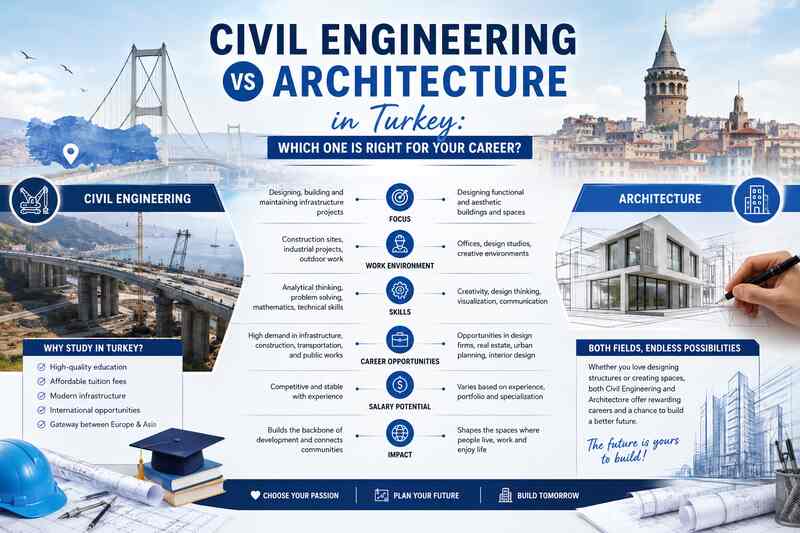
If you have been researching engineering and design programs in Turkey and keep going back and forth between civil engineering and architecture, you are not alone. This is one of the most common dilemmas for international students considering Turkey in 2026, and honestly most guides do not give a real answer. They either list universities without context or talk about costs without actually explaining what makes these two programs different from each other and why that difference matters for your future.
Both civil engineering and architecture in Turkey are connected to the built environment, both are in strong demand across Turkey and internationally, and both are available at leading Turkish universities with English medium instruction. But they are not the same degree, not even close. The way you think, the skills you build, the daily work you do after graduation, and the type of person who thrives in each field are genuinely different. Choosing the wrong one based on a vague idea of what it involves is a mistake that is very hard to fix later.
Civil engineering is the technical side of construction. It is about calculating structures, designing foundations, managing infrastructure and making sure buildings and bridges and roads actually hold together safely. If you enjoy mathematics and physics and want to work with measurable problems that have clear answers, civil engineering is the more natural fit.
Architecture is about design, space and the human experience of buildings. It is about creating spaces that work functionally but also feel right for the people who live and move through them. If you are passionate about drawing, visual thinking, creativity and the relationship between buildings and their surroundings, architecture will suit you much better.
Turkey in 2026 is one of the best places in the world to study either of these fields. The country has one of the most active construction and infrastructure sectors in Europe and the Middle East. Istanbul alone is a living classroom for architecture students with layers of Byzantine, Ottoman and modern design sitting side by side. And Turkish universities now offer internationally accredited programs in both fields with English medium options, MUDEK and ABET recognition, and strong connections to the real industry through internships and site visits.
This guide covers everything you need to make the right decision, including what you actually study, career paths and salaries, top universities for both fields, and which type of student each program is really built for.
A lot of students think civil engineering and architecture are basically the same thing because both programs deal with buildings and construction. They are not the same. These two fields think differently, teach differently, and take you to very different careers.
Civil Engineering in Turkey, Insaat Muhendisligi
The focus is on the technical and structural side, how buildings and infrastructure actually hold together under real forces and loads
From the first year the program is heavy on mathematics, physics and mechanics, you need to be comfortable with numbers from day one
You study bridges, roads, tunnels, dams, water networks and building structures, not just buildings
Strong emphasis on site work, project management and construction supervision in the later years
After graduation your daily work is mostly analytical, calculating, checking and solving technical problems with real numbers
Programs at serious universities carry MUDEK accreditation aligned with European EUR-ACE standards
When searching on Turkish university websites look for Insaat Muhendisligi
Architecture in Turkey, Mimarlik
The focus is on design, spatial thinking and the relationship between buildings and the people who use them
The program combines technical knowledge with art, creativity and cultural understanding, it is not purely engineering
You study architectural design, urban planning, heritage buildings, interior spaces and sustainable construction approaches
Strong studio culture runs through all years of the program, model making, drawing, digital design tools and presentations
After graduation your daily work is more visual and conceptual compared to civil engineering
Leading programs also carry MUDEK accreditation
In Turkish the program is called Mimarlik or sometimes Mimarlik Muhendisligi depending on the university
Which one is actually for you
If you enjoy mathematics and physics and you like problems with clear calculated answers, civil engineering is the more natural direction
If you are drawn to design and visual thinking and you care about how spaces feel for the people inside them, architecture will suit you better
Both programs need strong technical foundations, there is no easy road in either one
Students who choose based on their real interests almost always do better than those who choose based on salary expectations or what someone else recommended
Civil Engineering Curriculum in Turkey
A typical four year civil engineering program at a Turkish university covers a wide range of technical disciplines. The structure is quite logical, it builds from foundations up.
First and second year is mostly mathematics, physics, chemistry, technical drawing, introduction to programming, linear algebra and materials science, basically building the base you need for everything that comes after
Third and fourth year is where it gets more specific, you study structural mechanics, soil mechanics, fluid mechanics, reinforced concrete, steel structures, hydraulic engineering and transportation engineering
Construction management and site management are also part of the program, along with earthquake resistant building design which is obviously very relevant in Turkey
BIM software, CAD design and GIS tools are integrated from early years at most universities, you are not starting from zero when you enter the job market
Site visits to bridges, tunnels, highways and water networks are a regular part of the program, not just classroom theory
The final year capstone project often links with a real municipal or private engineering firm, which means you graduate with something actual to show
Programs at universities like METU and ITU that carry ABET accreditation are recognised internationally and can open doors to engineering positions outside Turkey as well
Architecture Curriculum in Turkey
Architecture in Turkey runs for four years but it feels more intensive than most other programs because there is a studio course every single semester from year one to year four. That studio culture shapes everything.
Core subjects include architectural drawing, structural analysis, building materials, construction management, history of architecture and environmental design
Design projects start from the very first year and gradually grow in scale and complexity, from small interventions to full urban design briefs by the final years
Digital tools like BIM, parametric design software and 3D modelling are taught alongside traditional hand drawing and physical model making, you do both
Urban design, landscape architecture, heritage protection and sustainable building design come in during the later years when you already have a solid foundation
Summer training at an architectural office is mandatory at most universities, and cities like Istanbul, Ankara and Izmir offer genuinely strong internship environments with real projects
Depending on the university you can take electives in interior spaces, facade design, Islamic architecture or urban mobility to go deeper in areas that interest you
The studio means long hours and regular critiques from professors and guests, it can be tough but the portfolio you build by graduation is honestly the most important thing you leave with
Civil Engineering Jobs in Turkey
Turkey is actually a very good country for civil engineers right now. There is a lot going on, earthquake reconstruction, new highways, urban renewal projects, infrastructure investments, so finding work after graduation is not as difficult as some other fields. The main directions graduates go into are:
Structural engineer, designing buildings, bridges and infrastructure
Site engineer, basically the person responsible on the construction ground
Geotechnical engineer, foundations and soil related work
Transportation engineer, roads, highways, rail projects
Construction project manager on larger scale developments
Environmental consultant focused on sustainable infrastructure
One thing worth mentioning, civil engineers with good English and an international portfolio do find opportunities in Gulf countries and Europe, the salaries there are considerably better.
For salaries inside Turkey in 2026, entry level is roughly 25,000 to 50,000 TRY per month. After 3 to 5 years of experience you are looking at 70,000 to 130,000 TRY. Senior level roles at international companies or Gulf positions can go up to 3,000 or even 6,000 USD monthly which is a completely different level.
Architecture Careers in Turkey
Architecture graduates have more variety in where they can go. Common paths are:
Architectural designer in a private office or bigger corporate firm
Urban planner working with city municipalities
Interior architect for residential or commercial spaces
Heritage restoration specialist, quite relevant in Turkey given the history
Landscape architect for public spaces and outdoor environments
Real estate project manager
Starting salaries for architecture are around 29,500 TRY per month. Senior architects in good positions can reach around 110,000 TRY, though honestly in both fields the people who build strong portfolios and international connections earn significantly more.
Choosing the right university makes a real difference in civil engineering, not just for the diploma but for the lab access, internship connections and accreditation that employers actually look at. In Turkey the options split between competitive public universities and private foundation universities, many of which offer English medium programs.
Best Private Universities for Civil Engineering in Turkey
Yeditepe University, Istanbul, English medium program with MUDEK accreditation and strong lab infrastructure in Atasehir, popular choice among international students
Bahcesehir University, Istanbul, MUDEK accredited with a large global network and active connections to Istanbul's infrastructure projects
Atilim University, Ankara, MUDEK accreditation valid to 2029 with CO-OP options that connect students directly to Ankara engineering market
Istanbul Okan University, Istanbul, industry oriented program with solid internship connections, available in both English and Turkish
Ozyegin University, Istanbul, more research driven with strong employer links and a modern engineering setup
Istanbul Gelisim University, Istanbul, ABET accredited engineering programs with a large single campus and over 120 laboratories
Istanbul Aydin University, English medium civil engineering with team based project learning throughout the program
Altinbas University, Istanbul, affordable English medium civil engineering, good option for students on a tighter budget
Best Public Universities for Civil Engineering in Turkey
Istanbul Technical University, ranked 95th globally for Engineering and Technology and holds more ABET accredited programs than any other university in the world, that is a serious fact
Middle East Technical University METU, Ankara, consistently top 3 in Turkey for engineering and fully English medium
Hacettepe University, Ankara, strong reputation in engineering and applied sciences
Gazi University, Ankara, well established engineering faculty with long history
Marmara University, Istanbul, solid engineering programs at public university accessibility
For students who want international recognition METU and ITU are the obvious first choices but several private universities now offer genuinely competitive programs especially for English medium study.
Turkey is honestly one of the best places in the world to study architecture if you think about it. Byzantine, Ottoman, Seljuk, modern, all of it layered on top of each other in cities you can actually walk through during your studies. That context makes architecture education here different from most other countries.
Best Private Universities for Architecture in Turkey
Istanbul Aydin University, Istanbul, English medium architecture with strong studio culture and project based learning from year one
Ozyegin University, Istanbul, research focused program with good employer connections and modern design labs
Bahcesehir University, Istanbul, one of the more well known private options for architecture with English medium instruction and international exchange networks
Istanbul Okan University, Istanbul, architecture available in both English and Turkish with active internship connections to Istanbul firms
Yeditepe University, Istanbul, solid architecture faculty with focus on heritage, sustainability and contemporary design, quite balanced program
Istanbul Gelisim University, architecture available in English and Turkish on a large single campus
Istanbul Medipol University, English medium architecture program with growing reputation in the city
Best Public Universities for Architecture in Turkey
Istanbul Technical University, very strong in urban design and structural architecture, one of the most respected options not just in Turkey but regionally
Mimar Sinan University of Fine Arts, Istanbul, this is the most prestigious architecture school in Turkey, it focuses entirely on architecture and fine arts which makes it quite unique
Middle East Technical University METU, Ankara, internationally recognised architecture faculty with strong research output and fully English medium
Yildiz Technical University, Istanbul, solid technical architecture program on a historic campus which is actually quite inspiring as an environment
Istanbul University, one of the oldest universities in the country with a deep academic tradition in architecture
For students who are serious about architecture as a creative and intellectual discipline, Mimar Sinan and METU are probably the names that carry the most weight internationally.
If you apply through Imtiyaz Education at the application is completely free and students get access to extra discounts not available elsewhere. The team also provides free visa assistance and residence permit support.
Civil Engineering, Bachelor Programs, Annual Tuition USD
University | Language | Annual Tuition USD | Notes |
|---|---|---|---|
Ozyegin University | English | 9,750 | MUDEK and EUR-ACE accredited |
Bahcesehir University | English | 9,000 | MUDEK accredited, large global network |
Yeditepe University | English | 6,000 to 12,000 | MUDEK accredited, strong lab infrastructure |
Atilim University | English | 5,950 to 7,250 | MUDEK accredited to 2029, CO-OP options |
Istanbul Aydin University | English | 6,500 | Team project based curriculum |
Istanbul Okan University | English | 4,500 | Industry oriented, internship focused |
Istanbul Gelisim University | English | 4,250 to 6,000 | ABET accredited engineering |
Altinbas University | English | 4,000 | Affordable English medium program |
Architecture, Bachelor Programs, Annual Tuition USD
University | Language | Annual Tuition USD | Notes |
|---|---|---|---|
Ozyegin University | English | 9,750 | MIAK architecture accreditation |
Bahcesehir University | English | 9,000 | Strong international exchange network |
Yeditepe University | English | 6,000 to 12,000 | Focus on heritage and sustainability |
Istanbul Medipol University | English | 6,400 | English medium, growing reputation |
Istanbul Aydin University | English | 6,500 | Studio based curriculum |
Altinbas University | English | 5,100 | Affordable English medium option |
Istanbul Okan University | English | 4,500 | Active Istanbul internship connections |
Istanbul Gelisim University | English and Turkish | 4,250 to 6,000 | Large single campus |
Civil Engineering, Master Programs, Annual Tuition USD
Program Type | Language | Annual Tuition USD |
|---|---|---|
Master with thesis, private universities | English | from 4,000 |
Master without thesis, private universities | English | 2,750 to 4,500 |
Master, Turkish medium, private universities | Turkish | from 2,750 |
Architecture, Master Programs, Annual Tuition USD
Program Type | Language | Annual Tuition USD |
|---|---|---|
Master, private universities | English or Turkish | 3,200 to 9,000 |
Master, Turkish medium, private universities | Turkish | from 3,200 |
Fees are updated every year so always double check current numbers directly with the university or at Imtiyaz before you apply.
Honestly there are not many countries in the world where studying engineering or architecture makes as much practical sense as Turkey does right now. Here is why so many international students are choosing it:
Turkey is basically a living classroom for architecture students. Byzantine churches, Ottoman mosques, Seljuk caravanserais, modern cable bridges, all of it exists in the same cities where you study. You do not read about architectural history, you walk through it
The construction and engineering job market here is genuinely one of the most active in the region right now. Earthquake reconstruction programs, urban renewal projects, new highways and metro lines, there is real work happening and students benefit from that directly through internships and site visits
Tuition fees are roughly 4 to 10 times lower than similar programs in Western Europe or North America, and the quality at accredited universities is comparable
A good number of programs are available fully in English, so international students do not need Turkish language skills to get started
MUDEK and ABET accreditation at the leading universities means the degree is recognised internationally, which matters a lot when you are looking for work after graduation
Istanbul alone has dozens of major ongoing construction and design projects running at any given time, giving students access to real site visits and internship environments that students in most other countries simply cannot get
The Turkiye Scholarships program run by YTB covers full tuition, accommodation, health insurance and a monthly stipend for eligible international applicants, which makes it one of the most generous government scholarship programs in the world for this level of study
Cost of living is significantly lower than European capitals, which means less financial pressure during your studies and more focus on actually learning
The requirements are honestly not that complicated compared to universities in Europe or North America. Most private universities in Turkey are quite accessible for international students as long as you have the basic documents ready.
Civil Engineering Admission Requirements
High school diploma with a solid GPA, and your grades in mathematics and physics matter more than other subjects for engineering programs
Official transcripts from your last three years of high school, translated if they are not already in English or Turkish
Valid passport copy
TOEFL minimum 70 or IELTS equivalent for English medium programs, some universities set the bar slightly higher so always check the specific university page
SAT results are accepted as supplementary evidence at some universities, not always required but can strengthen your application
If you do not have TOEFL or IELTS, many universities offer their own internal English proficiency exam which makes things much easier for students who have not taken those tests yet
Architecture Admission Requirements
High school diploma with a decent GPA, and if you have strong grades in both arts and mathematics that is genuinely an advantage for architecture programs
Official transcripts from your last three years of high school
Valid passport copy
TOEFL or IELTS for English medium programs, requirements vary between universities
Some architecture programs ask for a portfolio of creative or design work, not all of them do but it is worth preparing something even if it is not officially required, it shows commitment
SAT or IB results accepted as supplementary evidence at some universities
One thing worth saying is that the admission process at most private universities in Turkey moves quite fast compared to other countries. If your documents are ready you can sometimes get an offer letter within a few days.
This is honestly the question that matters most and only you can really answer it, but here is how to think about it clearly.
Choose Civil Engineering in Turkey if:
Mathematics and physics are genuinely subjects you enjoy, not just subjects you can survive, because the whole program is built on them from day one
You want to work on large scale infrastructure projects, bridges, tunnels, roads, water systems, the kind of things that exist for a hundred years after you build them
International career mobility matters to you and you want ABET or MUDEK accreditation that employers in the Gulf, Europe and beyond actually recognize
You are thinking about doing a master in civil engineering in Turkey later to specialize in structural, geotechnical or water engineering
You want to enter one of the most active construction job markets in the Europe and Middle East region right now
You prefer a technical and analytical work environment over a creative one
For the most affordable English medium option, Istanbul Okan University at around 4,000 USD per year is honestly hard to beat for the quality you get
Choose Architecture in Turkey if:
Design, drawing and the way spaces make people feel is something you genuinely care about, not just something that sounds interesting
You want to study in a country with one of the richest architectural heritages anywhere in the world and actually use it as your classroom
Istanbul as a living fieldwork environment excites you, because there is honestly no other city on earth with that kind of layered architectural complexity all in one place
You want a studio based education that builds a real portfolio you can show employers on graduation day
Urban design, heritage restoration, landscape or interior architecture are directions you want to explore in the future
You want to study fully in English without needing Turkish language skills
For the most affordable option Istanbul Okan and Istanbul Gelisim both offer architecture from around 4,000 to 4,750 USD per year in English which is very reasonable
Both programs are strong choices for international students in 2026. Turkey gives you affordable tuition, internationally accredited degrees, English medium instruction and a genuinely rich environment for learning about the built world. Whether you are looking for the best civil engineering university in Turkey or the best architecture program, the right university exists for your budget and your goals. You can apply completely free through Imtiyaz Education and the team will support you through the full process, application, visa and residence permit, they have already helped thousands of students make this exact decision.